An aid ship departed on Friday from the Mexican port of Progreso, on the Yucatán Peninsula, carrying medical supplies, food and solar panels to a fuel-thirsty Cuba paralyzed by a severe energy crisis.
The voyage is part of an enormous international effort to deliver humanitarian aid by air, land and sea to a country strangled by an oil blockade on Cuba that the Trump administration has enforced since January, pushing the country’s economy to the brink of collapse.
Before the 75-foot fishing vessel — named the Granma 2.0 — cleared the harbor in Mexico, dozens of volunteers gathered on the pier to load boxes of medicine, water, rice, beans, formula, food cans, bicycles and 73 solar panels on to the ship.
“Solidarity can’t be blocked,” said Thiago Ávila, 39, from Brazil, one of 32 participants who traveled to Mexico to board the ship. “Cuba needs our solidarity.”
Others joining include members of the European Parliament, Christian Smalls, a U.S. labor leader, and a delegation from the Democratic Socialists of America — the left-wing group that includes New York City Mayor Zohran Mamdani.
The ship is expected to arrive in Havana as early as Monday, and two other Cuba-bound convoys are expected to depart from the Mexican island of Isla Mujeres later on Friday. One of the leaders of the effort, which has received the blessing of the Cuban government, organized a similar flotilla to Gaza last year that was thwarted by Israeli forces, who maintain a blockade there.
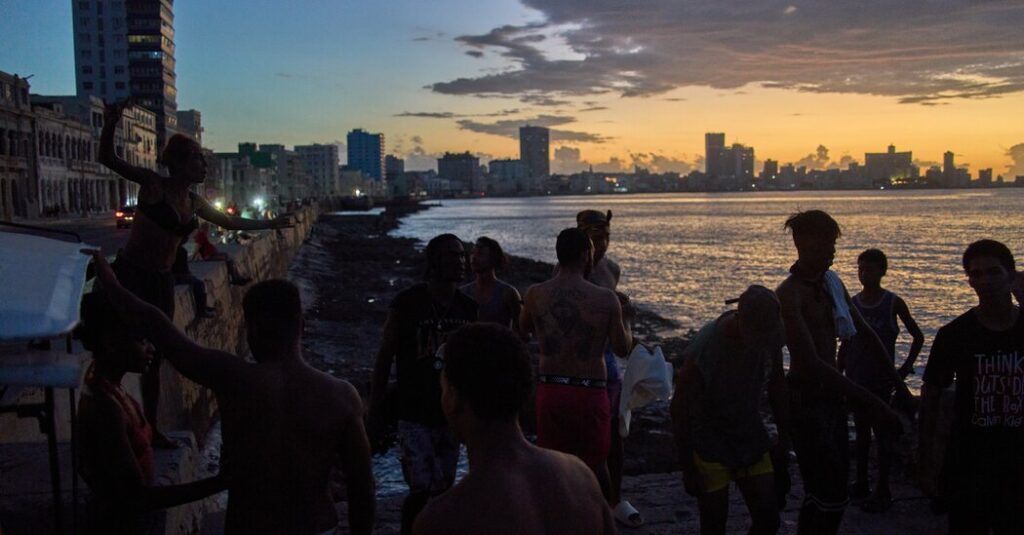
The convoy’s departure comes at a moment of desperation for Cuba. On Monday, the island’s national electric grid collapsed, causing a nationwide power outage — the third such failure in four months. Blackouts are becoming part of daily life. Gasoline prices have soared. Public transportation is now a luxury. Tens of thousands of surgeries have been postponed.
Organizers behind the coalition — named the Nuestra América Convoy (or Our America Convoy), after an essay by the Cuban thinker José Martí, in which he criticized the U.S. expansionism — believe grass-roots efforts can bypass Washington’s attempts at isolation.
“What country, what society anywhere in the world could survive one, two, let alone three months without any access to fuel?” said David Adler, a lead organizer and a coordinator of Progressive International, a movement aiming to unite different sectors of the global left. (Mr. Adler was one of the organizers of the Gaza flotilla.) “We can’t let this go unchecked and unchallenged.”
This week, Mr. Trump escalated his rhetoric against Cuba, telling reporters that he would be “taking Cuba in some form,” and adding, “I could do anything I want with it.”
The convoy has mobilized hundreds of volunteers from more than 30 countries. Some are sailing with solar panels and generators. Others have landed in Havana with suitcases stuffed with medicine or are arriving on charter flights loaded with food. In total, the mission expects to deliver more than 20 tons of supplies.
Last year, Mr. Adler helped coordinate the Global Sumud Flotilla to break Israel’s siege of Gaza. But the fleet was intercepted by Israeli forces before it could reach its destination. Hundreds of participants, including the Swedish activist Greta Thunberg, were arrested and taken to a prison complex where they said they were mistreated.
While the Trump administration renewed an emergency order authorizing U.S. authorities to intercept, detain and seize vessels traveling to Cuba, the restriction applies only to U.S.-registered boats. Other countries, including Brazil and Mexico, have successfully sent large humanitarian shipments in recent weeks. Even the United States announced $6 million in aid last month.
But it remains unclear whether the U.S. Coast Guard would target and board the Granma 2.0, which flies a Mexican flag and is expected to travel Mexican and Cuban waters. Yet as the mission’s profile has grown, so have questions regarding its political nature.
“I understand that international groups want to help Cuba,” said Norges Rodríguez, a Cuban engineer and journalist living in Miami. But many people have joined the movement, he added, “without really understanding the reality of the country” or “without truly listening to what the Cuban people have to say about what they are going through.”
Mr. Adler, for example, said that the donated supplies will not be handed to the Cuban state. Instead, some delegations plan to deliver aid directly to hospitals and clinics, with European activists beginning to do so this week.
But one of the convoy’s local partners facilitating logistics and distribution is the Cuban Institute of Friendship with the Peoples. Though organizers describe the institution as an independent nonprofit, declassified C.I.A. reports identify it as a front for Cuban intelligence services and a tool for state propaganda.
For some Cuban exiles, such partnerships are a bitter pill. The Cuban government, they said, shares the blame for many of the hardships that ordinary people have endured for decades — from a crumbling electrical grid and food shortages to the suppression of dissent.
“These delegations are going there to uphold that power instead of joining the demand of Cubans inside and outside the country to end that system,” Salomé García, a Miami-based Cuban activist who tracks political prisoners on the island, said of the convoy.
Suspicions were further fueled by the presence of Mariela Castro, the daughter of Raúl Castro, the country’s former president who is still viewed as the island’s most powerful figure, on Progressive International’s advisory council.
Mr. Adler did not answer specific questions regarding the criticisms, maintaining that the mission’s focus is humanitarian.
“The purpose of our convoy is simple,” he said. “To collect aid, bring it to the island, and demonstrate that international solidarity is powerful enough to break Trump’s siege.”
The ship that departed on Friday, a shrimp fisher called Maguro, was symbolically renamed in honor of the Granma, the famous yacht used in 1956 by Ernesto ‘Che’ Guevara, Fidel and Raúl Castro, among other revolutionaries, to reach Cuba.
The boat was scheduled to depart on Thursday, but was delayed as the activists rushed overnight to secure the proper authorizations from Mexico to depart and port officials inspected the vessel, which initially lacked life jackets and other safety measures.
Participants sailing from Progreso on Friday expressed confidence that Cuban organizations, syndicates and government officials would distribute the goods correctly.
Still, some exiles feel a stinging irony. While foreign delegations were being welcomed into Havana to converge there on Saturday, many Cubans living abroad are denied the right to return to their homeland.
“Why not allow Cubans who were born there to enter with humanitarian aid?” Mr. Rodríguez said. “I have a home in Cuba, where I was born, and I haven’t been back to my neighborhood in six years. I would love to go with friends to deliver aid directly. That’s also a legitimate demand.”
Luis Ferré-Sadurní contributed reporting from Bogotá, Colombia.
Emiliano Rodríguez Mega is a reporter and researcher for The Times based in Mexico City, covering Mexico, Central America and the Caribbean.
The post Aid Ship Departs for Cuba as Island Grapples With a Fuel Blockade appeared first on New York Times.