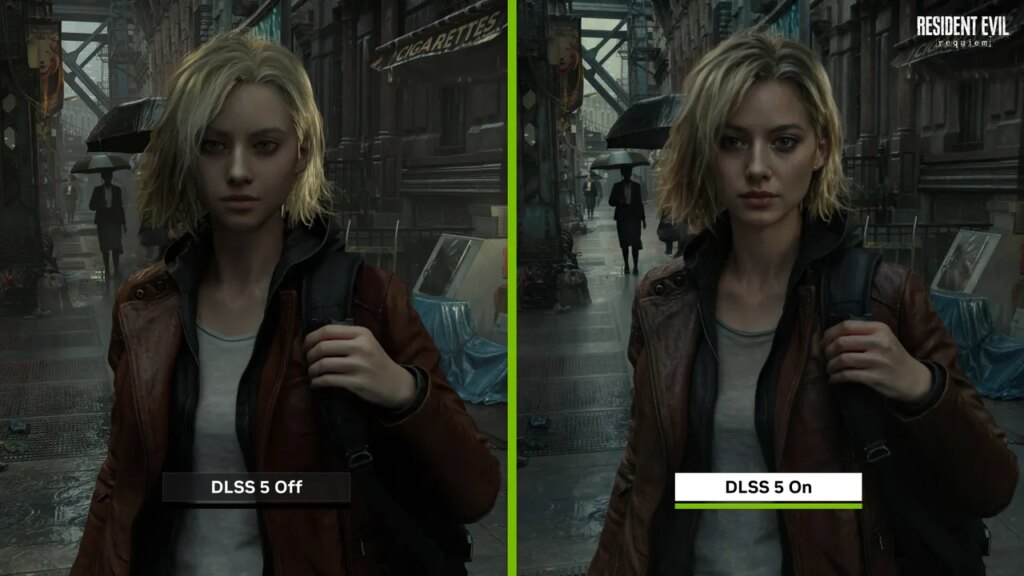
Nvidia announced a new version of its DLSS AI upscaling technology for its graphics cards earlier this week at its GPU Technology Conference (GTC), which it calls the Super Bowl of AI. But unlike previous versions of DLSS that used AI to improve frame rates in video games, DLSS 5 has a much more ambitious calling: using generative AI to make character faces in games look more realistic and detailed. The demonstration received sharp blowback on social media, with many finding the effect off-putting, reacting with outright disgust, and calling it yet another example of AI slop.
DLSS, or deep-learning super-sampling, is a feature Nvidia introduced on its graphics cards in 2018. The primary use has been to improve frame rates in video games by rendering games at a lower resolution, then using AI to upscale the quality. More recent versions of DLSS insert AI-generated frames in between actual rendered frames. These techniques use less computing power than generating the full frames, allowing for better gaming performance without taxing your PC’s hardware and maintaining visual fidelity. The feature can be turned on or off.
“From a technical standpoint, it’s quite an achievement,” Kevin Bates, CEO and creator of the open source retro gaming handheld Arduboy, wrote in a message to WIRED. “I would have expected a cloud-based rendering service to provide it. The fact they expect to distill it down to what can run on a single [graphics] card later this year is insane.”
But DLSS 5 has crossed a generative-AI rubicon. Instead of just being a tool Nvidia provides developers, it manifests as actual visual changes without their consent. While you can still turn it on or off in your video games, the technology has some developers—not just gamers—worried.
Nvidia showed off a demo of the tech on games like Capcom’s Resident Evil Requiem, Ubisoft’s Assassin’s Creed, and Bethesda’s Starfield. The company says it’s meant to improve the graphics and generate photorealistic details and lighting. The demo seemed to largely improve the lighting, which detractors compared to the glow of a ring light just out of frame. Faces became far more detailed, even introducing new facial features. It was also criticized on social media for over sexualizing characters, where people called the look “yassified,” or “porn faces,” and compared the effect to Instagram or Snapchat’s glamour filters, which smooth out imperfections on a person’s image. Gamers did not approve. The Verge called it motion smoothing, but worse.
The tech also has other issues, like introducing unexpected artifacts in real time. You can see some of those problems in the official demo video itself. In a scene in a FIFA game where a soccer ball is being kicked into a net, the ball has weird artifacts on it with DLSS 5 on, looking like a piece of the net is on the foreground of the ball before it has even gone in the goal. (Pause the video at 59 seconds.) People’s facial features, like the female character in Resident Evil Requiem, have some slight but noticeably different facial features: larger eyes, fuller lips, and a completely different nose.
“It devalues an artist’s creativity and intent on a basic level,” says James Brady, a video game artist and designer who has worked on games like Call of Duty: Modern Warfare 3. “All this takes away from the artist’s original design intent on the character and its shape language, with what pretty much functions on a surface level as a ‘Snapchat filter.’”
After a day of widespread, overwhelming pushback, Nvidia CEO Jensen Huang doubled down and said gamers are “completely wrong” about DLSS. (You know how much gamers love being told that they’re wrong.) But developers at Capcom and Ubisoft say they didn’t even know what the tech demo would look like and, according to Insider Gaming, found out about it the same time everyone else did and were just as surprised. (Nvidia, Ubisoft, and Capcom did not immediately get back to our request for comment.)
“I think the reaction from gamers is understandable,” Marwan Mahmoud, a game developer at Incrypt, wrote in an email to WIRED. “Some games started relying too heavily on these technologies instead of focusing on proper optimization. From a developer perspective, it feels a bit different because you see DLSS as a tool that helps rather than a core solution.”
The problem for many people, developers included, is the one-size-fits-all approach of a technology that can adjust visuals across various game types.
“The artist has a style, the artist has an art direction that you’re going to give him, and that’s something that AI kind of doesn’t respect all the time,” says Raúl Izquierdo, an indie game developer in Mexico, “Maybe I don’t want my characters to be yassified.”
Bates agrees, saying he doesn’t think every game needs to be photo real. And that sentiment is also echoed by game developer Sterling Reames, who has worked at Striking Distance Studios and Zynga. “People just want better games,” Reames wrote in a message to WIRED. “That’s as plainly as I can put it.
At GTC, Nvidia ran its demo on its most powerful consumer graphics cards, two GeForce RTX 5090s. Had Nvidia made its selling point for the tech that it saves resources, thus enabling older hardware to deliver more impressive graphics, there may have been something to that.
“What’s the point if you’re not going to do it on weaker hardware?” Izquierdo says. “If this were done on an [RTX 2080 graphics card], for instance, I think I would be thinking differently about it. OK, this is for the betterment of gamers’ experiences and everything, not just for selling graphic cards.”
Ultimately, Nvidia’s demo, and GTC writ large, was a flex of the company’s power in the AI space. The reaction, Bates posits, is more about humans dealing with not just crossing the uncanny valley, but what happens when we reach the other side.
“Right now it’s pretty clearly a thing they are forced to do to demonstrate their prowess as an AI company,” Bates says. “But the truth is, this is going to be the default in a few years, and nobody is even going to think twice about it. It’s Jensen’s world, we’re just living in it.”
The post Gamers Hate Nvidia’s DLSS 5. Developers Aren’t Crazy About It, Either appeared first on Wired.