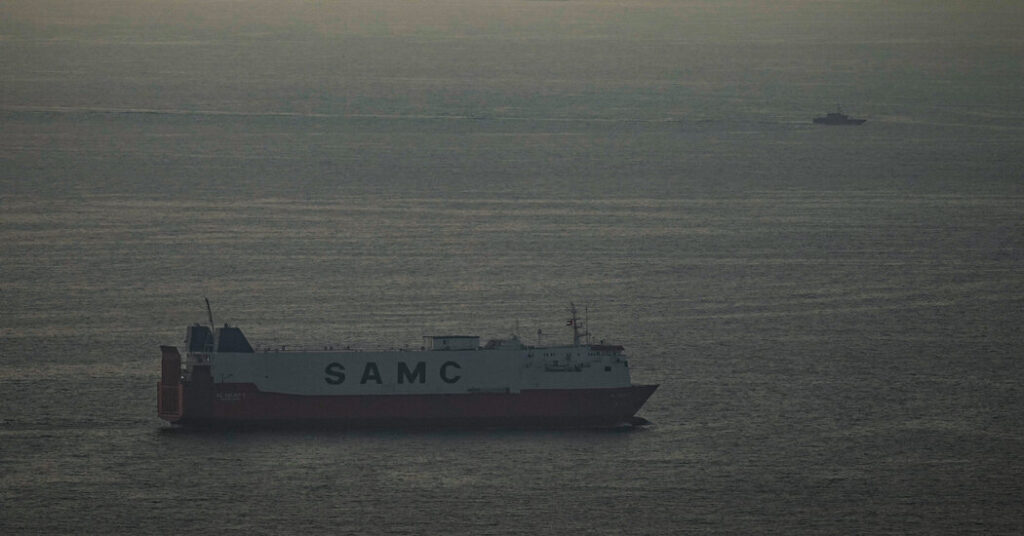
Iran has allowed some friendly countries, including China, India, Pakistan, Malaysia and Iraq, to secure safe passage of their ships through the Strait of Hormuz, a critical maritime route.
Now, Iranian lawmakers are discussing new rules to get through the strait, including a potential transit fee, Iranian and shipping news media reported. Around a fifth of the world’s oil and gas supplies pass through the strait. Iran has maintained a de facto blockade on it since the start of the war three weeks ago, giving its government a chokehold on global shipping and driving up global oil and gas prices.
Visible traffic through the Strait of Hormuz has slowed from more than 130 vessels a day to about an average three or four daily. More than 20 commercial vessels have been struck in and around the waterway. Roughly 2,000 ships and 20,000 seafarers are trapped in the area, according to the International Maritime Organization. And Iran’s new supreme leader, Mojtaba Khamenei, said in his first statement last week that “the lever of closing the Strait of Hormuz must continue to be used.”
Still, some ships have passed through.
At least nine ships have left the strait through a corridor that takes them through Iranian waters around Larak Island, where the Islamic Revolutionary Guards Corps and port authorities can see the vessels, Lloyd’s List, a shipping news and data service, reported Wednesday. Among these were vessels from India and Pakistan, along with ships that had been sanctioned by the United States as part of Iran’s shadow fleet traveling under the flags of Aruba, Palau and Madagascar.
“There is a clear and discernible pattern of some ships passing through,” Richard Meade, Lloyd’s List editor in chief, said in an interview.
Windward, a maritime intelligence agency, also reported on vessels leaving the Gulf through Iranian territorial waters, “sailing along the coastline rather than standard international navigation channels.” That is a new route emerging.
Traveling this way, which in at least one case involved a significant payment to Iran, Lloyd’s List found, is not necessarily safe. Mr. Meade said shipping companies had been talking to Iranian officials through indirect channels, sometimes with people in the Iranian diaspora. Safety isn’t guaranteed, he warned.
Iraq’s energy minister, Hayyan Abdul Ghani al-Sawad, said on Tuesday that his government was in contact with Iran to allow Iraqi oil tankers to pass through the Strait, providing the name of the ships, owners and affiliations for approval. India’s foreign minister, Subrahmanyam Jaishankar, said direct talks with Iran had proved effective for securing passage for two of his country’s gas tankers and that talks were ongoing.
Even if Iran were to establish a new system to get ships through, it is unlikely to meet global oil and gas needs.
Oil prices have surged, nearly doubling since the start of the war on Feb 28. The Trump administration is considering lifting sanctions on Iranian oil in a bid to boost global supply, and has already allowed Iranian oil tankers to pass through the Strait of Hormuz, U.S. Treasury Secretary Scott Bessent said in an interview with CNBC this week. The White House has also temporarily lifted sanctions on Russian oil at sea.
The moves show “a level of desperation” from Washington, said Brett Erickson, a sanctions specialist and managing principal of Obsidian Risk Advisors. “It’s hard to see how the U.S. can meaningfully exert pressure.”
The International Maritime Organization’s council, at a special session this week, called on countries to urgently find ways to evacuate ships trapped in the region.
The agency’s head, Arsenio Dominguez, warned ships to avoid trying to make dangerous crossings. “We must not expose seafarers to a higher risk than they already face now,” he said.
Ephrat Livni is a Times reporter covering breaking news around the world. She is based in Washington.
The post A Few Ships Are Trickling Through the Strait of Hormuz With Iran’s Approval appeared first on New York Times.