David Feith is a senior fellow at the Hudson Institute. He served as deputy assistant secretary of state for East Asia (2017-2021) and as White House senior director for technology and national security (2025).
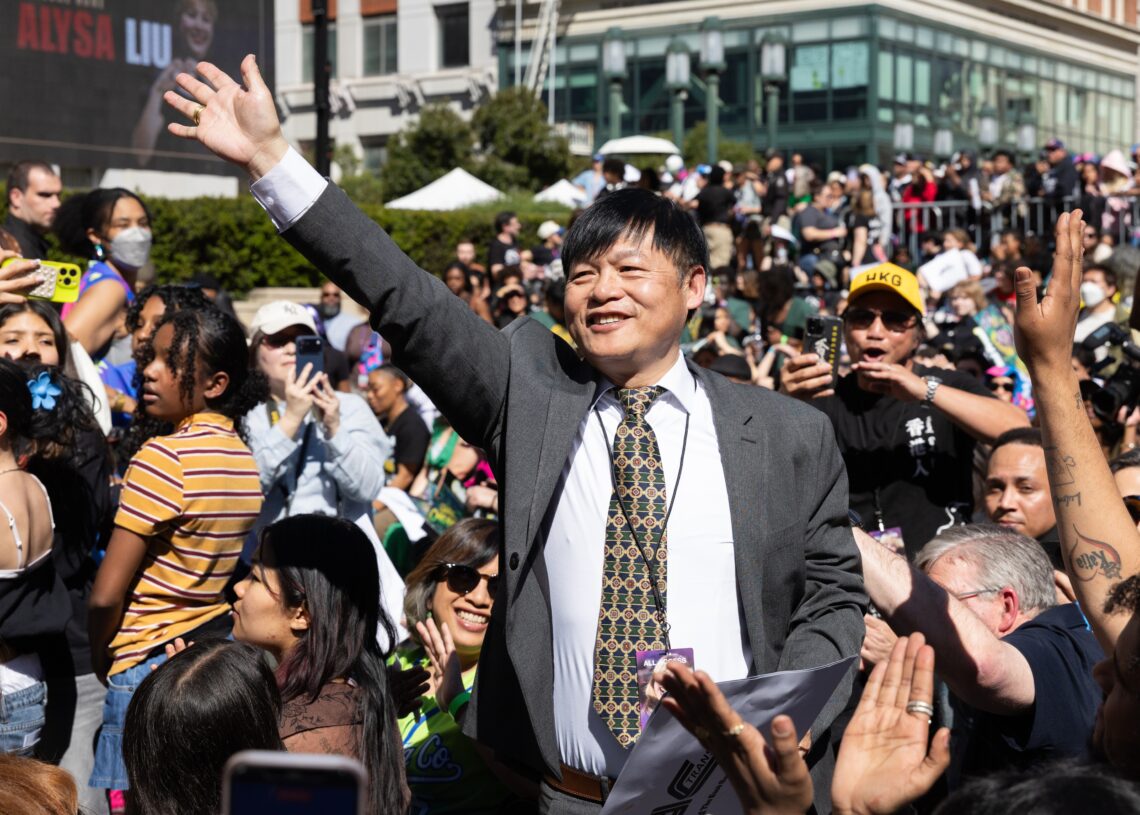
The basic storyline of Alysa Liu’s recent Olympic triumph was plenty inspiring: Young Chinese American figure-skating phenom quits the sport at age 16, citing burnout, returns at 18, and with carefree charm at 20 secures gold for America for the first time in a generation. But that doesn’t begin to capture the astonishing backstory of the events that ultimately led to her celebration in Milan, wrapped in an American flag.
The most amazing part of the Liu tale may be how her father got to America in the first place, thanks to a perilous undertaking called Operation Yellowbird. It involves student democracy protesters, a brutal crackdown, clandestine networks, secret escapes, speedboats racing on dark waters, and an unlikely alliance of church leaders and smugglers — literally Baptists and bootleggers — united in a rescue mission.
After the Chinese Communist Party’s massacre of pro-democracy protesters in 1989 at Tiananmen Square in Beijing, the regime began hunting the young leaders of the student movement. Many found themselves on the CCP’s most-wanted list, facing years in prison or worse.
In Hong Kong, then still under British rule, an extraordinary coalition secretly mobilized to rescue the student leaders. Christian pastors and other church leaders worked alongside pro-democracy activists, wealthy Hong Kong businesspeople, Western diplomats and even members of Chinese triads — organized-crime groups whose smuggling networks proved especially useful for getting fugitives out of southern China.
The operation used safe houses, forged documents and code names. Couriers guided fugitives through checkpoints. Triad speedboats with false bottoms normally used for concealing drugs instead carried a hidden cargo of dissidents, racing from the shores of Guangdong province to Hong Kong and safety. Diplomats quietly arranged visas and onward flights to Europe and the United States. Over several years, hundreds of dissidents targeted by the CCP escaped this way.
Among them were some of the most remarkable figures of the Tiananmen generation.
Chai Ling, one of the best-known leaders of the student movement in Tiananmen Square, escaped China and eventually settled in the United States, where she went on to build a successful career in technology and business. Li Lu, another student leader, made his way to America and later became one of the most successful investors of his generation, working with Berkshire Hathaway’s Charlie Munger. Wu’er Kaixi and Wang Dan, both prominent voices of the pro-democracy movement, continued their political activism in exile in Taiwan and the U.S.
Another of the dissidents spirited out by Operation Yellowbird was Arthur Liu. Some 35 years later, his daughter would glide across Olympic ice wearing the red, white and blue.
Media coverage of Alysa Liu’s achievements sometimes notes her father’s history as a Tiananmen Square protester who fled China and made a new life in the United States. But the part about Operation Yellowbird remains little-known. That is no accident. It reflects the success of China’s government in erasing the history of Tiananmen and its aftermath, not only in China but around the world.
In China, discussion of the Tiananmen protests and massacre is censored. Textbooks omit it. Families who lost children are harassed and silenced. Online searches are blocked. Even Chinese artificial-intelligence platforms such as DeepSeek now help scrub the record.
Beyond China’s borders, Beijing’s efforts to impose silence reached to the ice rink in Oakland, California, where Alysa Liu trained for the Olympics. In 2022, the Justice Department indicted an American private investigator for allegedly acting on behalf of Chinese intelligence by surveilling Arthur and Alysa Liu before the Beijing Olympics that year. The case was part of a broader federal crackdown on what U.S. officials call China’s campaign of “transnational repression” against critics living in the United States.
In Hong Kong, long the world capital of Tiananmen memory, the annual candlelight vigil that once drew hundreds of thousands to Victoria Park is now banned under Beijing’s sweeping national-security laws. The organizers have been prosecuted. The once-free city that sheltered Operation Yellowbird’s rescue network has itself been strangled.
I’m aware of Operation Yellowbird only because, as a Wall Street Journal writer in Hong Kong a decade ago, I interviewed one of its leaders, the Rev. Chu Yiu-ming. At the time, some 25 years after Tiananmen, Chu was busy as a leader of Occupy Central, the Hong Kong pro-democracy movement that sparked the Umbrella Revolution in 2014. But in interviews, he recounted amazing details of Yellowbird, including his collaboration with triad members — criminals going by names such as “Brother Six” and “Tiger” — who refused to profit from helping the hunted student leaders escape.
Today Chu is over 80 and living in exile in Taiwan. The two causes that defined his life — remembering Tiananmen and defending Hong Kong’s democracy — have both become crimes in the city he once served.
But even outside China, subjects that aren’t criminalized can still be ignored or snuffed out. Hollywood studios, ever chasing profits in the Chinese market, have spent years avoiding stories that portray the Chinese Communist Party in an unflattering light. Scripts are rewritten, villains are altered, and many subjects are avoided altogether. This is self-censorship. It leaves audiences with plenty of fictional dystopias but few stories about the real authoritarian systems shaping the modern world.
Alysa Liu’s Olympic gold medal will be remembered for years. But behind that shining moment lies a deeper drama of courage, geopolitical intrigue and the human desire for freedom. That should be remembered, too.
The post ‘Operation Yellowbird’: The thrilling tale of Arthur Liu’s China escape appeared first on Washington Post.