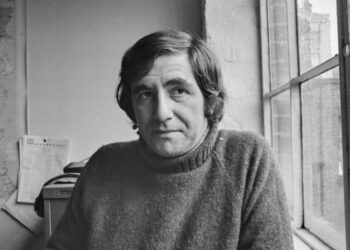
Calvin Tomkins, whose New Yorker profiles of contemporary artists in the 1960s and ’70s revealed the avant garde painters, sculptors and installationists being ignored by classical critics and elevated them from gritty, obscure galleries in downtown New York City into the broader American culture, died March 20. He was 100.
New Yorker editor David Remnick announced Tomkins’s death. He did not specify a cause.
During his six decades at the magazine, Mr. Tomkins wrote more than 400 articles of immense range, including long pieces on TV chef Julia Child, composer John Cage and the real-life Jazz Age couple — Gerald and Sara Murphy — who inspired F. Scott Fitzgerald’s 1934 novel “Tender Is the Night.”
But his adroit, deeply reported profiles of emerging masters were his most meaningful and lasting accomplishment. They set him apart from the diminutive, conservative world of art criticism in mainstream publications.
In profiling boundary-breaking artists such as Jean Tinguely, Robert Rauschenberg, Damien Hirst and Richard Serra, Mr. Tomkins both chronicled and defined the contemporary art world.
“When I started,” Mr. Tomkins told ArtReview magazine in 2014, “there was no art coverage in the news magazines and there was no regular coverage, even in Time … Contemporary art, particularly, was considered a ridiculous and foolish aberration. It didn’t have anything to do with art, according to a lot of people.”
Called a “portraitist” by Remnick, Mr. Tomkins eschewed criticism altogether and instead spent months watching artists work and probing their personalities in lively prose characteristic of the magazine’s other reporters. Even when he took over the magazine’s “Art Scene” column from Harold Rosenberg in 1981, Mr. Tomkins avoided criticism.
“I’ve always seen myself as a reporter on art,” he told ArtReview. “I think what’s been happening in art in this country and abroad for the last 50 years is so interesting and so varied and so connected with life in America that it’s perfectly legitimate to make an effort to report on it, to try to give a picture of the artist and the art as it’s been happening.”
His style — personable, accessible, an accumulation of telling details — was a counterpoint to the pompous, impenetrable prose sometimes associated with writing about art. “He’s not trying to impress with his use of language. I love him because he would rather say house than edifice,” John Baldessari, a conceptual artist, told the New York Times in 2011 when Mr. Tomkins became one of the few writers honored by the Whitney Museum of American Art at its annual gala.
Throughout his career, Mr. Tomkins had unparalleled access to often reclusive artists, whether unknown or famous. In 1974, after sitting on the patio of an aging New Mexico painter known for her landscapes and flowers, he wrote: “Georgia O’Keeffe, who is eighty-six, spends almost no time thinking about the past. … What interested her at the moment were the wild purple asters that grow so abundantly at this time of the year, when there has been enough rain.”
Mr. Tomkins’s career was “a pure accident,” he told the art magazine Ursula. In 1959, he was working as a reporter at Newsweek magazine in New York and an editor asked him to interview the French painter and sculptor Marcel Duchamp, who was in town and the subject of a recently published short biography that included photos of his work.
Such an assignment would have delighted a reporter with an even passing interest in art. Mr. Tomkins was not that reporter. “This might sound unbelievable now, but I had almost no interest at all,” he recalled to Ursula. He lived in New York but never visited galleries.
As a young reporter, Mr. Tomkins couldn’t refuse the assignment, so he quickly skimmed the book and met Duchamp at the King Cole bar of the St. Regis Hotel. He was unexpectedly enchanted by Duchamp and the exhilaration with which he described his work.
“It was a phenomenal experience,” Mr. Tomkins told the Seattle Times. “He was an absolutely wonderful interview, the kind of person who could take the most unenlightened or stupid question and make it something interesting. It really opened my eyes to contemporary art.”
Mr. Tomkins was struck, he later said, by Duchamp’s “complete freedom: freedom from tradition, freedom from dogmas of any kind.”
After his Duchamp piece appeared in Newsweek, Mr. Tomkins began spending his lunch hour at the Museum of Modern Art. Two years later, the New Yorker hired him as a reporter, and for his first major piece he profiled Tinguely, a Swiss motion-sculptor who, in Mr. Tomkins’s telling, became famous for making “a big, fantastic machine in the garden of the Museum of Modern Art whose sole purpose was to destroy itself in an act of mechanical suicide.”
The profile foreshadowed a thematic question Mr. Tomkins circled around throughout his career exploring the avant garde whims of contemporary artists: What even is art? “I don’t think it can be defined,” he told ArtReview. “Art is too diffuse, too vital. It’s always growing and changing. Certainly, we no longer can think of art as something that hangs on the wall. That is the work of art. The art remains with the artist.”
Mr. Tomkins next profiled Rauschenberg, an up-and-coming artist who collected discarded objects around New York and fused them with paintings. He accompanied Rauschenberg to an opening of his exhibition at the Jewish Museum in 1963.
“In the far corner of the room,” Mr. Tomkins wrote, “hung the work that is usually thought to be the most shocking of Rauschenberg’s works — a real quilt and a real pillow, liberally daubed with oil paint and matter-of-factly entitled ‘Bed’ — while in the middle of the floor stood ‘Monogram,’ one of what he calls his ‘combines’; its central feature is a stuffed Angora goat encircled at midriff by an automobile tire.”
The reactions of attendees were “varied and intense,” Mr. Tomkins wrote. “Some left the premises precipitately, others walked about looking dazed.” Rauschenberg later penetrated the art establishment, undoubtedly aided, like Mr. Tomkins’s other subjects, by the imprimatur of a New Yorker profile. When Rauschenberg died in 2008, he was widely regarded as one of the premier artists of his era.
Calvin Tomkins II was born Dec. 17, 1925, in Orange, N.J., and descended from a wealthy family that quarried limestone. His father owned a plaster business, and his mother was a homemaker. The family had a small collection of modernist paintings, but Tad, as he was known, didn’t pay them much attention growing up.
He was more interested in writing, which became a sort of salve to his stuttering problem. “I’m sure that writing, the whole act of writing, of not having to speak to express myself, felt like some sort of a victory over that or a way around it,” he told Ursula magazine.
After serving two years in the Navy, Mr. Tomkins graduated from Princeton University in 1948 and set ought to become a writer, with his father funding his pursuit. He traveled to Mexico, writing at a small inn near Guadalajara.
“It was a kind of Hemingway-esque experience for me,” he told Ursula. He wrote “Intermission,” a novel about war veteran returning home to attend Princeton. His agent submitted it to several publishing houses. A few weeks later, he sent a telegram to his parents: “Have turned pro. Viking accepts novel.”
The novel, published in 1951, was well reviewed but had middling sales. Mr. Tomkins joined Radio Free Europe in 1953 and then Newsweek four years later, rewriting copy sent in from foreign correspondents. Mr. Tomkins’s writerly ambitions went beyond the newsweekly, and he began submitting humor pieces and fiction to editor Roger Angell at the New Yorker, which published a few.
Mr. Tomkins wanted a staff job, though, so he went to see New Yorker editor William Shawn, who suggested he try writing some longer pieces. Casting around for ideas, an engineer friend suggested Tinguely, the Swiss motion-artist with a predilection for blowing things up.
“And thus Tomkins’ New Yorker career began with a literal bang — a piece about the infamous self-destruction of Tinguely’s ‘Homage to New York’ in the sculpture garden of the Museum of Modern Art,” Ursula magazine said.
The Tinguely piece helped secure a staff writer position Mr. Tomkins held until his death. In addition to his hundreds of articles he wrote for the New Yorker, Mr. Tomkins published 18 books, including biographies of Duchamp and philosopher Eric Hoffer and several collections of his profiles. One of his most celebrated books was “Living Well Is the Best Revenge,” based on his New Yorker profile of the Murphys.
Mr. Tomkins was a frequent and coveted guest on the New York cocktail party circuit. He married four times. Three of his marriages – to Grace Lloyd, Judy Johnston and Susan Cheever (the daughter of author John Cheever) — ended in divorce. His fourth wife was Dodie Kazanjian, a Vogue journalist whom he took to Andy Warhol’s funeral on their first date. Kazanjian later accompanied her husband on his reporting trips and helped with interviews, though they never shared a byline.
Mr. Tomkins worked into his 90s. In early 2023, he profiled Tala Madani, an Iranian American artist. Even after six decades, Mr. Tomkins said he never developed any overarching theories about art, nor did he ever figure out what truly made artists tick.
“To me, art is still a mystery,” he told Artnet. “Everything just gets more complicated.”
The post Calvin Tomkins, who narrated the rise of contemporary art, dies at 100 appeared first on Washington Post.