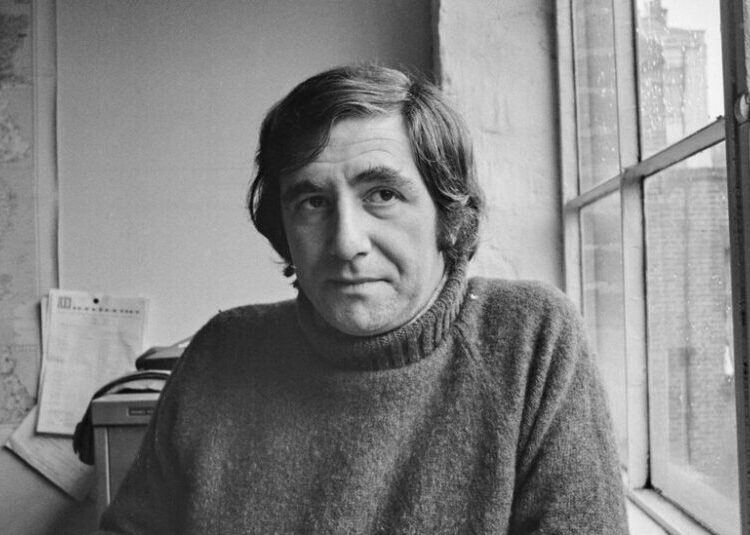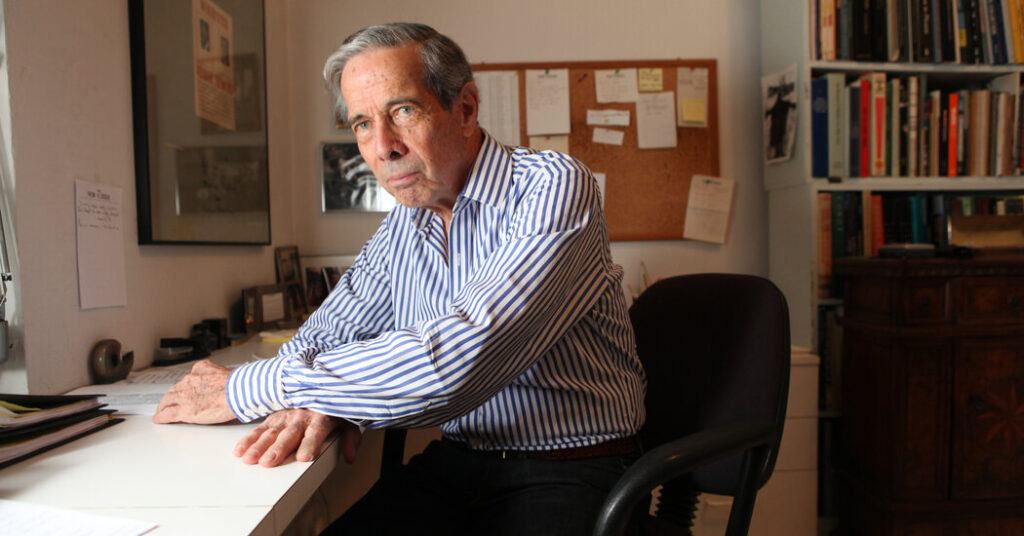
Calvin Tomkins, whose elegant and searching profiles for The New Yorker created an enduring portrait gallery of the prime movers in modern art from the 1960s onward, died on Friday. He was 100.
David Remnick, the editor of The New Yorker, announced the death on the magazine’s website. He did not say where Mr. Tomkins died.
Mr. Tomkins, by his own admission, knew nothing about modern art when, as an editor at Newsweek, he was sent in 1959 to interview Marcel Duchamp, the French-born conceptual artist who offered up “ready-made” objects as artistic creations. The ensuing conversation, in which Duchamp discoursed wittily about the complex relationships between art and ideas, turned out to be an eye-opener.
“I began thinking about modern art for the first time,” Mr. Tomkins told an interviewer for the National Gallery of Art in 1997. “So he’s really responsible for my whole interest in this subject.”
Mr. Tomkins started visiting galleries and picking up on the seismic changes in the art world as a new avant-garde emerged from the aftermath of Abstract Expressionism. After joining the staff of The New Yorker in 1960, he wrote a profile of Jean Tinguely and his self-destroying sculptures. He followed with studies of Duchamp, John Cage, Robert Rauschenberg and the dancer and choreographer Merce Cunningham. The profiles of this disruptive band were later gathered in book form in “The Bride and the Bachelors: The Heretical Courtship in Modern Art” (1965).
Urbane, cool and perceptive, his Tinguely article defined an approach that informed the dozens of artist profiles he wrote for The New Yorker over the next 62 years, providing the magazine’s readers with a sophisticated guide to often arcane styles and -isms.
“As chronicler of the avant-garde for The New Yorker, Calvin Tomkins has specialized in rendering the esoteric doings of artists comprehensible to a reader whose initial reaction to the art might be suspicion or hostility,” the art historian Mary Ann Tighe wrote in The Washington Post in 1980. “His quiet, meticulously detailed prose is the voice of reason calmly explaining the work of madmen.”
Mr. Tomkins described his methods in disarmingly simple terms. Speaking to the reference work Contemporary Authors in 1981, he said, “I go around and get a sense of what’s going on and then write about something that interests me.”
Calvin Tomkins II, known as Tad, was born on Dec. 17, 1925, in Orange, N.J. The family was well-to-do. His father, Frederick, owned a plaster company that made drywall and was eventually acquired by American Gypsum. His mother, the former Laura Graves, was a homemaker. (He was Calvin Tomkins II because his father’s older brother was also Calvin.)
He attended the Berkshire School in Sheffield, Mass. After serving two years in the Navy, he enrolled at Princeton, where he earned a bachelor’s degree in English in 1948.
At Radio Free Europe’s offices in New York, Mr. Tomkins edited news summaries for the service’s foreign bureaus before being hired at Newsweek in 1957 as a foreign news editor.
He found his métier after joining The New Yorker. “You know, John Cage said that at any one time one of the arts is doing the talking and the others are listening,” he told the magazine Art Review in 2014. “At the time he said it, he felt it was music that was doing the talking and the others were listening. I think that since the early 1960s it’s art that’s been doing the talking.”
Time-Life enlisted him to write “The World of Marcel Duchamp,” part of a series of bookson major artists. He returned to the subject in “Duchamp: A Biography” (1996) and “Marcel Duchamp: The Afternoon Interviews” (2013), a collection of interviews he conducted for his 1965 New Yorker profile.
“Mr. Tomkins’s writing style, as it happens, shares much with Duchamp’s aesthetic,” the critic Deborah Solomon wrote in a 2011 profile of Mr. Tomkins in The New York Times. “It is witty, literary and civilized. It does not betray the strain or turmoil inevitably involved in its creation. But, unlike Duchamp’s, Mr. Tomkins’s work is prized for its clarity and accessibility. His profiles read as if they were coated with a nonstick surface created to repel academic theory and moldy clumps of artspeak.”
Some artists escaped Tomkins’s scrutiny. In a 2019 interview with the Artnet news website, he noted that he never profiled Ellsworth Kelly. “And there were a lot of women I’m really sorry I didn’t get to, like Eva Hesse, Lee Krasner,” he added.
His many books, several of them collections of his New Yorker articles, included “The Scene: Reports on Post-Modern Art” (1976), “Post- to Neo-: The Art World of the 1980s” (1988) and “Lives of the Artists” (2008). “Merchants and Masterpieces: The Story of the Metropolitan Museum of Art,” an official centennial history, was published in 1970.
He expanded his profile of Rauschenberg into a full-length study, “Off the Wall: Robert Rauschenberg and the Art World of Our Time (1980),” and took up Cunningham once more in “Merce at 75” (1995). He was president and a member of the board of the Cunningham Dance Foundation from the early 1960s until 1990.
One of his most admired books was “Living Well Is the Best Revenge” (1971), a slender, flavorful biography of the glamorous aesthetes Gerald and Sara Murphy, the models for Dick and Nicole Diver in F. Scott Fitzgerald’s novel “Tender Is the Night.”
Mr. Tomkins’s first three marriages ended in divorce. He is survived by his wife, the Vogue writer Dodie Kazanjian, with whom he wrote “Alex: The Life of Alexander Liberman” (1993); a son, Spencer; three daughters, Anne Baffert, Susan Seidl and Sarah Flohre; five grandchildren; and three great-grandchildren.
In December, as Mr. Tomkins was turning 100, The New Yorker published a journal he had been keeping over the previous 10 months. In a November entry, he recalled standing in front of a Rauschenberg collage — one of whose elements was part of a man’s shirt — at the Museum of Modern Art in 1959.
“By chance, I was alone in the gallery,” he wrote. “My heart was racing. I fished a quarter out of my pants and slipped it into the shirt pocket in the collage. What was I thinking? That this act somehow made me a participant? Or was it just a quiet bravo, a vote of confidence? It made me feel good for the rest of the afternoon.”
The post Calvin Tomkins, Who Profiled Giants of Modern Art, Dies at 100 appeared first on New York Times.