The defining narrative for the U.S. economy over the past several years has been one of remarkable resilience in the face of inflation, tariffs and all manner of uncertainty. For individual Americans, however, the same period has often been defined by frustration, insecurity and, in many cases, real hardship.
The war with Iran looks set to repeat that pattern.
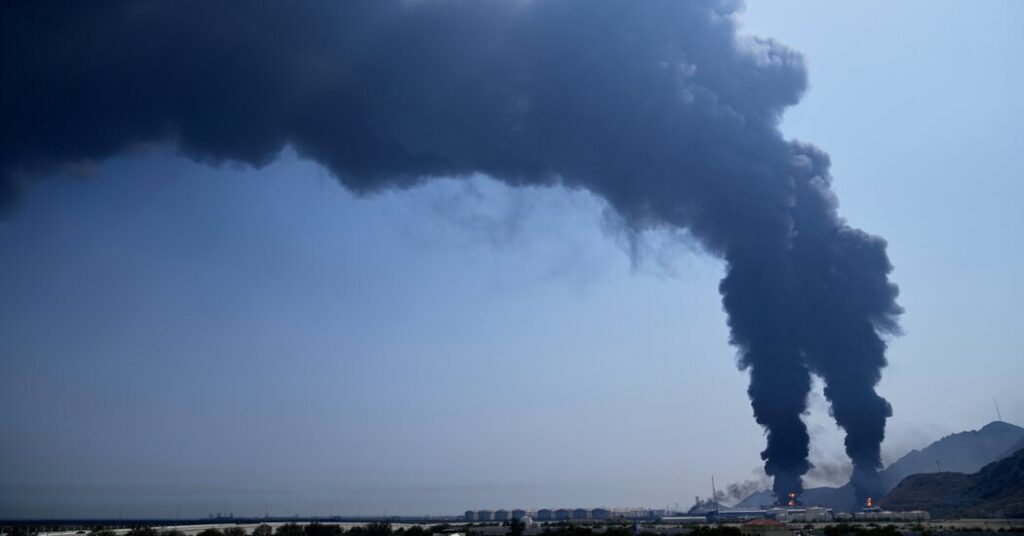
The jump in oil prices to over $100 a barrel in recent weeks will push nearly every major economic variable in the wrong direction. Inflation will be faster. Growth will be slower. Unemployment will most likely be higher. If the war were to last longer than expected, or energy prices were to go higher — as they have in recent days — the damage would grow.
Still, unless the situation takes a significant turn for the worse, the impact will most likely be modest, measured in tenths of a percentage point of economic growth. Federal Reserve policymakers, at their first meeting since the war began, made only small adjustments to their economic forecasts for the year and left interest rates unchanged.
In a news conference after this week’s meeting, Jerome H. Powell, the Fed chair, said it was too soon to predict how the war would affect the economy. But he noted that the economy had repeatedly exceeded expectations in recent years, including by defying the near-consensus view among forecasters that the Fed’s efforts to control inflation would lead to a recession.
“The U.S. economy has really been just doing pretty well through a lot of significant challenges over the past few years,” Mr. Powell said. “It’s just been amazing to see.”
Few Americans have shared that sense of amazement. Measures of consumer sentiment have been persistently weak as inflation and high interest rates have taken a toll on household finances. President Trump won back the White House partly by promising to control inflation, then proceeded to impose tariffs that drove up the price of imported goods, according to nearly all independent analyses.
Now the U.S.-Israeli war with Iran is threatening to deliver another inflationary blow just as the effects of tariffs were beginning to fade.
The cost of gasoline has jumped by about a dollar a gallon nationally since the war began and is all but certain to head higher. The prices of food and electricity — already pain points for many households — could be close behind. Even housing is set to become less affordable: Concerns about inflation have pushed mortgage rates to their highest level in three months, just weeks after they fell below 6 percent for the first time since 2022.
Those higher costs are hitting at a time when many families are struggling with mounting debt and dwindling savings, and when a weakening labor market has sapped workers’ bargaining power and made them nervous about their job security.
“These price increases are very pervasive,” said Maurice Obstfeld, a senior fellow at the Peterson Institute for International Economics and a former chief economist of the International Monetary Fund. “If you’re already struggling to pay your bills, it could be a very significant setback for you.”
Ripple Effects
Neither consumers nor the overall economy are as vulnerable to high oil prices as they were in the 1970s, when a succession of oil shocks contributed to the combination of rising prices and high unemployment that came to be known as “stagflation.” Cars have become more fuel efficient, partly because of reforms enacted after those crises. Energy-intensive industries account for a smaller share of economic output. And a surge in domestic production has turned the United States from a large importer of oil into a net exporter.
Wall Street forecasters estimate that the rise in energy prices will reduce U.S. gross domestic product, adjusted for inflation, by less than half a percentage point in the second quarter. For comparison, that is a more modest hit to growth than last fall’s six-week government shutdown. A prolonged disruption to global oil supplies would have more significant consequences. But unless oil prices hit $200 a barrel for a sustained period — a scenario that energy experts say is plausible but relatively unlikely — most forecasters do not think the shock will be enough to cause a recession.
Because the United States is both the world’s largest producer of oil and its largest consumer, the economic consequences of higher prices are complex. Rising costs mean bigger profits for oil companies and their investors, and perhaps also more jobs for workers in Texas, North Dakota and other energy-rich states.
But for the businesses that rely on oil to produce and ship their goods, higher prices are a cost that they must either pass on to their customers or swallow in the form of lower profits. Diesel fuel has already crossed $5 a gallon, and the price of jet fuel is up more than 50 percent since the war began.
The effects of the war go beyond oil: Natural gas prices have soared globally, as has the cost of nitrogen-based fertilizer. That could push up food prices, and further strain the already battered agricultural sector. In a letter to Mr. Trump on Thursday, a coalition of farming groups asked for federal help dealing with the increased costs. Supplies of aluminum and helium, key industrial inputs that are produced in the Gulf region, have also been disrupted.
“This is not just an energy shock,” said Aditya Bhave, chief U.S. economist for Bank of America. “It’s difficult to sit here and figure out exactly how that is going play out through global supply chains.”
The most immediate impact, however, will be on consumers. Gasoline makes up a relatively small share of consumer spending, only about 3 percent for the average household, but it is an expense most Americans have little choice but to pay. People may be able to put off road trips or weekend excursions, but they mostly cannot avoid driving to work or school.
“It is a fixed cost,” said Alex Jacquez, chief of policy and advocacy for the Groundwork Collaborative, a progressive group. “You’re not going to not go to work because the price of gas is up, so you’re going to cut back somewhere else.”
A recent analysis by economists at Stanford found that the increase in gas prices could be enough to wipe out the benefits of the higher tax refunds that resulted from the tax cuts that Mr. Trump signed last year. The impact will be particularly hard on low-income families, who typically dedicate more of their budget to energy and have less room to cut back spending elsewhere.
“I doubt we’ll see a big recession coming for the U.S. economy — in that sense it may not look like that big an impact,” said Matthias Kehrig, a Duke University economist who has studied the effects of high oil prices. “But in terms of pain for low-income people, it is a big recession.”
Even for households that can afford to pay more, gas prices are a uniquely visible reminder of the rising cost of living. Shoppers may notice when they have to pay more for eggs or beef, but only gas prices are posted in giant numbers alongside every highway in America.
Measures of consumer sentiment dropped sharply in the early days of the war, as surveys showed that Americans were anticipating not just higher prices at the pump but also a broader pickup in inflation over the next year. And unlike many consumer attitudes in a polarized era, concern about rising gas prices cut across partisan and ideological lines, said Joanne Hsu, the director of the University of Michigan’s long-running consumer survey.
“This isn’t ‘I don’t like this foreign policy and I’m going to tell you I hate the economy as a result,’” Ms. Hsu said. “People aren’t even specifically mentioning the word ‘Iran.’ They’re really reacting to the economic reality that they’re seeing with gas prices going up.”
Less Bargaining Power
Americans’ last experience with high gas prices came in 2022, when they hit a record $5.55 a gallon nationally after Russia’s invasion of Ukraine.
That price spike occurred in a very different economic context. Inflation was much higher then, but it was also a newer phenomenon — Americans had not yet been battered by years of high prices. And the labor market was much stronger, with employers competing with one another for workers as they tried to staff up in the wake of the coronavirus pandemic. That gave workers leverage to demand raises that helped them offset the pain of higher prices.
Today, job growth has slowed to a crawl, and while the unemployment rate is still relatively low, it has crept up. Workers report feeling less confident about their ability to find a new job if they were to need one. As a result, wage growth has slowed, particularly for low-wage workers, making higher gas prices harder to absorb.
“This time, all the bargaining power really seems to lie with employers,” said Kayla Bruun, lead economist for Morning Consult, a polling firm.
In data released this week, Morning Consult found that consumers were already responding to higher gas prices by cutting back spending on discretionary expenses, such as plane tickets and restaurant meals, and on frequently purchased items like groceries, where they had the option to buy less.
Even before the war began, Ms. Bruun said, surveys were showing some erosion of sentiment among consumers as the labor market softened. Today, oil prices are adding a new source of concern.
“We’ve had this slow-moving story, and then now we have this fast-moving story,” Ms. Bruun said. “The slow-moving story has been this kind of gradual weakening that’s a little bit been undermining sentiment.”
Now, she said, “with this shock of gas prices, this thing that consumers have no choice really but to absorb, that’s putting pressure on budgets.”
Ben Casselman is the chief economics correspondent for The Times. He has reported on the economy for nearly 20 years.
The post The U.S. Economy Is Insulated From High Oil Prices. Americans Aren’t. appeared first on New York Times.