Traveling has always come with complications. Our By The Way Concierge column will take your travel dilemmas to the experts to help you navigate the unexpected. Want to see your question answered? Submit it here.
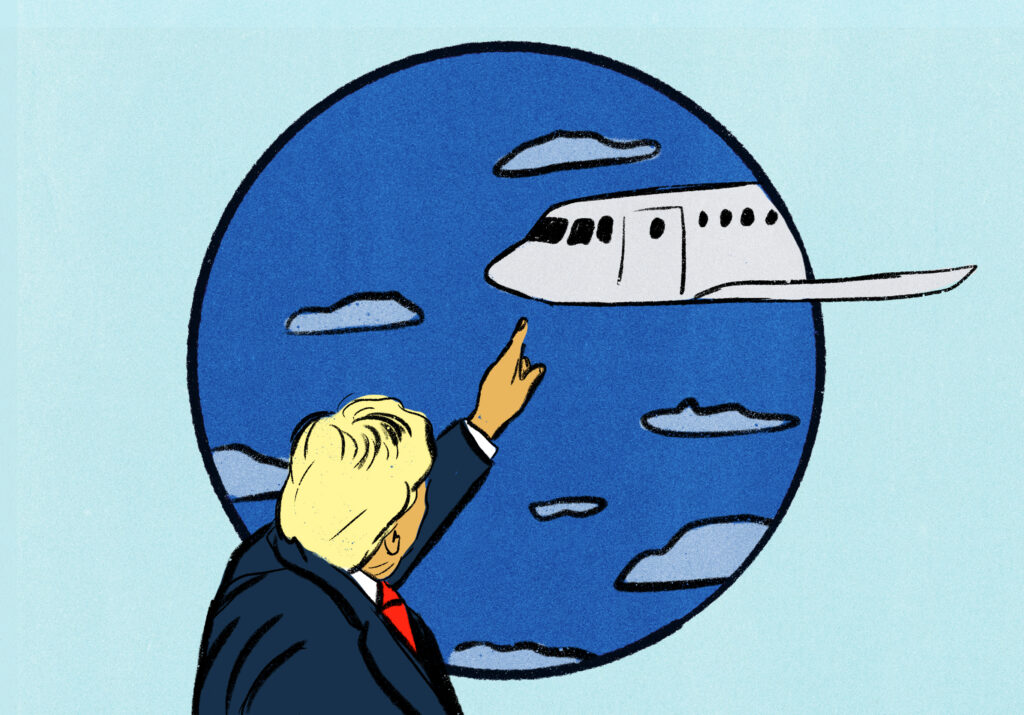
“I’m a U.S.-born citizen who will be traveling to France. I’ve been critical of Trump on social media. Should I be worried about getting back into the U.S.?” — Anonymous.
We know the government is interested in traveler social media — at least for foreigners. Last year, U.S. Customs and Border Protection floated a proposal for international travelers to disclose five years of social media history. And we also know that searches of devices belonging to American citizens is on the rise — from 8,657 in 2023, to 10,541 in 2024 and 13,590 in 2025 — according to CBP’s latest reports.
Does that mean your posts could be held against you at the border?
First, I took your question to the Department of Homeland Security. Their response was simple: “This is absurd. No one has been denied entry to the U.S. because they were critical of President Trump,” a spokesperson said in an email.
I also spoke to a few lawyers and travel risk experts to get their take. Here’s what they told me.
Your free speech is protected
According to the law, U.S. citizens “have a First Amendment right to criticize the government on social media,” said Sophia Cope, senior staff attorney for the Electronic Frontier Foundation. There are, of course, exceptions. Your speech isn’t protected if your social media post was a credible threat of violence, for example.
But Cope does still have concerns.
“There is the law, and then there’s the practicality of what’s happening on the ground, and the delta between those two things makes me sad and frustrated,” she said.
Cope believes President Donald Trump’s administration has “shown that they have a pretty significant disregard for individual rights and the rule of law,” she said, pointing to reports of travelers being held at airports for questioning. “So how do you give people advice when you’re dealing with government agencies that behave that way?”
“Essentially we say one size doesn’t fit all, because everyone has their own personal circumstances,” Cope continued.
You can’t be denied entry to the U.S.
John Rose, chief risk officer for the travel agency Altour, said he’s had “more than a few” inquiries like this from clients.
“The main thing I tell people, though, is if you’ve got proof of citizenship, they can’t deny you entry into the United States,” he said. “They can delay it, but they can’t deny it. So [you] should be fine.”
Cope brought up the same point.
“U.S. citizens have a right to immediately enter their country, unless there’s probable cause to arrest for a crime,” she said.
There’s always a chance your device could be searched
Mike Ballard, director of intelligence at Global Guardian, a travel risk management firm, said that you should have “no concerns about getting back into the U.S.” and that citizens “should have no issue going to and from Europe,” regardless of political stance.
However, “there is always a possibility they may be selected for a search of electronic devices,” Ballard said in an email.
Per the CBP website, all travelers coming into the country are subject to inspection, and “on rare occasions, CBP officers may search a traveler’s mobile phone, computer, camera, or other electronic devices during the inspection process.”
This isn’t new with the Trump administration. “The government has claimed the power to do that for years now,” said Nate Wessler, deputy director of the American Civil Liberties Union’s Speech, Privacy and Technology Project.
“DHS publishes data every year about the volume of those searches,” he said, “and it has been steadily increasing over time and continues to increase under the Trump administration.”
Maria Villegas Bravo, a lawyer who focuses on government surveillance of mobile devices as counsel for the Electronic Privacy Information Center, said travelers should be prepared for two kinds of potential CBP searches.
In a basic search (also called a manual or consent search), an officer will ask if they can look through your device and scroll through whatever’s available (e.g. your photos or text messages) but shouldn’t ask you to log into anything not immediately available on airplane mode without a warrant (such as a cloud storage account, for example).
In an advanced or forensic search, they may plug your phone or laptop into a government device that downloads everything on it for further investigation. To conduct an advanced search, Wessler said officers “say they need reasonable suspicion, which is a pretty low bar.”
Have a strong password
As a general precaution, Bravo recommends travelers have a strong password enabled to unlock their devices, and to turn off biometric authentication for extra security. That won’t stop your device from being searched, though.
When a border agent wants to search your phone and it’s locked, they’ll ask you to either unlock it or give them the passcode. But “the government does not have the power to literally compel somebody to do that,” Wessler said.
U.S. citizens can refuse to unlock their device but should be prepared for the ramifications.
For example, Wessler said the agent could seize your phone and let you into the country, but keep your device to send to a forensic examiner at a government facility “where they try to break into the phone,” he said. “We’ve seen people who have been without their phones for at least weeks and sometimes many months.”
Don’t travel with sensitive information
Bravo said concerned travelers should think about “data minimization” when they’re going abroad. Essentially: Don’t bring what you don’t want searched.
“It’s something attorneys talk about all the time … don’t send an email that you don’t want to show up in the court record,” she said.
It might not be realistic for you to travel with a second phone, but you could store sensitive information elsewhere (an external hard drive or cloud storage account) and delete it from your device while you’re on the road.
If you do get searched, stay calm
Altour’s Rose was once detained in Frankfurt, Germany, for having a suspicious travel history after attending speaking engagements in South America, Africa, the Middle East and Greece. He stayed calm and explained himself to officers, and was eventually let go. He recommends any traveler who gets stopped do the same.
“I say practice patience with empathy because if you’re mad at these agents, whether it’s customs or TSA … you’re just subjecting yourself to additional scrutiny,” Rose said. “They’re also going to treat that as: ‘Why is this person being belligerent? Do they have something to hide?’”
Have a travel dilemma for By The Way Concierge? Send it to us here.
The post You asked: I’ve been critical of Trump. Should I worry about flying? appeared first on Washington Post.