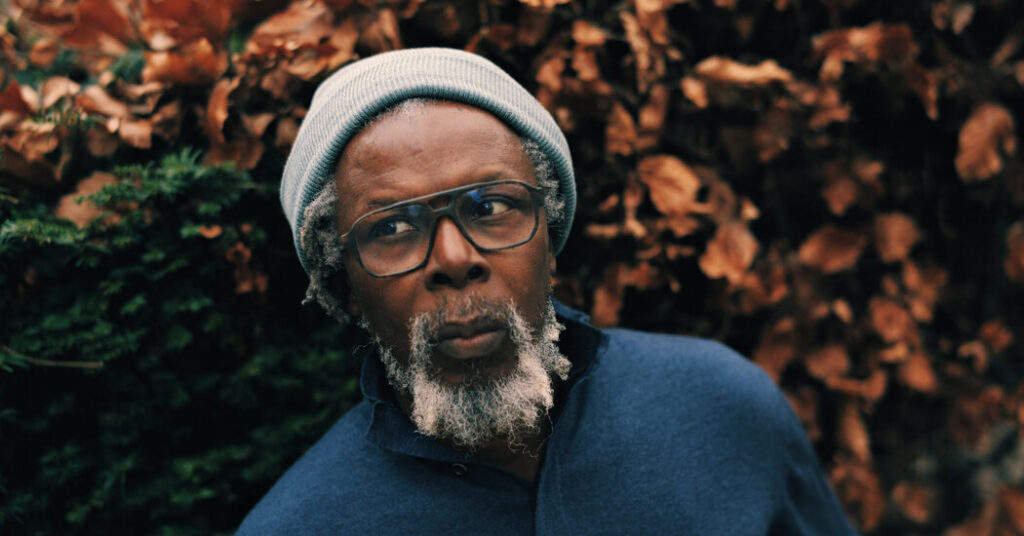
When the British artist Hurvin Anderson was visiting one of his exhibitions with his family last year, his 5-year-old daughter made a picture of her own in the gallery. She drew a goldfish bowl, which Anderson took as a sign — a metaphor for being on display and under scrutiny.
That got him thinking about his four-decade-long relationship with the art world. “It’s interesting to a point,” he said recently. “But then after that, it’s not much fun.”
Success in the art market has bought Anderson a lot of attention. “Audition,” his 1998 painting of a swimming pool scene, fetched one of the highest prices ever for a painting by a living Black British artist when it sold at auction for more than $10 million in 2021. Last year, a piece called “Lower Lake” brought in almost $4.5 million at Christie’s.
Yet as a 61 year-old, married father of five, Anderson is still trying to figure out a balance between work and home life. There are days when he does the school run and other times when he is holed up for weeks in his purpose-built home studio in Cambridgeshire, England.
“We constantly want to have it all,” he said — “not sure it’s really possible.”
Right now, he is preparing for a major survey of his work — the largest of his career — at Tate Britain in London, opening on March 26. The show will bring together more than 80 of his vibrant, vivid paintings and drawings, luscious works that are deeply rooted in both British landscape painting and Caribbean terrains and interiors: modernist abstractions and real-life observations, tinged with a sense of fantasy.
Dominique Heyse-Moore, the exhibition’s curator, writes in the catalog that “Anderson’s personal experience, his family and Black culture, are there — always there — but protected by painting itself: Its opacity, liquidity, how absorbing and pleasurable an act it is.”
The artist was born in 1965 in Handsworth in Birmingham historically a hub of Afro-Caribbean life in England. He was the youngest of eight children: his mother, a seamstress; his father, a welder. “I had a very hard father who would talk you to death,” Anderson recalled. “I couldn’t leave the house without having a lecture. ‘What are you doing? Where are you going? Who are you hanging around with?’” he said. “I think I was more scared of my dad than the police.”
He drew a lot as a child and took photographs but never initially considered pursuing art as a career. After school, he went through a period of unemployment and taking on odd jobs. He “tried to do the 9-5” thing, he said, but found it wasn’t for him. Then he tried his hand at a sound recording course, but that wasn’t a fit either. “Maybe I didn’t work hard enough,” he said.
Eventually, Anderson leaned into his creative side, and enrolled in an art course. “Sometimes these things choose you,” he said.
He went on to study at Wimbledon College of Art and the Royal College of Art, both in London. Still, it’s Anderson’s Birmingham upbringing that is central to his artistry, according to the historian, artist and professor Eddie Chambers, who founded the influential BLK Art Group in nearby Wolverhampton. He attributes Anderson’s imaginative way of working to the thriving multiethnic culture of England’s West Midlands region.
“Birmingham is home to a distinguished number of artists,” Chambers said, listing Barbara Walker, Keith Piper and Marlene Smith. “Hurvin can be bracketed in.”
Anderson’s first survey show, held at Ikon Gallery in Birmingham in 2013, showcased depictions of warm landscapes and rich botany that had been inspired by a visit to Trinidad. A later exhibition, “Dub Versions,” explored ideas about belonging, genealogy and identity through paintings, collages and drawings.
That show, at New Art Exchange in Nottingham, a Midlands city northeast of Birmingham, earned him a nomination in 2017 for the Turner Prize, the prestigious British art award. An article on the website Artnet at the time said that Anderson had introduced “a quality not often associated with the Turner Prize: beauty.”
Although Anderson said that his works show “the influence of Michelangelo,” — he acknowledged resisting that impulse, saying, “I tried to push him to one side, but he always comes back” — they are also indebted to representations of the Black British experience, like Sonia Boyce’s 1984 painting “Big Woman’s Talk” and “Handsworth Songs,” a movie by Black Audio Film Collective about 1985 riots in London and Birmingham.
Anderson said that history was perhaps the dominant theme of his work, which engages with the past, memory and nostalgia — especially when it romantically circles the Caribbean. He was the only child in his family born in Britain, and there is sense of longing in his paintings for his parent’s homeland of Jamaica. Whenever he visits the island, he said, he picks up on details that he incorporates into his works.
His 2005 “Welcome Series,” for example, depicts private homes viewed through the window security grilles that are a staple of Caribbean architecture.
“The ways in which Hurvin is able to turn this cultural trait into an investigation in his paintings says something about his originality of thought,” said Chambers. “He’s not a literal painter,” he added. “What he creates are these painting investigations of geometric forms.”
During a 2017 trip to the island, Anderson noticed several abandoned hotels on the beach. Disturbed by the eerie sense of collapse, but fascinated by greenery that surrounded the buildings, he began depicting the crumbling concrete structures engulfed by foliage and vegetation.
When Hurricane Melissa swept through Jamaica last October, the destruction it wrought made Anderson question his role as an artist, he said. “Should I be responding in some way?” he recalled asking himself. “Is it my responsibility?”
He has never been a painter who works in an overtly political mode — and this comes with its downsides.
“From the Anglo-Saxon community, the first statement they’ll make about my work is, ‘I like your work because it doesn’t beat me over the head,’” Anderson said. Statements like these make him nervous, he added, because they suggest that his work appeases and pacifies.
He prefers to think of his viewers as constantly looking, questioning and trying to get to the bottom of “what something means,” he said. Take, for instance, his depictions of barbershops, which were the focus of his solo exhibition “Salon Paintings” at the Hepworth Wakefield museum in northern England in 2023.
The barbershop is a place of significance within Black communities, and has been depicted in artworks from Spike Lee’s 1983 student film Joe’s “Bed-Stuy Barbershop: We Cut Heads” to the play “Barber Shop Chronicles” by Inua Ellams. Anderson depicts the salons with a sense of curiosity, incorporating the colors, the people, the posters, the mirrors.
It wasn’t just the barbershop’s aesthetic qualities that intrigued him, Anderson said, but also what it represents. “It breaks the line between business and personal space,” he said. “Somehow those lines get distorted.”
Several of these canvases will go on view at Tate Britain. There will also be new works that explore Anderson’s relationship with Rastafari, an Abrahamic-rooted faith that developed in Jamaica during the 1930s, centered on Black consciousness and liberation. As a young man, Anderson was part of the Twelve Tribes of Israel, he said, a devout group within Rastafari that also counted Bob Marley as member. Though Anderson is no longer a practicing Rasta, “many of the principles are still there,” he said.
“I understood the movement and what it was trying to do,” he added. “Rasta, religion, growing up in Handsworth, growing up in a Caribbean community in general: It’s a kind of skepticism of everything.”
A new work in the Tate Britain show features a depiction of Haile Selassie, the emperor of Ethiopia from 1930 to 1974 and a divine figure to Rastafarians. For Anderson, these works are about forming and “finding your own view of the world,” he said.
He added that he hoped the new works would reveal something deeper about his life and personal history. Recently, he said, his nieces had been researching their family history and how it had been shaped by the trans-Atlantic slave trade. A document they uncovered showed that their ancestors had been trafficked to a plantation in Hanover, a parish located on the northwestern tip of Jamaica. Where they were shipped from remains unknown.
“How do you reconcile that?” Anderson said.
He seemed surprised at the place he has earned in Britain’s art historical canon. “We’re Black kids,” he said, in a tone of disbelief. “I wasn’t that good a runner,” he said, “wasn’t that great at football. What else could I have done?”
Hurvin Anderson March 26 through Aug. 23 at Tate Britain in London; tate.org.uk.
The post A Painter Faces His Biggest Show, and the Truth About Success appeared first on New York Times.