You’re reading Awakenings, a newsletter on religion. Click here to get the full newsletter in your inbox.
Ayaan Hirsi Ali is the founder of the AHA Foundation and a research fellow at the Hoover Institution.
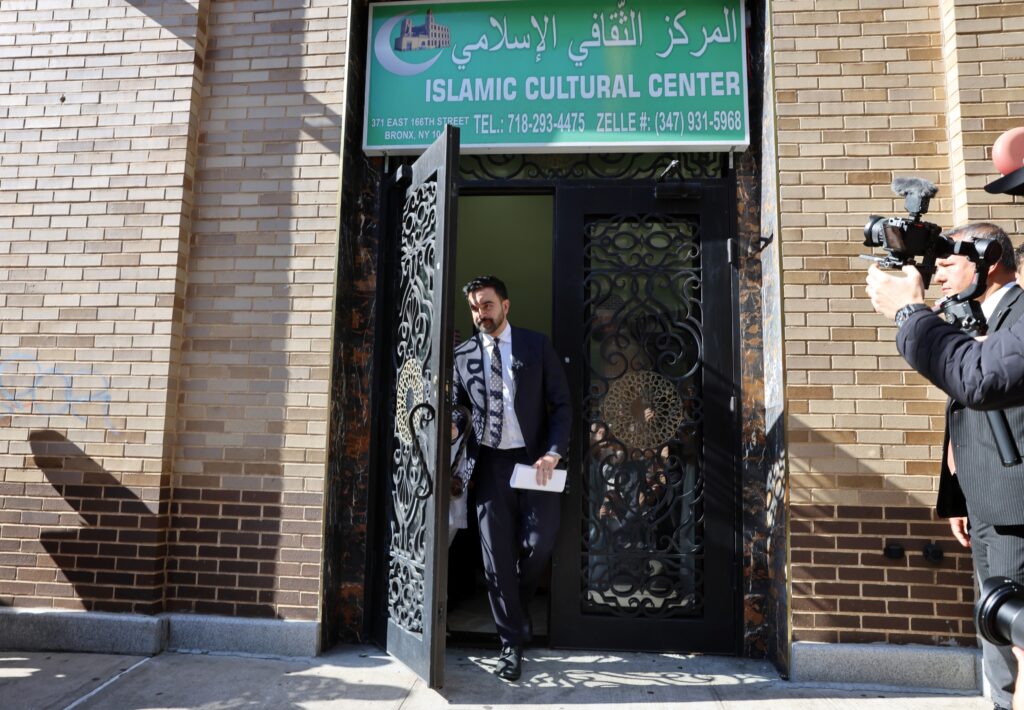
Zohran Mamdani swept into office on a democratic socialist platform and a proud embrace of his Muslim identity. “I am Muslim. I am a democratic socialist. And most damning of all, I refuse to apologize for any of this,” he said in his victory speech. But while the New York mayor’s economic proposals have been widely debated, there has been less examination of how his understanding of Islam shapes his statements and policies.
New York contains more than 750,000 Muslims, who make invaluable contributions to the city. It is also home to the largest Jewish community outside Israel and millions of Catholics. By American law and custom, Mamdani must be impartial to all three groups. Previous mayors have done just that. Rudy Giuliani governed as mayor of all New Yorkers, not as a Catholic. Michael Bloomberg likewise worked for all, not as a Jew. That is the standard against which Mamdani must be measured. And he fails it — as his early choices show.
With the Jewish community, Mamdani’s record is striking. As a state assemblyman, he stopped co-sponsoring an annual resolution condemning the Holocaust. In his first hours as mayor, he reversed New York City’s adoption of the International Holocaust Remembrance Alliance (IHRA) definition of antisemitism. As other political leaders condemned a crowd for chanting “we support Hamas” outside a synagogue in Queens, Mamdani remained silent — until a question from a reporter forced a clipped response. When it was reported that Mamdani’s wife had liked Instagram posts celebrating the Oct. 7 attack, Mamdani called her a “private person.” He has called Israel an apartheid state, supports the Boycott, Divestment and Sanctions movement and wants to arrest Israeli Prime Minister Benjamin Netanyahu. Asked to condemn the inflammatory slogan “globalize the intifada,” Mamdani declined. (He later promised to “discourage” use of the phrase.)
Meanwhile, Catholic New York has received a cold shoulder. About one-third of the metro area’s adults are Catholic — the largest faith bloc in New York. They learned where they stood not from any policy announcement but from a conspicuously empty mayor’s seat at St. Patrick’s Cathedral. In February, Mamdani became the first New York mayor in at least a century to skip the installation Mass for a new archbishop. Cardinal Timothy Dolan, the departing archbishop, took the unusual step of saying he was “ticked off” by Mamdani’s snub. He also criticized the lack of Catholics on Mamdani’s transition team.
Mamdani has adopted a very different approach toward Islam. While discarding the IHRA definition of antisemitism, he has stressed the threat of Islamophobia. He eschewed the archbishop of New York but was photographed with Siraj Wahhaj, a Brooklyn imam who, though never charged, was named on a list of potential co-conspirators in the 1993 World Trade Center bombing. Mamdani’s office celebrated World Hijab Day, describing as a “powerful symbol of devotion” a garment that millions of women across the Islamic world are beaten, imprisoned or killed for refusing to wear.
In Mamdani’s treatment of Jewish, Christian and Muslim communities it is possible to detect a basic religious asymmetry. Muslims’ concerns are taken more seriously than those of Christians and Jews, and criticism of Islamic practices and figures is more readily dismissed.
Shiite Islam makes hard metaphysical demands on its adherents. It is at odds with Mamdani’s support for LGBTQ+ and abortion rights. It also runs counter to the postcolonial outlook with which Mamdani was raised. Postcolonial theory treats all claims of universal truth with deep suspicion. Every absolute, it insists, conceals a power relation. As Zohran’s father, the postcolonial theorist Mahmood Mamdani, has written, in certain circumstances “the call for justice is really a slogan that masks a big power agenda.”
So is Mamdani simply using his Islamic identity as a convenient political accessory while he governs as a secular progressive? Or is he something more distinctive — a man in whom two militant worldviews, Islamism and socialism, are not fighting each other but fusing? Mamdani has described the Palestinian struggle as “the core” of his politics and the thing that drew him to the Democratic Socialists of America. By emphasizing his Muslim heritage, he identifies with the oppressed. His asymmetric treatment of different religious groups thus reflects a broader theory of which groups are colonizers and which are colonized.
The Iranian philosopher Abdolkarim Soroush has distinguished the “Islam of identity” from the “Islam of truth.” The former deploys religion as cultural armor while shorting its metaphysical claims. Mamdani exemplifies one powerful version of the Islam of identity. This views Islam primarily not as a set of religious teachings, but as an oppressed identity that can serve as a locus of resistance.
This has serious consequences. Two young men were recently arrested outside Gracie Mansion, the mayoral residence, and face terrorism charges for an alleged Islamic State-inspired bomb plot. Mamdani’s first response was to condemn by name the anti-Islam activist they targeted, before vaguely criticizing the bombers themselves. He appears linguistically helpless before jihadist violence, perhaps because naming it would require conceding something his coalition will not accept: that such violence can arise for reasons internal to a tradition, not merely as a reaction to Western provocation.
In normal times, this might not matter. These are not normal times. America is at war with the Islamic Republic of Iran. New York is the city that lost nearly 3,000 people on Sept. 11. It is a symbol of everything the Islamist imagination has spent decades promising to destroy: materialism, hedonism, capitalism. As the West confronts Islamism, Mamdani will have to make clear where he stands.
The post Why Mamdani’s faith matters appeared first on Washington Post.