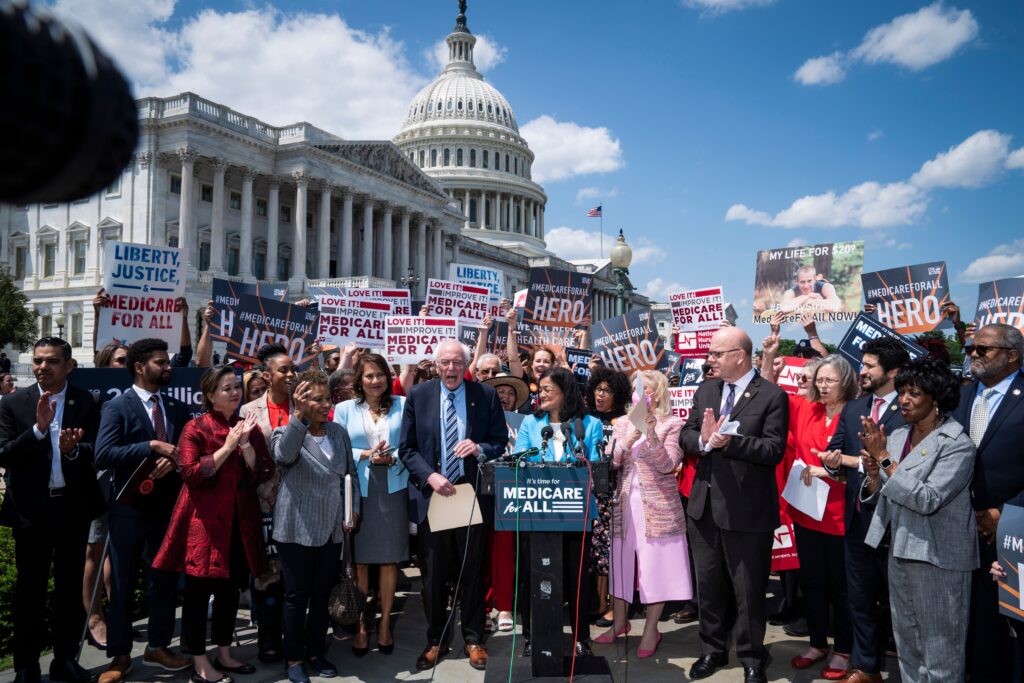
Juliana Stratton, Illinois’ Democratic nominee for U.S. Senate, favors Medicare-for-all. So does progressive heartthrob Graham Platner, who is running for Senate in Maine. Abdul El-Sayed, another Senate hopeful, touts the same policy in Michigan. Several Democratic candidates for governor of California want to bring the idea to life in the most populous state in the union.
A government takeover of the health insurance industry is on the verge of its second moment in the spotlight. Its first test in the glare came during the 2020 Democratic presidential primaries. It didn’t go well: Candidates first endorsed the idea, also called “single-payer,” and then had to retreat when others scrutinized it. If any of its current enthusiasts gets close to a competitive general election — as Platner and El-Sayed could — the party could relive that experience.
That’s because Medicare-for-all’s political and policy deficiencies become impossible to ignore as soon as the debate moves beyond slogans.
Problem No. 1: It requires tax increases on the middle class. To his credit, Sen. Bernie Sanders (I-Vermont), the policy’s leading champion, says so. In recent years, he has gotten more specific about the more than $13 trillion in tax increases he wants, although that is not nearly enough to pay for the policy. Sanders also suggests most people would face lower overall costs because they’d save more on insurance premiums and the like than they would pay in extra taxes.
Voters won’t trust that promise. Tax increases on the middle class are sufficiently unpopular that most Democrats haven’t tried to enact them for decades. Democratic Sens. Cory Booker (New Jersey) and Chris Van Hollen (Maryland) recently introduced plans to cut taxes, on balance, for all but the highest-earning 1 percent of Americans.
Voters shouldn’t trust the promise of lower health spending because of problem two: Supporters are counting on cost savings that are unlikely to materialize. They note that other countries have national health systems that spend less than the United States. But the Sanders bill, which with 17 co-sponsors is the main proposal on the table, is more generous than many of those systems, both in abolishing deductibles and co-pays and in covering more services. Sanders highlights a conservative scholar’s estimate that the plan could cut costs by $2 trillion dollars, but that estimate assumes the new system would pay doctors and hospitals 40 percent less than private insurance would. The scholar, with understatement, calls that “an unlikely scenario.” If it happened, good luck keeping the quality and volume of medical care from declining.
Which brings us to problem three: The foreign systems most similar to Medicare-for-all, those of Canada and Britain, have long wait times, especially for specialty care.
But problem four might be able to sink this project all by itself: It requires the government to kick 181 million people off their employer-provided insurance, 36 million off their individually purchased policies and 35 million off their Medicare Advantage plans. Surveys regularly find that an overwhelming majority of those enrollees like their coverage.
There’s a reason President Barack Obama’s sales pitch for his health insurance overhaul emphasized that people who liked their plans could keep them, something Sanders and company can’t say. But this feature of Medicare-for-all isn’t just a political obstacle for progressives. It also raises a more fundamental question: If most people are happy with their coverage, why should the government abolish their plans? What’s the vital public purpose that justifies this federally imposed disruption to people’s health care arrangements?
That disruption would neither cut costs nor improve the quality of care. While it’s true that Britain has longer life expectancies than the U.S., the difference appears to be explained by car crashes, gun deaths, substance abuse and heart disease. Health insurance seems likely to have a large effect only on the last of those, and even that partly reflects Americans’ decisions about food and exercise.
Forcing so many people out of their insurance is not necessary to expand coverage: Congress could do so by boosting subsidies, cutting regulations or both. The Sanders bill defines “all” to include noncitizens and even illegal immigrants (which probably deserves to be listed as problem five). If Congress wanted to make those groups eligible for existing government programs, it could do that, too, without abolishing private insurance.
The claims made in favor of Medicare-for-all are so flimsy that one begins to suspect its advocates believe that greater government control of health insurance and care is a good thing in itself. That is, thankfully, a hard sell — as Democrats may be on the verge of learning again.
The post Medicare-for-all makes a comeback appeared first on Washington Post.