Joseph Briseño arrived at CSL Plasma around 8 a.m., just as the morning rush of donors was thinning out. He took a few small sips from his water bottle, preparing for what he ruefully described as his second job.
Four days a week, Mr. Briseño, who lives in the Houston suburbs, works long shifts seated at the controls of a crane at a local waste disposal company, where he is a supervisor. It’s his full-time job, and he earns around $50,000 a year. On two of his days off, he sits in a cushioned recliner for an hour with a needle in his left arm, donating blood plasma to be used in making certain medical therapies. Donating is a misnomer. He earns an average of $70 for each visit.
“That can be gas money, grocery money, money put into savings for emergencies,” said Mr. Briseño, who started going to this plasma collection center a year ago after struggling to find a part-time job that didn’t conflict with his work schedule. He needed to do something to offset the increased costs of living.
“In this economy, it’s expensive,” he said, “and donating helps.”
Every day, an estimated 215,000 people donate plasma, the yellowish liquid component of blood. Mr. Briseño is among them. He is not jobless or facing eviction, but, like many in the American middle class, he is caught in the vise of rising expenses and wages that aren’t growing fast enough to cover them. So he is turning to a method more commonly associated with the lowest-income Americans. For people like him, an extra $600 or so a month can mean making a mortgage payment or covering increased health-insurance costs.
While no one publishes statistics on the exact incomes of people who sell their blood plasma, the location of the centers suggests a shift toward a less financially desperate clientele. A recent study by researchers at Washington University in St. Louis and the University of Colorado, Boulder, observed that while older plasma centers are clustered in low-income areas, newer centers were increasingly likely to open in middle-class neighborhoods. A New York Times analysis shows the trend has continued: Centers have sprung up in more than 100 such neighborhoods, in suburbs and wealthier sections of cities, since researchers finished collecting their data in 2021.
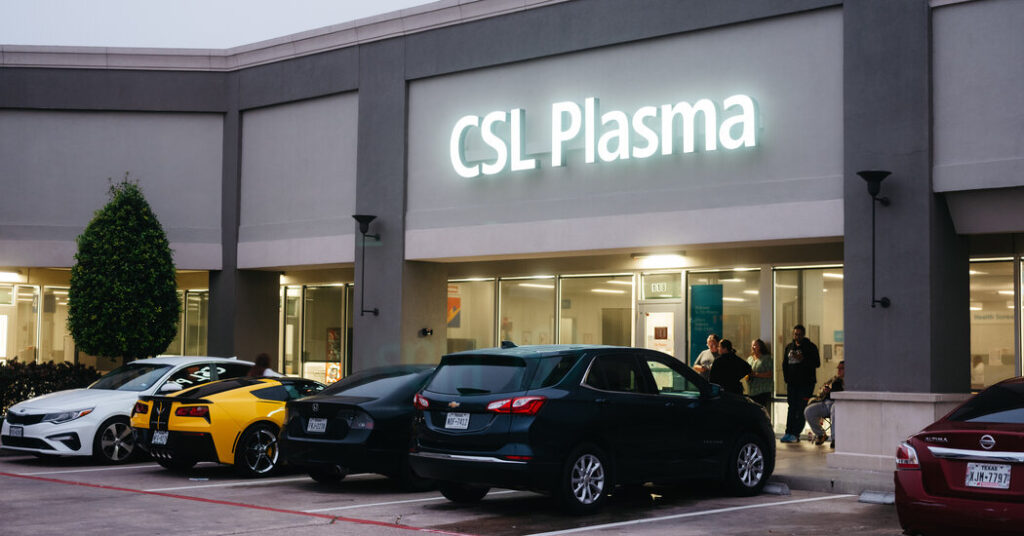
In the Houston suburb of Webster, Texas, a short drive from the Johnson Space Center, two sites opened in 2022 along a stretch that perfectly embodies a certain slice of suburbia. The CSL Plasma location, where Mr. Briseño goes, is in a strip mall a few doors down from an Orangetheory Fitness. And BioLife Plasma Services, a little more than a mile away, is in a stand-alone building next to a man-made pond and a Charles Schwab branch.
On recent mornings, people waited in long lines outside both locations. Many described themselves as middle class, and said that even a few years ago they would not have imagined exchanging their plasma for cash. There was a 30-something tech worker trying to save for a house, a sixth-grade special education teacher looking to cover rising health care costs, a night-shift nurse struggling to pay child care fees.
Most of them donate twice a week — the maximum allowed under Food and Drug Administration regulations — and earn an average of $70 per visit, although pay can vary depending on things like the collection amount and incentives.
“If people need to do this to supplement their incomes, then there are a lot of jobs out there just not paying high enough wages for people to live on,” said Emily Gallagher, a professor of finance at the University of Colorado, Boulder, and one of the authors of the study of the plasma industry.
Mr. Briseño, 59, scrolled his phone as he donated plasma at CSL on a recent morning. There were many other places he would rather have been — at home with his wife, clocking overtime at his job, taking a vacation, which he had not done in years.
“It would be great to not have to do this for extra money,” he said.
‘A Shadow Safety Net’
The United States provides around 70 percent of the world’s blood plasma. Because it is one of around a dozen countries that allow payment for plasma — a practice discouraged by the World Health Organization — the industry has established itself here.
It has become a multibillion-dollar business.
In 2024, the United States exported $6.2 billion worth of plasma. For companies like CSL Limited and Takeda Pharmaceutical Company Limited, which own the centers in Webster, plasma is the raw material necessary to make some of their medical products — therapies for patients with immunodeficiencies, liver disease and bleeding disorders, as well as burn victims.
Between 2014 and 2021, the number of plasma centers in America more than doubled, according to the study. Today, there are around 1,200. The practice is considered safe, although there is little research on the long-term health effects, and serious adverse events and deaths are rare. (In Canada, however, officials recently began investigating two deaths possibly tied to plasma centers owned by the company Grifols.)
Last year, donors in the United States produced 62.5 million liters of plasma, the highest volume ever collected and an 8 percent increase from the year before, said Peter Jaworski, a professor at Georgetown University who studies the economics and ethics of the global blood plasma industry.
Mr. Jaworski said that, more than in the past, plasma centers were looking for reliable donors — “people who will show up at 3 p.m. if they reserved a donation time at 3 p.m.” — and could be finding them in more suburban areas.
“They want people who will come back and become repeat donors,” he said.
(CSL said in a statement that it chose locations based on population density, along with factors like access to parking or public transportation.)
For decades, plasma centers have been concentrated largely in impoverished and under-resourced neighborhoods and faced charges of exploitation. In her 2023 book, “Blood Money: The Story of Life, Death, and Profit Inside America’s Blood Industry,” Kathleen McLaughlin explored how plasma centers targeted, among others, laid-off autoworkers in the Rust Belt and communities along the U.S-Mexican border.
“There isn’t anyone really that you’ll find who’s doing this for purely altruistic reasons,” Ms. McLaughlin said. “A lot of people like it because they get paid and they do something that they feel is giving back to society. But the primary motivation is always financial.”
The presence of these centers, however, might be offering people an alternative to predatory loans. When a plasma center opens in an area, the study found, demand for high-interest payday loans among younger borrowers declined nearly 20 percent within the first three years.
Plasma donation centers function like “a shadow safety net,” said Mr. Jaworski, who has at times served as a paid consultant in the plasma industry. “We have Lyft and Uber and different side gigs, and here is yet one more option.”
That was the reality that drew Mr. Briseño to donate.
Even with careful budgeting, his savings account was stagnant. He and his wife have lived with their daughter, son-in-law and young grandsons in a two-story brick home in a sprawling subdivision for three years. It’s the kind of place with lush lawns and homeowners’ association rules. Mr. Briseño, who has not received a raise in several years, helps pay part of the mortgage. He purchases groceries for the family. His health-insurance co-pays kept rising.
“I was starting to pull from my savings because prices have been going up,” he said.
He was reluctant when a friend and neighbor encouraged him to donate for additional cash, but he needed the money.
“For me personally, this is not something I am the most proud of,” he said. “But it’s quick and effortless and offers consistent pay.”
When Social Security Isn’t Enough
The line outside CSL Plasma had grown to nearly two dozen people. It was after 8 a.m., and the center should have opened an hour earlier.
“A nurse is running late,” one woman, a regular, reassured each new arrival.
People stood with blankets that would keep them warm inside the air-conditioned center; others scrolled phones or listened to podcasts through earbuds.
Arnold Williams arrived after driving 45 minutes to and from downtown Houston, where he had dropped off his wife at her administrative job.
Mr. Williams, 66, who served in the Air Force and later worked in management at food distribution centers around the South, has donated plasma for the past year. He and his wife rent a two-bedroom apartment for $2,100. Despite the income from her job and his $1,800 monthly benefits from Social Security, things are tight. He found himself using credit cards more and more to cover bills until his benefit checks arrived.
“It’s in those in-between times where this is beneficial,” said Mr. Williams, who donates on Monday and Thursday mornings.
Each visit begins with a screening questionnaire that asks about everything from sexual history to medications. It then includes a brief check of vitals and a finger prick to measure the amount of red blood cells and protein levels. The hourlong donation process for Mr. Williams then begins, and he has about a liter of plasma collected. Sixty dollars was loaded onto a prepaid card. Donors can receive bonuses for returning frequently or referring others.
Often, after Mr. Williams is done, he goes home to rest because donations sometimes leave him fatigued, before driving in the evening to pick up his wife from work.
“Do I want to be doing this forever?” he pondered after the recent morning session. “No, but right now it’s working to my benefit.”
Wendy Baker started donating plasma twice a week in December after seeing an advertisement on Facebook that promised $500 for first-time donors. Ms. Baker, 54, who has a college degree, left her job in biosciences about two years ago to deal with a personal matter. She and her husband and their two teenage daughters live comfortably on her husband’s salary, but she was intrigued by the Facebook posting.
Her family’s health insurance premiums had been going up, and they had stopped eating out quite as much. It would be nice, she thought, to have a little extra money to put toward Christmas gifts.
“Why not?” she thought.
When Ms. McLaughlin researched her book on the plasma industry, she found that many people saw donating as a bit taboo and did not tell anyone outside their small circle.
Some people still feel that stigma. In nearly two dozen interviews outside the Houston-area locations, many people would speak only anonymously, saying they felt a sense of shame having to donate to make ends meet. But that may be changing. Several others, like Ms. Baker, said they felt proud that their plasma would ultimately help someone in need.
Anita Brikman, president and chief executive of the Plasma Protein Therapeutics Association, which represents plasma collection centers, said that “plasma-derived medicines are indispensable for patients with rare and chronic diseases, many of whom have no alternative treatment options.” A secure and reliable plasma supply, she said, is critical.
Even so, plasma companies are looking for ways to bring down costs. Improved plasmapheresis machines are now being used to increase volume.
Other efforts could trickle down to donors. Last year, CSL announced that it would be closing 22, or 7 percent, of its less productive centers in the United States. And in an analyst call, the company said it would maintain profit margins “with improved efficiencies and a gradual decline in donor fees.”
For now, though, it works for Ms. Baker.
Recently, she noticed that the other collection center nearby was offering a higher introductory pay meant to entice first-time donors. She had to decide if she would donate there.
Methodology
To assess demographic patterns of blood plasma center locations, The Times obtained facility information from the Food and Drug Administration website and connected their locations with neighborhood income data obtained from the Census Bureau.
The current locations were compared with a similar data set provided by researchers at Washington University in St. Louis and the University of Colorado, Boulder, who documented the location of facilities as of September 2021.
This allowed The Times to identify the neighborhoods where centers operate today, and determine whether they already had a facility in 2021, or whether the industry is new to the local area.
Income classifications are based on per capita income by census tract. For each metropolitan area, tracts were divided into deciles, and the bottom 10 percent are considered poor, and other tracts that are below the 50th percentile are labeled working class. Middle-class neighborhoods are those with above-average income levels, except for tracts above the 90th percentile, which are labeled upper income.
Kurtis Lee is an economics correspondent based in Los Angeles who focuses on the lives and livelihoods of everyday Americans. He has written about economic inequality for a decade.
The post The Middle-Class Suburbanites Who Sell Their Blood Plasma to Get By appeared first on New York Times.