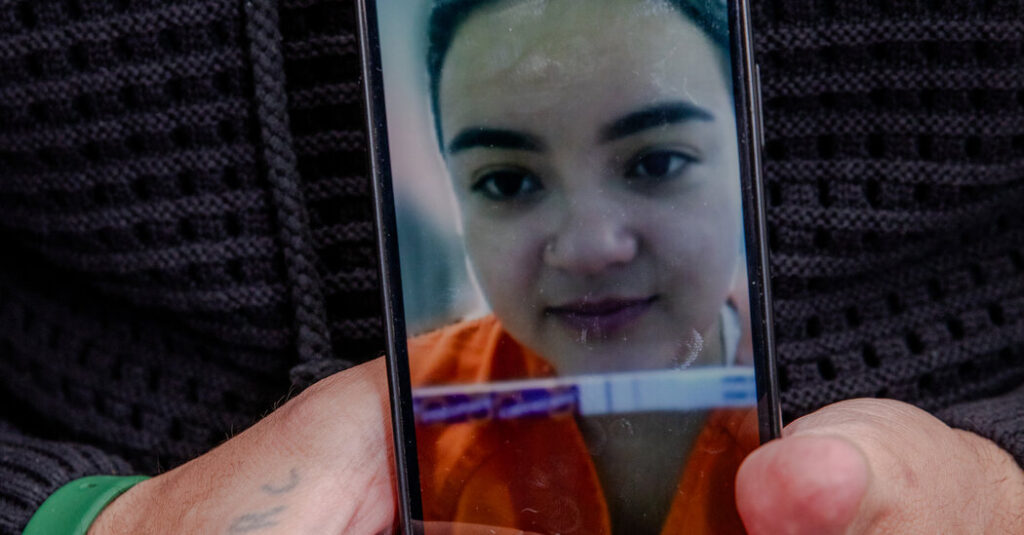
Candy Castillo Collantes was six months pregnant when she stepped inside the giant tent where she would live for the next 47 days.
Her enclosure at the South Texas detention center held dozens of bunk beds, she said, with one tiny slit for a window. Women wailed late into the night for their husbands and children. When Ms. Collantes experienced vaginal bleeding and asked for medical care at the facility, she and her lawyer said, she was offered only water, prenatal vitamins and a temperature check.
“It’s not a center that we know has a doctor,” Ms. Collantes, a 38-year-old Venezuelan who obtained temporary legal status under the Biden administration, said in an interview from the facility in late February. “The people here can’t tell you that everything is fine.”
Ms. Collantes had heard from other detainees about a woman who had gone into labor at their detention center months earlier.
She was terrified that she could be next.
Pregnant women who have been swept up in President Trump’s immigration crackdown have been held in detention centers as late as eight months into their pregnancies without adequate food or medical care, according to a New York Times examination of 10 cases. The Times review found that, in those cases, the Department of Homeland Security violated longstanding agency guidelines for how to treat pregnant women in detention, subjecting them to conditions that medical experts say can jeopardize the health of mothers and their babies.
Pregnant women said they were served food covered in cockroaches and water that tasted like bleach. They described how Immigration and Customs Enforcement agents shackled their hands and feet, refusing to believe that they were pregnant until a bump appeared. One woman said ICE agents ignored her as she lay on the floor screaming in pain, and took her to the emergency room only after her fellow inmates began banging on the door for help.
This account is based on interviews with pregnant women either currently detained or recently released, as well as an analysis of court filings, government documents and medical records.
The Biden administration instituted a policy under which pregnant women could only be detained in “exceptional circumstances,” such as when a person poses a national security threat or an “imminent risk of death, violence, or physical harm” to someone. While Trump administration officials have offered conflicting opinions in court on whether that policy remains in effect, Lauren Bis, a Department of Homeland Security spokeswoman, said in a statement to The Times that it still stands.
Ms. Bis also said that pregnancy in ICE detention is “exceedingly rare,” comprising 0.18 percent of all undocumented immigrants in custody. That comes out to about 126 women, according to recent estimates of the number of people in detention. Ms. Bis added that no women had given birth in ICE custody under the Trump administration and that the medical care provided to women in detention was “the best health care many of these individuals have received in their entire lives.” She said that clean and bottled water was provided for detainees.
“Pregnant women receive regular prenatal visits, mental health services, nutritional support and accommodations aligned with community standards of care,” Ms. Bis said in a statement.
Abigail Jackson, a White House spokeswoman, said that ICE detention facilities were “safe” and “clean,” and had the “highest standards.”
The issue of pregnant women in detention has galvanized an unlikely coalition of advocates, including antiabortion leaders eager to protect undocumented pregnant women and their babies.
“I don’t think we should have the detaining of pregnant women, period,” said Lila Rose, the founder and president of the national antiabortion group Live Action. Ms. Rose recently signed an open letter to Mr. Trump urging the administration to enforce the Biden-era guidance. “It’s only putting lives that are already vulnerable in a more vulnerable position,” she added.
Of the cases examined by The Times, some pregnant women were deported, while others were temporarily released in the United States before they delivered their babies. Some remain in detention.
“It is alarming to hear how these women are being treated,” said Eunice Cho, a former senior counsel at the American Civil Liberties Union who coauthored a report last October that documented over a dozen cases of pregnant women in detention, none of which overlapped with the cases examined by The Times. “When people inform agents that they are pregnant, it’s not really being taken into consideration.”
In Texas, Ms. Collantes was detained at Camp East Montana, a makeshift 5,000-bed tent facility opened over the summer to accommodate the surge of immigrants under arrest. A group of congressional Democrats last month called for the site’s permanent closure, citing “inadequate medical care” amid an outbreak of measles there.
Ms. Bis, the Department of Homeland Security spokeswoman, said Ms. Collantes underwent a medical evaluation immediately upon arriving at the detention center, and never reported any bleeding to medical staff members.
Ms. Collantes said she felt isolated and terrified, unable to access the care she felt she needed.
“If you feel unwell, they say, ‘Well, it’s normal because you’re pregnant,” Ms. Collantes said in late February, fearful that she might go into early labor while living in a tent. “‘If you feel unwell, drink water.’”
Four days later, Ms. Collantes was rushed to the hospital.
Months Spent Waiting for Medical Care
From the moment they were arrested, women interviewed by The Times said, ICE agents appeared unconcerned with the fact that they were pregnant.
In five cases identified by The Times, ICE agents cuffed a pregnant woman’s hands and ankles, even after learning about their pregnancies, according to the women, their lawyers, their family members and legal briefs. Two said the agents wrapped chains around their bellies, refusing to remove them even after one woman began bleeding on the airplane bound for a detention center.
When ICE agents arrested Djeniffer Benvinda Semedo, 22, in the Boston area last month, she said they put her in handcuffs and chains and pushed her into a van, without providing a warrant or telling her where she was going.
“I told them, ‘You don’t have to do this. I’m pregnant and it hurts. My belly is big,’” said Ms. Semedo, who was between five and six months pregnant at the time. “They just said, ‘We have to do this.’”
Pregnant women are supposed to receive special care in ICE detention, according to national detention standards published by the Department of Homeland Security, robust guidance that dates back to the early 2000s.
The standards prohibit the use of handcuffs or other restraints on pregnant women “absent truly extraordinary circumstances that render restraints absolutely necessary.” In its written statement, D.H.S. maintained that ICE complied with these standards, saying that a pregnant detainee would only be restrained “in the exceedingly rare situation where doing so would protect the life and safety of the detainee.”
The national Department of Homeland Security standards also require pregnant women to receive “close medical supervision” and “access to prenatal and specialized care.”
Most women interviewed for this article said that while in ICE detention, they received little or no prenatal care — a regimen to facilitate a healthy pregnancy that is supposed to include regular medical checkups, tests and ultrasounds.
While ICE is responsible for overseeing the medical care provided at all of its detention centers, many are operated by private contractors, which sometimes hire other companies to handle medical services. Acquisition Logistics, a small Virginia-based company, received roughly $1.2 billion from the federal government last year to operate Camp East Montana, where Ms. Collantes was detained. (Acquisition Logistics did not respond to a request for comment.)
Women interviewed for this article who did see a doctor while in detention either received that care at a hospital during a medical emergency, or reported waiting months for detention personnel to arrange an appointment.
Amanda Fanego Cardoso, 22, was several months pregnant when she was detained by ICE in Florida last fall following a shoplifting arrest. When Ms. Cardoso asked to see a doctor immediately upon arriving at the Otero County Processing Center in New Mexico, she said, detention center staff members promised that they would soon make her an appointment. But then another month passed, and another.
When she finally saw a doctor last December — almost six months pregnant — she said she learned that she had gestational diabetes and pre-eclampsia, both serious health conditions that classify a pregnancy as high risk. After that initial visit, Ms. Cardoso said, she was taken to a medical facility for a checkup every few weeks.
“I was scared,” said Ms. Cardoso, who was granted temporary parole after coming into the United States from Cuba in 2023. “I thought I was going to have some kind of problem because of so many months without attention. You just don’t know what’s going on.”
Ms. Cardoso was released in February, at 33 weeks pregnant. Her lawyer, Sam Badawi, had by that point filed several emergency motions citing the “grave physical and emotional harm” that would result from continued detention in the final stages of her pregnancy.
Ms. Bis at the Department of Homeland Security said Ms. Cardoso was “prescribed a daily prenatal vitamin and referred to an off-site OB/GYN, who saw and treated her regularly until she was released.”
Some women said they struggled to get the attention of ICE agents even in acute medical emergencies.
Last spring, Iris Dayana Monterroso Lémus had a miscarriage almost six months into her pregnancy while detained at the Richwood Correctional Center in Monroe, La., records show. Ms. Monterroso Lémus, whose miscarriage received widespread media attention at the time, came into the United States illegally from Guatemala in 2018 and had been arrested on charges of child abuse, neglect or endangerment in Tennessee. She also had a warrant for homicide in Guatemala, which, according to a document surfaced by The Daily Beast, was dismissed last May.
Government documents reviewed by The Times show that Ms. Monterroso Lémus raised alarms about her health almost one month before her miscarriage. She reported what felt like contractions, stomach pain and 21 pounds of weight loss, and asked for an ultrasound to check on her baby, according to the documents.
There is no indication in the records reviewed by The Times that Ms. Monterroso Lémus received medical services between the time she made that report and when she was taken to a nearby hospital to receive treatment for the miscarriage. In the records from the hospital, a doctor noted that Ms. Monterroso Lémus told detention center staff members that her pregnancy “didn’t feel right” for a few days before she arrived at the hospital, but that “nothing was done.”
Also around six months pregnant, Ms. Semedo spent three days last month in a holding cell with no beds at an ICE office in Burlington, Mass. At 2 a.m. on her third night in the facility, Ms. Semedo said she felt abdominal pain so intense that she started screaming and crying on the holding room floor.
The ICE agents, she said, “were sitting right there, watching TV” for about 10 minutes before they came to check on her. When an officer eventually appeared, she said, he surveyed the room and asked, “Which one of you needs help?”
“He could see me. I was literally lying down on the floor in front of him,” said Ms. Semedo. “It was just terrifying.”
Ms. Bis at the Department of Homeland Security said that ICE officers took Ms. Semedo to the hospital “immediately after she complained of upper abdominal pain.”
Ms. Semedo came into the country at age 13 from Cape Verde with her mother as a conditional permanent resident, according to her lawyer. By the time Ms. Semedo was arrested for not appearing in court for a domestic violence charge, her status as a permanent resident had been terminated without her knowledge, Ms. Semedo said.
While still in detention, Ms. Semedo was hospitalized for several days with gallstones and a possible obstruction in her bile duct that could have increased her risk of infection, according to a legal brief prepared by Blair Johnson Wylie, the chair of the Obstetrics and Gynecology department at the hospital where Ms. Semedo was treated. She also had electrolyte deficiencies, Dr. Wylie said, which could have been caused by her diet in detention, where Ms. Semedo said she was offered only microwavable macaroni and cheese for breakfast, lunch and dinner.
Ms. Semedo’s detention at an ICE facility put her “at higher risk of preterm labor,” Dr. Wylie wrote.
“Prenatal care is critical throughout pregnancy,” the doctor added, “and specifically when a patient experiences complications.”
‘What Will Become Of Me?’
Several months after she arrived at the South Louisiana ICE Processing Center last December, 29-year-old Ely Yohana Lopera learned that she could be deported to Ecuador — a country she had never been to — months before she was due to give birth.
“We don’t know Ecuador, nor do we know anyone in Ecuador,” said Ms. Lopera’s husband, Robinson Carvajal. His wife had sought asylum four years ago when she came to the United States from Colombia.
“She has no idea what would happen there — with the baby, or with her,” he said.
Ms. Bis at D.H.S. said Ms. Lopera had received regular medical checkups and that “she has not made any complaints or concerns regarding the pregnancy.”
Ms. Cardoso was also informed while in detention in New Mexico that she would be deported to Ecuador.
“I thought, I have no one there. I have nothing,” said Ms. Cardoso, who has been temporarily released from detention but could still be deported. “If I have my baby in Ecuador, what will become of me? Where am I going to live? Where are they going to leave me? What am I going to do? How am I going to get medical care?”
In a statement, the Department of Homeland Security said that “no pregnant women have been threatened with removal to a third country,” and that “any illegal alien is subject to third-country removal if they cannot be removed to their home country.”
Women in ICE detention have been deported well into their third trimesters. In one case last spring, ICE agents tried to deport a Mexican woman with a high-risk pregnancy on an ICE plane when she was about eight months pregnant, according to the woman, who spoke on the condition of anonymity because of fear of retribution from the U.S. government.
When officials on that flight turned her away, saying she was too far into her pregnancy to fly, ICE agents returned her to the detention facility, she and her lawyer, Helen Vargas-Crebas, said.
The woman was “in the final stages of a high-risk pregnancy,” Ms. Vargas-Crebas wrote in an email to several ICE officials on May 19, 2025, asking for her client to be released from ICE custody. “We are gravely concerned that she may give birth while in detention, which poses significant risks to both her health and that of her unborn child.”
The woman, who Ms. Vargas-Crebas said had an order of removal at the time, said ICE agents pressured her to sign a release that would have allowed her to board a commercial flight at such a late stage in her pregnancy.
Terrified, she said, she decided to sign the release and board the plane — arriving in Mexico before she gave birth.
In South Texas, Ms. Collantes, the woman who feared giving birth in detention, left Camp East Montana on Feb. 25, bound for a nearby hospital.
Officials at the detention center had agreed to take her in, she said, after she spent the day vomiting, with a high fever. By the time she got to the hospital, she said, she was one centimeter dilated, a possible sign she could be starting to progress toward preterm labor.
Ms. Collantes did not have her baby that day. Amid her pregnancy complications, immigration agents agreed to release her, said one of her lawyers, Iris Ramos.
Around the time she is due to give birth, Ms. Collantes is scheduled to return to court for a hearing on her immigration status. The judge could grant her application for asylum, Ms. Ramos said — or order her to be deported.
“She is still in removal proceedings,” Ms. Ramos said. “Being released doesn’t mean she is out of the woods.”
Miriam Castillo, Campbell Robertson and Brent McDonald contributed reporting. Kitty Bennett and Julie Tate contributed research.
Caroline Kitchener is a Times reporter, writing about the American family.
The post Handcuffs, Tents and Pleas for Medical Care: Pregnant in ICE Detention appeared first on New York Times.