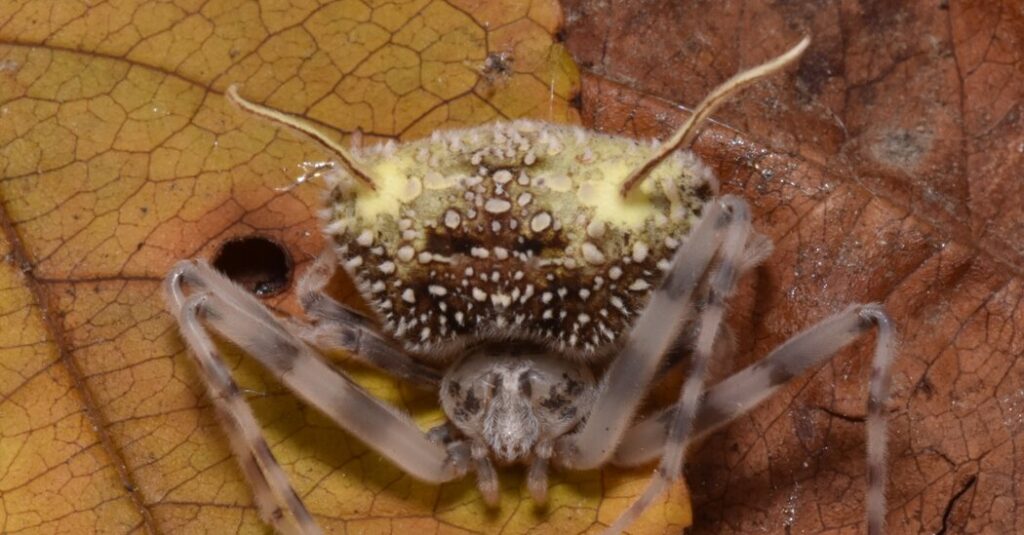
Alexander Bentley, a herpetologist, often leads regular tour groups through a stretch of the Amazon rainforest in Ecuador. He spots lizards, vipers and frogs, and he especially enjoys pointing out cordyceps — a parasitic fungi that kills its insect hosts and is the inspiration for the postapocalyptic franchise “The Last of Us.”
But on a rainy night last August, he found something he had never seen before. After flipping a leaf to show his group some cordyceps, he poked the fungal growth — the hairy, yellowish tendril-like stalks that are usually a sign that the cordyceps has killed its host.
The fungal mass suddenly moved. Mr. Bentley was shocked: Had he found a cordyceps that figured out how to force its host to move around after its tendrils had pierced through the creature’s exoskeleton?
Mr. Bentley, a founder of Waska Amazonía, a conservation foundation, collected the specimen and posted his discovery to iNaturalist, a citizen-science platform. The site’s users said that it was not a fungus, but a spider pretending to be infected by one. The fungus the spider was mimicking was gibellula — a genus of parasitic fungi that belongs to the same family as cordyceps.
Users on iNaturalist helped identify the spider’s group, which was a rarely seen genus known as Taczanowskia. Mr. Bentley’s colleague, David Ricardo Díaz-Guevara, an arachnid curator at the National Institute of Biodiversity in Ecuador, studied the specimen and was “stunned” to identify the spider as a new species: Taczanowskia waska.
The two, along with Nadine Dupérré of the Museum of Nature Hamburg, published their findings in the journal Zootaxa last month.
Parasitic fungi depend on invertebrates to spread their reproductive units, known as spores. Their life cycle starts when spores land on a creature, such as a spider, and begin to grow inside it. The fungi can digest the creature’s insides, interfere with its nervous system and manipulate its behavior to facilitate spore dispersal, eventually killing the host. This is why they are compared with zombies.
To further study the spider, Dr. Díaz-Guevara took it to a lab to observe its behavior, hunting patterns and movement. He then examined the spider’s organs and structures. But the fungal mimicry was “without a doubt super crazy and very surprising,” he said. The spider imitates the fruiting body of the fungus — the hornlike structures on its abdomen — by having abdominal prolongations on its own body.
Dr. Díaz-Guevara said that effectively, “over time, a spider has evolved to realize that if it mimics something that is dead, the chances of being hunted are low.”
After scouring photos taken by citizen scientists, researchers found spiders with fungal mimicry all over the world. All the spiders belonged to the same family, Araneidae. The family is also known as orb-weavers because of the creatures’ ability to build conspicuous, wheel-shaped webs.
But Taczanowskia spiders do not build foraging webs. Instead, they hunt by ambushing their prey and grabbing them in the air with their front legs. This group of spiders are difficult to find in the field. According to the World Spider Catalog, there are eight described species of Taczanowskia.
Individual creatures from the genus have rarely been spotted since it was first described in 1879. Little is known about their role within an ecosystem and their behavior. All but one specimen have been females. Males in this genus tend to be much smaller than females — some as tiny as a third of an inch.
Gustavo Hormiga, a spider researcher at George Washington University who was not involved with the discovery, said the new spider’s similarity to the pathogenic fungus was “striking.”
Not looking like a spider is possibly an advantage, he said, “Especially if you look like a fungus that nobody is particularly interested or attracted to.” To allow its prey to get close before attacking, the spider might also be mimicking female pheromones that attract a male insect.
“This study gives you a great example of mimicry in a spider group that is very poorly understood, very poorly represented in collections, with very few specimens of each species,” Dr. Hormiga said. It also shows how much there is to discover about spiders, he added.
There are about 53,000 known species of spiders in the World Spider Catalog. Some scientists estimate that another 50,000 to 100,000 species remain to be discovered. They play an essential role in ecosystems by eating and regulating insect populations.
Many outcast critters are often seen as “creepy and gross,” Mr. Bentley said, but they still capture people’s attention.
Sometimes “this creepy, gross thing is totally new to science,” he said, “and so that is, in its own right, respectable.”
Alexa Robles-Gil is a science reporter and a member of the 2025-26 Times Fellowship class, a program for journalists early in their careers.
The post ‘The Last of Us’ on Eight Legs appeared first on New York Times.