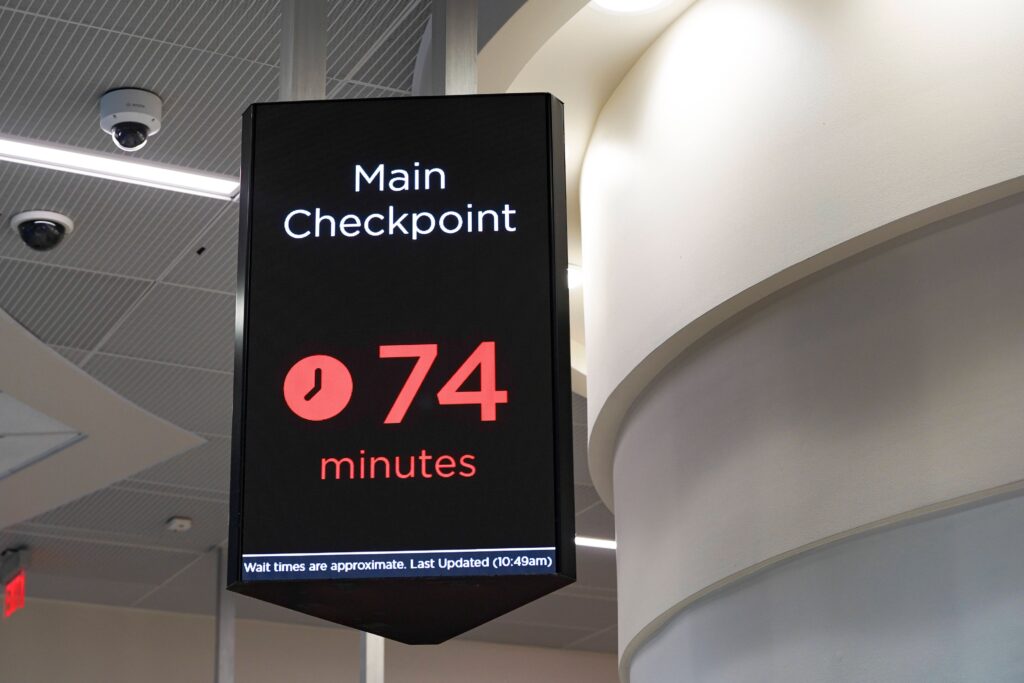
Passengers are waiting in long lines at airports across the country because security screeners are going unpaid and not showing up to work. They’re going unpaid because politicians in Washington disagree about immigration policy. It makes no sense, but fortunately there’s a way to prevent this from ever happening again.
Currently 20 American airports use private contractors, not the Transportation Security Administration, to screen passengers. And those private contractors still get paid regardless of whether Congress passes legislation on time.
The federal government’s Screening Partnership Program (SPP) allows airports to apply to use qualified private companies for passenger screening, rather than relying on unionized federal employees. TSA still gets to set all the regulations and standards for the private screeners. The agency just doesn’t do the screening itself.
This is a much better way to do airport security. A government agency regulating itself creates conflicts of interest. International Civil Aviation Organization standards say that security providers and regulators should be independent.
Major countries around the world follow this best practice. Canada, Britain, Germany, France and Spain use private contractors for passenger screening. Even in other countries where the government is the provider, it’s rarely a national bureaucratic agency doing the screenings.
While most of the 20 airports with private screeners are small, one is San Francisco International Airport. Checkpoints have been running smoothly at the major hub.
Another is Kansas City International Airport. “Our screeners are still getting paid,” a Kansas City Aviation Department spokesman told local media. “They’re still working what their expected shifts are.”
That’s better for the workers and the passengers. It’s absurd to expect screeners to go without paychecks, even if they get back pay after the shutdown inevitably ends. It’s even more absurd to tie their income to whether Democrats and Republicans in Congress can get along.
The SPP is a step in the right direction, but it still puts control of the contracts in the federal government’s hands. It would be better to turn the September 11 Security Fee that passengers already pay, which goes to federal coffers, into a user fee that goes directly to the airport. Each location would then be responsible for contracting its own security.
Airports already do this for every aspect of security besides passenger screening. They rely on local law enforcement, their own police departments and private contractors to secure airfields and terminal buildings. Those tasks are just as vital to ensuring the security of the skies, and they clearly don’t need to be performed by federal employees.
Having a government monopoly in charge of passenger screening subjects air travelers to political dysfunction in a completely unnecessary way. Airports are high-value infrastructure assets that should continue to operate smoothly even when Congress does not.
The post The airports without long security lines appeared first on Washington Post.