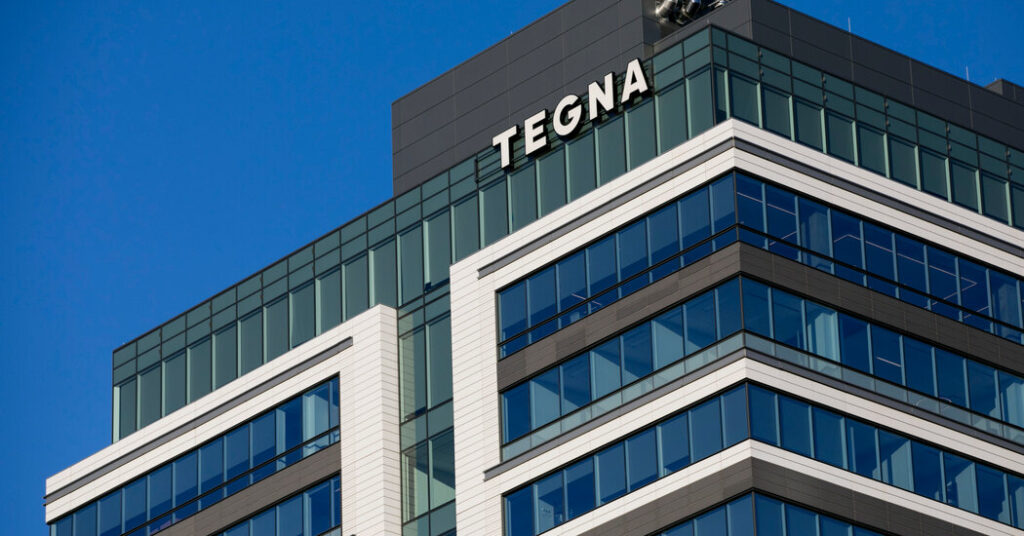
The Federal Communications Commission said on Thursday that it had approved the local television giant Nexstar’s $6.2 billion acquisition of a rival TV company, Tegna, saying the deal will help counter the growing power that national programmers have amassed in recent years.
Nexstar and its partners will now oversee 265 television stations in 44 states and Washington, reaching about 80 percent of U.S. households and cementing the company’s position as the largest owner of local television stations in the United States.
Nexstar drew national attention in September after Disney, the owner of ABC, suspended Jimmy Kimmel’s late-night show because of on-air remarks that the comedian had made about the Trump administration’s response to the killing of the conservative activist Charlie Kirk. When the nearly weeklong suspension ended, Nexstar, which owns dozens of ABC stations, continued to pre-empt the show with other programming for another week, effectively preventing it from airing in large parts of the country.
The Nexstar boycott occurred as the F.C.C. was reviewing the merger with Tegna, which was created in 2015 when the newspaper giant Gannett spun off its TV stations into a separate company. At the time of the suspension, Brendan Carr, the chairman of the F.C.C., said local television stations — and not national programmers — had an obligation to meet the needs of their communities.
Mr. Carr reiterated those comments in announcing the approval of the deal.
“The F.C.C. has been focused on empowering broadcast TV stations to serve their local communities, consistent with their public interest obligations,” he said in a statement. “Today’s agency decision does exactly that.”
Critics have argued that fewer station owners make for a less competitive market for viewers and advertisers. Other opponents have said consolidation in local broadcasting gives station owners more influence over programming.
Anna M. Gomez, the lone Democrat on the three-member commission, criticized the decision.
“This merger was approved behind closed doors with no open process, no full commission vote and no transparency for the consumers and communities who will bear the consequences,” she said. She called the approval “a quiet sign-off meant to avoid public scrutiny.”
On Wednesday, eight Democratic attorneys general from states including California, New York, Colorado and Virginia filed a lawsuit to block the transaction. The deal “consolidates ownership of many popular local television stations that currently compete against each other, likely resulting in significant harm to competition,” the states said in the complaint.
The F.C.C. said that Nexstar would own fewer than 15 percent of television stations, and that the deal would ensure that broadcasters had the resources to continue investing in their local news operations. The commission added that Nexstar had committed to divesting six TV stations.
Perry Sook, the chief executive of Nexstar, said on Thursday that the company, which is based in Irving, Texas, had closed the transaction after receiving approval from the F.C.C. and the Department of Justice. In a statement, he thanked Mr. Carr and President Trump, who initially opposed the deal before changing his mind.
“By bringing these two outstanding companies together, Nexstar will be a stronger, more dynamic enterprise — better positioned to deliver exceptional journalism and local programming with enhanced assets, capabilities and talent,” Mr. Sook said.
Daisuke Wakabayashi is an Asia business correspondent for The Times based in Seoul, covering economic, corporate and geopolitical stories from the region.
The post F.C.C. Approves Nexstar’s Acquisition of a Local TV Rival appeared first on New York Times.