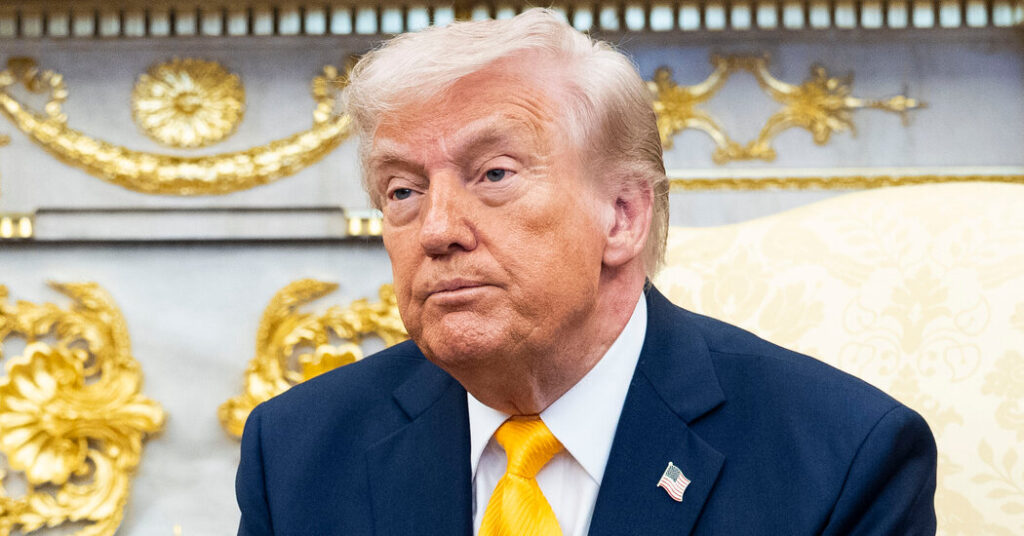
President Trump said on Thursday that he had complained to Prime Minister Benjamin Netanyahu of Israel about the bombing of one of Iran’s largest offshore gas fields, exposing the sharply different strategies by the United States and Israel as they try to collapse the Iranian government.
Asked about the Israeli strike, which sent oil markets reeling, Mr. Trump said, “I told him don’t do that,” and he suggested that Mr. Netanyahu “won’t do that” again in the future.
“We’re independent, we get along great,” said Mr. Trump, who spoke to reporters as he welcomed Japan’s prime minister, Sanae Takaichi, in the Oval Office. He insisted that the U.S. and Israeli approaches were “coordinated.”
Three Israeli officials briefed on the strike on the gas field said that the United States was informed before the attack.
But in a war that is about to complete its third week with no end in sight, the attack and the furious counterstrikes on the energy facilities of Persian Gulf states revealed that the two allies were clearly not coordinated in their approach.
European officials, speaking on the condition of anonymity, said that it was clear to them by the military operations in the past few days that Israel believed that if it dismantled Iran’s main sources of revenue, the country’s surviving leaders would relent and surrender — what the Israelis call “state collapse.” The European view is that the result will be the opposite: Iran will escalate, using its drones and surviving missiles to destroy the vulnerable infrastructure of its neighbors, even if it amounts to a suicide mission.
Israel has been targeting the Iranian leadership, and with the attack on the South Pars gas field — a vast natural gas field in the Gulf run jointly by Iran and Qatar — it was striking directly at Iran’s ability to generate revenue.
In contrast, Mr. Trump has been trying to preserve Iran’s oil and gas infrastructure and keep the country from retaliating at energy facilities throughout the Gulf. With every piece of evidence that the war is escalating, the price of oil increases, and Mr. Trump’s aides are scrambling to contain the economic ripple effects, starting with oil prices.
Treasury Secretary Scott Bessent said that to calm the markets, the United States was thinking about releasing more from the Strategic Oil Reserve, which the administration had failed to refill to capacity in the run-up to the war. But more strikingly, he has discussed suspending sanctions on Iranian oil already at sea — in an effort to free up roughly 140 million barrels — as another way to tamp down prices.
That would, of course, bring more revenue to Iran, but Mr. Bessent insisted that “we will be using the Iranian barrels against the Iranians to keep the price down for the next 10 or 14 days, as we continue this campaign.”
At every moment, Mr. Trump and Mr. Bessent are trying to signal to the markets that they have everything under control, even amid evidence that their effort to contain Iran’s retaliation — and the markets’ response — is failing. Mr. Trump tried to characterize his conversations with Mr. Netanyahu as a modest difference of opinion. “On occasion, he’ll do something,” Mr. Trump told reporters on Thursday, “and if I don’t like it, and so we’re not doing that anymore.”
In their public explanations of the status of the war, Defense Secretary Pete Hegseth and Gen. Dan Caine, the chairman of the Joint Chiefs of Staff, contended anew on Thursday that the United States was hitting all of its targets. Mr. Hegseth stressed the attacks on Iran’s defense industrial sites, so that it cannot replace missiles, launchers and drones destroyed in what has been an aerial hide-and-seek operation.
They spoke about dropping 5,000-pound bonds earlier this week at a suspected missile storage site near the Strait of Hormuz, part of an effort to keep Iran from being able to harass shipping through the 21-mile-wide stretch that has become a bottleneck for oil and gas exports.
“To date we’ve struck over 7,000 targets across Iran and its military infrastructure,” Mr. Hegseth insisted, saying that Thursday would be “the largest strike package yet,” repeating his vow of “death and destruction from above.”
But the speed of the Iranian retaliation for the South Pars attack was evidence that the United States had not gained what military strategists call “escalation dominance,” the ability to keep an adversary from further escalating its response. And Mr. Hegseth repeated that he would provide no “definitive time frame” for declaring that it had achieved its objectives.
In Mr. Hegseth’s telling, the entire war is playing out according to plan. But evidence to the contrary abounds. The rush to find allies to patrol the strait — which so far has resulted in no takers — and the scramble to contain increases in energy prices suggests that the administration continues to be surprised at Iran’s ability to strike back. Its skillful asymmetric attacks are designed to drive prices up and stock markets down in the United States — metrics that get Mr. Trump’s attention.
Washington’s fear now is that the Gulf countries, which have shown considerable restraint in not responding to Iranian missile and drone attacks, will begin retaliating. On Wednesday, shortly after the Israeli attack on South Pars, part of the world’s largest offshore gas fields, two waves of incoming ballistic missiles were intercepted over Riyadh, the capital of Saudi Arabia, according to the Saudi Defense Ministry.
The kingdom’s foreign minister, Prince Faisal bin Farhan, warned that his government reserved the right “to take military actions if deemed necessary.”
“We will not shy away from protecting our country and our economic resources,” he said at a news conference early Thursday.
He would not say how long Saudi patience with attacks would stay in place. “Do they have a day, two, a week?” the prince asked. “I’m not going to telegraph that.”
He added that “what little trust” there was between the kingdom and Iran had “completely been shattered.” The countries re-established diplomatic relations in 2023.
David E. Sanger covers the Trump administration and a range of national security issues. He has been a Times journalist for more than four decades and has written four books on foreign policy and national security challenges.
The post Trump’s Reaction to Israeli Strike on Gas Field Exposes Divergent Strategies appeared first on New York Times.