To the Editor:
Re “Cesar Chavez Accused of Abusing Girls” (front page, March 19):
I am gutted by the news that Cesar Chavez groomed, abused, assaulted and raped women and girls as young as 12, according to their detailed accounts. And that even the great Dolores Huerta, the renowned labor activist, endured sexual abuse by him (followed by two pregnancies and births).
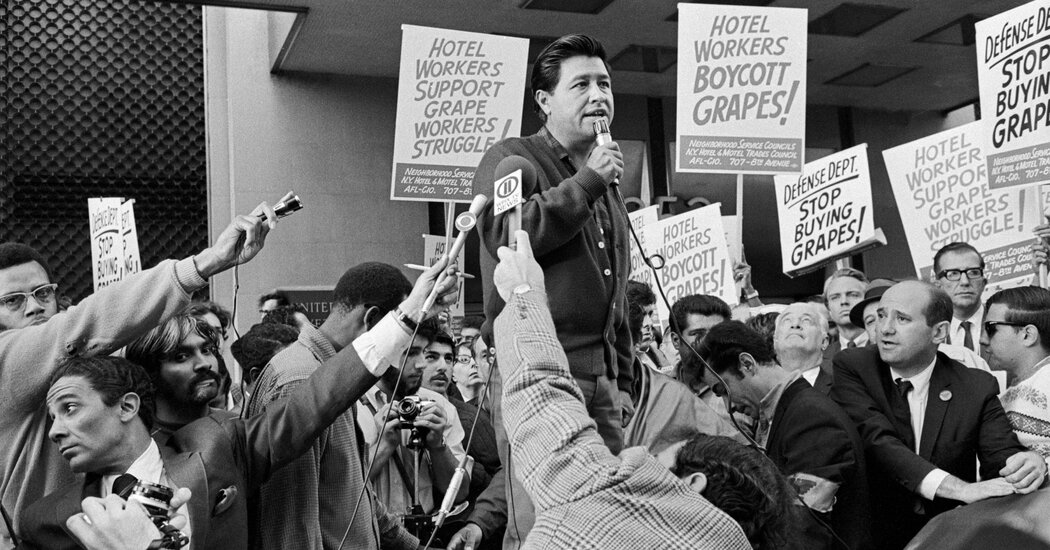
I went to Delano, Calif., as a young child with my father, Marvin Stender, when he did criminal defense work for Mr. Chavez and the nascent United Farm Workers union. My father appealed Mr. Chavez’s conviction (for something very minor, as I recall, like using a loudspeaker without a permit) and got it overturned.
Political activities such as marches, rallies, demonstrations and forming picket lines were family events in the 1960s and early 1970s, which helps to explain why these young girls were in Mr. Chavez’s orbit. We all believed in the United Farm Workers’ cause and looked up to people such as Mr. Chavez.
My childhood is littered with men we saw as heroes, most of whom turned out to be, as one of the young women said about Mr. Chavez, “just a man.”
Oriane Stender Brooklyn
To the Editor:
It is shocking and disappointing that someone as beloved as Cesar Chavez committed crimes — grooming and sexually abusing girls. While we are looking at him, though, let’s also look at the entire society that has allowed — and still allows — egregious acts like this to be all too common.
We keep adjudicating these crimes against women on a person-by-person basis, as if they are the transgressions of only certain individuals rather than societywide injustices, deeply embedded in patriarchal systems. Women have been wronged by the entire society, and still are.
Deb Slater Yellow Springs, Ohio
To the Editor:
The article detailing allegations against Cesar Chavez does a profound disservice to both the man and his legacy. While historical inquiry is valid, publishing such grave accusations against a man who has been dead for decades denies him the most fundamental right to defend himself. We are being asked to judge a complex historical figure solely through a 2026 lens, based on claims he can never refute.
Mr. Chavez dedicated his life to lifting the most marginalized members of our society, enduring immense personal sacrifice to secure dignity and justice for farmworkers. That legacy, which improved the lives of millions, should not be dismantled by unanswerable allegations. We must hold space for the truth that historical figures are imperfect, but we must also demand fairness.
Today, we are not hearing a defense; we are witnessing a verdict passed in absentia against a man whose real legacy is written in the humane conditions and collective bargaining rights farmworkers enjoy today.
Frank Aragon Los Angeles
To the Editor:
As the daughter of a Mexican immigrant who crossed the border at age 14 in 1942 to work in California’s fields, I grew up hearing about the hardship farmworkers endured. My father lived in tents with dirt floors provided by the farm owner and, in many ways, became an indentured servant — his wages barely covered the cost of shelter, food and basic necessities purchased from the same system that employed him. He worked long days in the heat, with little opportunity to get ahead.
I am sickened by the recent revelations about Cesar Chavez. The abuse of women and girls is inexcusable, and it is equally disturbing that so many may have known and failed to act. My heart breaks for those women.
At the same time, it is undeniable that Mr. Chavez played a role in improving conditions for farmworkers like my father in the years that followed. Both truths can and must coexist.
We should not ignore wrongdoing, no matter who commits it. But we also should not erase the broader history. The full story — both the good and the deeply troubling — deserves to be told.
Evette Cáceres Bruesehoff La Quinta, Calif.
To the Editor:
This is a story as old as the hills. Why is it that men who lead movements to promote equality and justice do not apply the same ethical rigor to their own lives? How do men work to improve working conditions and wages of all people, yet demean and prey on others? Why do so many powerful men have a sense of entitlement when it comes to women’s and girls’ bodies?
It’s so sad these young girls were so conditioned by society that they didn’t fully understand what was happening and how wrong it was, and they had nowhere to turn for help. Thank you for exposing predators, no matter their status. Cesar Chavez remains a labor hero, despite being a deeply flawed one.
Susan E. Anderson Chicago
To the Editor:
In light of Cesar Chavez’s sexually abusive behavior, why not rename Cesar Chavez Street in San Francisco after an obvious choice: Dolores Huerta?
Kevin Levine San Francisco
Kennedy and Vaccines
To the Editor:
Re “Judge Rejects Kennedy’s Limits for Child and Covid Vaccines” (front page, March 17):
The effects of a federal judge’s ruling against Health Secretary Robert F. Kennedy Jr.’s assault on evidence-based vaccine policies can’t be overstated.
Mr. Kennedy’s ideological crusade of misinformation against sound public health recommendations has already fueled dozens of outbreaks of measles, resulting in thousands of infections (most among children and teens) and at least three deaths, according to the Centers for Disease Control and Prevention. More than 90 percent of infections were in unvaccinated individuals.
Moreover, Mr. Kennedy and some of his advisers are pushing the concept of shared clinical decision making, suggesting that parents, in consultation with their doctor, should individually determine whether or not to vaccinate their children. But that paradigm misses the point of public health policies designed to protect the whole community from dangerous, highly contagious diseases that are preventable with safe and effective vaccines.
The fact that Mr. Kennedy, who runs the world’s largest and most powerful public health agency, fails to understand the difference between personal medical decisions that do not affect others and the government’s responsibility to safeguard the public’s health is appalling — and should be grounds for his dismissal.
Irwin Redlener New York The writer is a clinical professor of pediatrics at Albert Einstein College of Medicine and a senior adviser for the Institute for Global Politics at Columbia University.
Shielding Lawyers
To the Editor:
Re “Making Government Safe for Lawyers Who Lie,” by Deborah Pearlstein (Opinion guest essay, March 14):
Ms. Pearlstein’s powerful and persuasive depiction of the Trump administration’s efforts to protect its lawyers from sanctions for repeatedly lying in court is masterly.
American lawyers have historically been taught, and well understand, the difference between vigorously advocating on behalf of their clients and lying in order to do so. That sanctions are imposed upon lawyers who do the latter is a necessary element of a functioning legal system.
The Trump administration has determined that instead of ensuring that its lawyers comply with well-established norms — not to lie in the course of defending their clients — it will seek to avoid serious scrutiny of whether they have done so.
That says all we need to know about the administration’s own lack of rectitude.
Floyd Abrams New York The writer is a lawyer and the author of “The Soul of the First Amendment.”
The post A Shadow Cast Over Cesar Chavez appeared first on New York Times.