California lawmakers announced on Thursday that they intend to change the name of Cesar Chavez Day to “Farmworkers Day” in the wake of devastating accusations of sexual abuse by Mr. Chavez, an iconic labor leader who has been celebrated for decades in the state.
Twelve days before the annual March 31 state holiday, leaders of the California State Assembly and State Senate said they were introducing a bill to make that change. It came as elected officials across the Southwest were grappling with how to respond to a New York Times investigation that detailed how Mr. Chavez groomed and sexually abused two girls and raped Dolores Huerta, his most prominent farm labor ally.
“This moment calls for honesty, it calls for reflection, and it calls for a renewed commitment to the values that the farmworker movement was built on,” Assembly Speaker Robert Rivas said in an emotional floor speech on Thursday, recalling his grandfather’s history in the union that fought to improve pay and conditions for farmworkers.
Monique Limón, leader of the California State Senate, said that lawmakers were examining how to update other parts of state law, because the Cesar Chavez holiday is mentioned in a dozen different provisions, including educational requirements.
“We will move swiftly to make the changes,” she said in an interview.
Mr. Chavez, who co-founded the United Farm Workers and died in 1993 at age 66, has been hailed as a civil rights champion for decades. His status only seemed to build over time as governments and schools hailed him as a hero, holding celebrations and teaching lessons every March grounded in farmworker history and the fight for Latino equality in the United States.
So shocking were the revelations, however, that many state and local leaders raced on Wednesday to distance themselves from Mr. Chavez. The governors of Texas and Arizona almost immediately moved to cancel state observances of Cesar Chavez Day on March 31.
In Los Angeles, Mayor Karen Bass, joined by women serving on the City Council, signed a proclamation on Thursday to erase Mr. Chavez’s name and rename the holiday “Farm Workers Day” in the city, the mayor’s office said.
Los Angeles leaders also planned to move the annual holiday to the last Monday each March, untethering it from Mr. Chavez’s birthday. The California Legislature is keeping the holiday on March 31 for this year, while lawmakers consider other possibilities for future years.
In Dallas, City Council members are seeking a different change: renaming the holiday “Dolores Huerta Day” and moving it to April 10, her birthday.
The clock is ticking, given that Cesar Chavez Day is in only 12 days. Many elected officials said Wednesday they needed time to deliberate, saying they were still processing the allegations while they condemned the sexual abuse detailed in the Times investigation.
That included Gov. Gavin Newsom, a longtime friend of Ms. Huerta’s. During a news conference to discuss financial literacy at a Bay Area school library, Mr. Newsom said he would discuss with state legislators whether to rename the state holiday that had been observed since 2000, when California became the first state to recognize it as a paid day off.
“None of us knew,” Mr. Newsom said. “We need to reflect.”
Mr. Chavez was born to Mexican immigrants in 1927 near Yuma, Ariz., and later worked as a farm laborer in the Central Valley of California with his family. With two other activists, Ms. Huerta and Gilbert Padilla, he created the National Farm Workers Association, which later merged with another union to form the United Farm Workers. The workers drew national attention when they marched hundreds of miles to Sacramento to secure union recognition and higher wages.
In the decades since Mr. Chavez died, his status as a labor hero and Latino icon grew to outsize proportions, especially across the Southwest. His name and likeness have been attached to numerous streets, schools and parks nationwide. No state has recognized him more deeply than California, where nearly 50 schools are named for him, according to the state’s Department of Education.
But for some leaders in California, where Mr. Chavez rose to prominence after the farmworker movement began in the 1960s, the accusations of Mr. Chavez’s predatory behavior struck on a personal level. Those who remembered meeting and feeling inspired by Mr. Chavez’s leadership were trying to reconcile their early admiration for the man with the troubling allegations against him.
Antonio Villaraigosa, who in 2005 became the first Latino mayor of Los Angeles in modern history, recalled on Wednesday feeling inspired by what he called Mr. Chavez’s “quiet dignity and seeming selflessness” when, as a 15-year-old activist, he met the labor leader.
Still, Mr. Villaraigosa, a Democrat running for governor, called the allegations of sexual violence “shocking, painful and deeply troubling.” He added: “No individual, no matter how revered, is above accountability.”
While governments are likely to act soon to recast the upcoming Cesar Chavez holiday, renaming buildings, schools and programs could take months, if not years.
At the University of California, Berkeley, where the student center has celebrated Mr. Chavez since 1997, a committee of community members must first agree to rechristen a building. Then, the public needs an opportunity to provide feedback, followed by a recommendation to the school’s chancellor. Ultimately, the president of the U.C. system has the final say.
A University of California spokeswoman, Rachel Zaentz, said the 10-campus U.C. system was “deeply concerned about these troubling reports.” She added: “We stand firmly with survivors and are evaluating these findings internally. We will communicate updates when appropriate.”
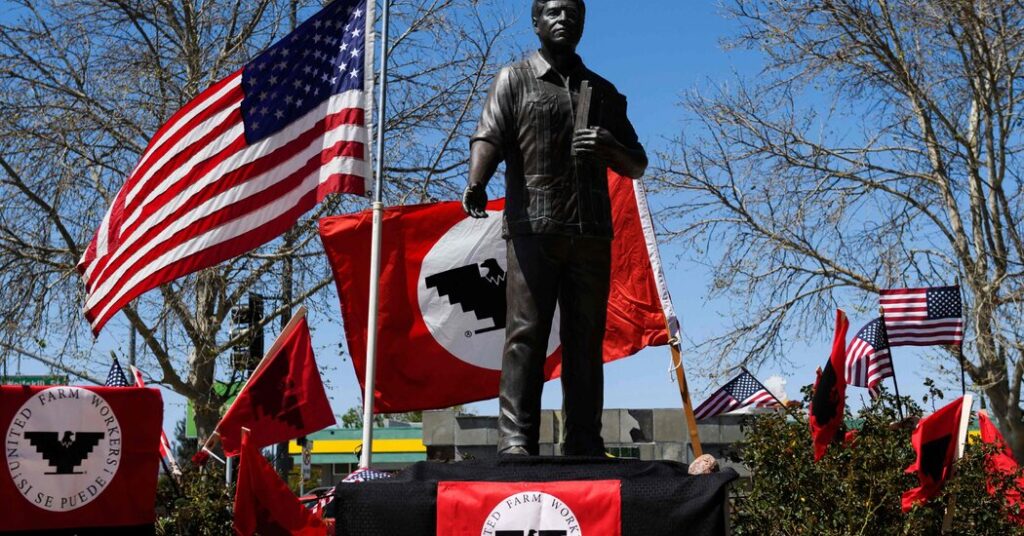
Other schools moved quickly to do what they could within their immediate control. At Fresno State University, a statue of Mr. Chavez was covered up, and the university’s president, Saúl Jiménez-Sandoval, said officials would “determine appropriate next steps for its removal.”
In Los Angeles County, Hilda Solis, the chair of the Los Angeles County Board of Supervisors and a former Obama administration official, said on Wednesday that she planned to ask her colleagues to explore renaming the holiday and to start a process for renaming parks, monuments and streets. She also wants to remove Mr. Chavez’s image from public artwork.
“Our responsibility is to center survivors, demand accountability and ensure that our public recognitions reflect our shared values,” said Ms. Solis, a close friend of Ms. Huerta’s.
In Sacramento, Mayor Kevin McCarty said he had begun the process of renaming Cesar Chavez Plaza, which sits across the street from City Hall. Elsewhere in the city, the California Museum board of trustees on Wednesday began the process of removing Mr. Chavez from the California Hall of Fame, where he had been enshrined in 2006 as part of the inaugural class.
The announcement came the night before Mr. Newsom and his wife, Jennifer Siebel Newsom, planned to induct the 19th Hall of Fame class on Thursday. Museum officials pointed out that Ms. Huerta remains a member of the seventh class and Larry Itliong, a Filipino American labor organizer, is a member of the 14th class.
Before the Times investigation was published, the Cesar Chavez Foundation and the U.F.W. released statements on Tuesday acknowledging the abuse allegations. Foundation officials said they were “deeply shocked and saddened” and working to support those who may have been harmed.
The U.F.W. said the organizations had established a channel “for those who wish to share their experiences of harm, to identify their current impacts and needs, and, if desired, to participate in a collective process to develop mechanisms for repair and accountability.”
The allegations could have legal and financial implications for the union.
Under California law, survivors of sexual abuse can file civil lawsuits until age 40 or within five years of discovering an emotional injury linked to the abuse. If the sexual abuse occurred after the survivor turned 18, a new state law now allows sex assault claims to be filed through Dec. 31, 2027. If the survivor was facing a physical or emotional threat, the statute of limitations must be paused until the threat goes away.
Soumya Karlamangla, Jill Cowan, Jennifer Medina, Heather Knight, Jesus Jiménez and Alan Blinder contributed reporting.
Laurel Rosenhall is a Sacramento-based reporter covering California politics and government for The Times.
The post California to Rename Chavez Holiday as ‘Farmworkers Day’ appeared first on New York Times.