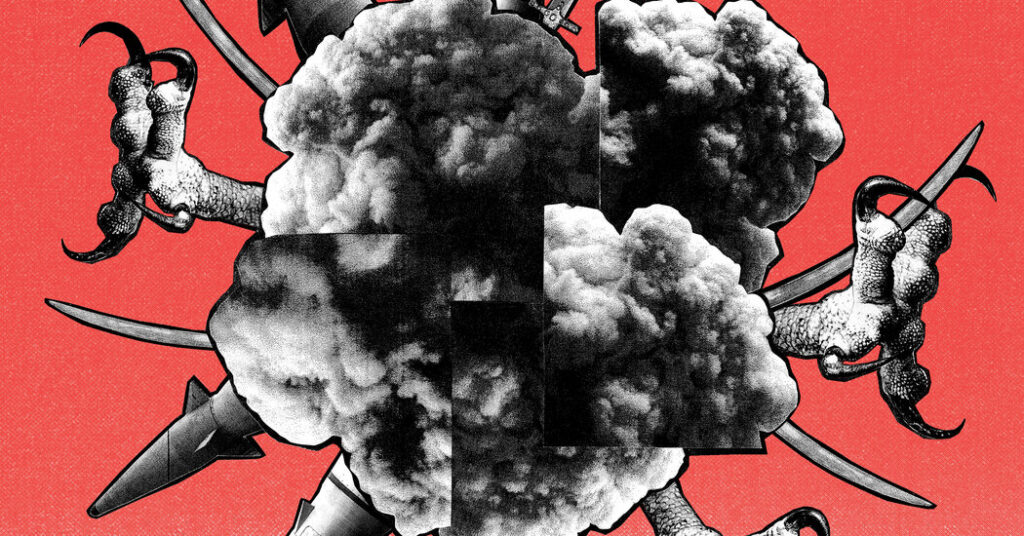
President Trump has created the conditions for another quagmire in the Middle East, and the question is whether American military excellence can rescue him from his own impulsiveness and incompetence.
Here is the present situation, in a nutshell: The United States and Israel have established absolute air dominance over the nation of Iran. In a few short days, our combined forces have destroyed Iran’s ability to protect its own airspace, have killed much of Iran’s senior military and civilian leadership, and have sunk much of Iran’s navy.
At the same time, the United States and Israel are damaging Iran’s nuclear program from the air, and they are destroying Iran’s ability to manufacture and deploy ballistic missiles. They are also attacking the internal security forces that maintain the Iranian regime’s hold on the population.
The intention of the air campaign is clear: to destroy the regime’s capacity to harm its neighbors while also creating the conditions for a revolution on the ground.
If that’s the extent of the military mission, the military is accomplishing it with remarkable efficiency. Iran is being badly battered. Even if the war ended today, it would take years for the Iranian military to fully recover from the losses it has suffered so far.
While Iran’s drones and missiles have inflicted damage on American forces and our allies, that damage is far less than what the U.S. and Israel have inflicted on Iran. There are no confirmed reports of Iran shooting down any American or Israeli aircraft (it has destroyed a number of drones), and it hasn’t yet sunk a single American or Israeli warship.
So why, then, is Trump lashing out at American allies? Why was he “shocked” that Iran struck Saudi Arabia, Qatar, the United Arab Emirates and Kuwait in response to American attacks?
Perhaps the answer lies in a Wall Street Journal report from last Friday. According to The Journal, Gen. Dan Caine, the chairman of the Joint Chiefs of Staff, warned Trump that Iran might attempt to close the Strait of Hormuz and Trump shrugged off the threat and launched the attack anyway.
“He told his team that Tehran would likely capitulate before closing the strait,” The Journal wrote, “and even if Iran tried, the U.S. military could handle it.”
But Iran did not capitulate. There is no real sign the regime is in danger of falling. Instead, it has effectively closed the strait, and it’s reportedly done so without choking off its own oil exports. In other words, while other nations can’t ship oil through the strait, Iran still is.
Iran may not be able to seriously damage Israel with its missiles (though a few missiles have gotten through Israel’s defenses and killed Israeli civilians), and it may not be able to sink American ships, but it can still potentially plunge the world economy into a state of crisis. It could well emerge from the conflict with its regime intact (and perhaps even more hard-line) and its power over the world economy undiminished.
In a recent post, the Institute for the Study of War described the problem well: “A weakened regime that remains in power after this war would be able to disrupt shipping whenever and for however long it pleases with little effort if its current, relatively limited, strike campaign on shipping proves sufficient to cause the U.S. and Israel to surrender.”
“A failure to demonstrate the will and ability to deny Iran the ability to disrupt traffic,” it wrote, “will make it enormously harder to deter Iran from future disruptions.”
That’s the logic that leads to a quagmire. If America declares victory now, when the Iranian regime is still in power and the strait is closed, then Iran perversely can claim that it won. It took a huge punch, absorbed the blow, and still forced America to climb down. It employed its ultimate weapon — closing the strait — and America had no effective answer.
Commit to opening the strait (and keeping it open) by force, and the U.S. may well find itself in yet another open-ended, costly conflict with at least some American soldiers on Iranian soil. This would be war on our enemy’s terms and terrain, with the potential of slowly but surely inflicting casualties and costs on the American military until we grow tired of the conflict and leave.
The only way to cut this Gordian knot is with a military miracle — a fast campaign with minimal casualties that can quickly reopen the strait, minimize harm to the international economy and leave Iran almost entirely toothless, unable to inflict military or economic damage on its foes.
Trump’s recklessness has left the United States with few good options. Indeed, the dilemma America now faces is a perfect illustration of why Trump should have taken his case for war to the Congress and the American people before he fired the first missile.
I’ve had friends ask me, “Well, if he didn’t think Congress would approve, what do you expect him to do? Sit on his hands?” The answer is simple: The Constitution doesn’t give the president the power to disregard Congress. So, no, don’t go to war if you can’t get Congress to approve.
And if a Republican president can’t get a Republican Congress to support his war, perhaps that provides even more reason to doubt the wisdom of the conflict.
Had he made the case for war, he could have prepared the people for potential economic hardship. He would have been forced to precisely define our war aims and the means he’d choose to pursue those aims. Had he not alienated key allies through economic warfare and threats to seize Greenland, it could have been easier to assemble, in advance, an allied force to protect the Strait of Hormuz.
Instead, Trump launched a major war on his own initiative while announcing competing and potentially contradictory war aims. Is the goal regime change? Unconditional surrender? Or is it much narrower — the destruction of Iran’s missile and drone forces, sinking its navy, stopping its nuclear program and destroying its ability to wage war through its proxy forces, including Hezbollah, Hamas, the Houthis and the kaleidoscope of allied militias in Syria and Iraq.
The Iranian regime, by contrast, has a single, simple theory of victory: Survive. If the regime is still standing at the end of the conflict, then Iran lives to fight again. And if it survives at least in part through closing the Strait of Hormuz, then it knows exactly how to fight again.
Even when wars are carefully planned, with allies brought on board and a majority of the public in support, they are still highly volatile and unpredictable. The best analysts in the world can be confounded by the way events actually unfold. For example, we are now in the fifth year of a war in Ukraine that many people expected would end in few days.
The best way to analyze events isn’t to ask, “Will this plan succeed?” but rather, “Have you created the conditions for success?” And, “Have you carefully considered what happens next?”
In the military context that can mean that your troops are well supplied, well trained, well led and acting according to a solid, achievable battle plan. You can still fail under those circumstances, but your chances of failure are far less.
My great concern is that Trump has created the conditions for failure. He has taken our well-supplied, well-trained and well-led troops and has deployed them on a mission that lacks clear public support (especially compared to previous American wars), lacks clearly defined objectives, and may not ultimately be achievable without a large-scale escalation.
And now, dismayed that the war has not resulted in the regime’s immediate capitulation or destruction, he’s flailing about, once again threatening the viability of NATO if our allies don’t come and bail him out from a war they did not start and did not ask for.
As an American, I want our forces to succeed, once they are committed. I want to see the military open the Strait of Hormuz as quickly and painlessly as possible. I want to see the Iranian regime collapse and replaced by a democracy. That regime is loathsome. It’s an enemy of the United States. It deserves to fall. If it does, I will cheer its demise.
At the same time, however, my patriotism can’t blind me to reality. This is not how our democracy should go to war. Trump is not the right man to lead our nation into battle. People I respect applaud Trump for his courage in taking on Iran. But I don’t see courage. I see recklessness. I see thoughtlessness.
I see a man who plunged a nation into a conflict without fully comprehending the risks. I see a man full of hubris after achieving success in much more limited military engagements. And he’s now counting on two of the world’s most competent militaries to essentially bail him out.
He’s counting on them accomplishing a mission without clear precedent in military history: destroying a hostile regime and forcing its compliance entirely from the air and sea, and to do so quickly enough that the economic pain doesn’t overshadow the military gains. Previous successful aerial campaigns, such as NATO’s campaigns in the Balkans and the allied campaign in Libya, were supplemented by local allied ground forces who could take and hold the land.
Or he can just declare “victory” and try to extricate the United States from the fight. He can point to the smoking ruins of the Iranian military and say that we’ve accomplished something substantial. We’ve “mowed the grass,” to use a term applied to Israeli counterterror operations before the Oct. 7 attacks by Hamas.
In other words, you may not have defeated the enemy, but you’ve hurt the enemy, and it will take years for it to recover. In fact, there are signs that the administration is moving to exactly that position. Its messaging has begun to slide from regime change and “unconditional surrender” to objectives that look a lot like mowing the grass — damaging the Iranian military enough that it will take considerable time to rebuild.
But Oct. 7 should have demonstrated to all of us that mowing the grass doesn’t make anyone safer. Instead it prolongs the conflict. It hardens the combatants. It plants the seeds for vengeance. Israel should know this now, and we should know it as well.
When Saddam Hussein faced a catastrophic defeat during Operation Desert Storm, he doubled down. He tried to kill George H.W. Bush, he supported the second intifada against Israel, his troops fired on American pilots. He harbored terrorists. Defeat did not make him any less of an enemy to the United States, and in 2003 we fought him again, in a much longer and bloodier war.
Trump has only himself to blame. He led America into an unconstitutional war. And now he’s compounding that sin by proving to be every bit as reckless a commander as he is a president.
Some other things I did
In my Sunday column I revisited one of the most polarizing topics I’ve addressed this year — the cultural, political and religious impact of James Talarico’s faith-forward, progressive campaign for Senate. Why does he trigger such outrage from the right?
American hatred is growing so great that partisans, perversely enough, often view kindness and tolerance from political opponents as a threat. The only good people are people who agree with them. The supposedly decent person on the other side? We have a name for him or her: a wolf in sheep’s clothing.
But we should appreciate people who treat us with kindness even when they disagree:
To call for decency doesn’t deny the depth of our disagreements. It does, however, acknowledge the essential humanity of our opponents. I keep thinking about the commitment card that Martin Luther King Jr. asked his followers to sign before they joined the 1963 Birmingham campaign.
The 10 directives included these admonitions: “Meditate daily on the teachings and life of Jesus,” “Remember always that the nonviolent movement seeks justice and reconciliation — not victory,” “Walk and talk in the manner of love, for God is love,” and “Refrain from the violence of fist, tongue or heart.”
Does anyone believe King was not dedicated enough to justice? Or that he was ineffective in his quest to transform American culture and politics? His love and regard for others — even as he fought desperately for civil and economic and political rights — were indispensable to his success. They’re what make reconciliation possible, even if we’re still far from perfect.
I disagree with Talarico on many things. But I also agree with his desire to reject politics as a blood sport. And unless we can remember — as King did, with his life perpetually on the line — to seek both justice and mercy, then we’ll be left with neither.
The post Trump Has Only Himself to Blame appeared first on New York Times.