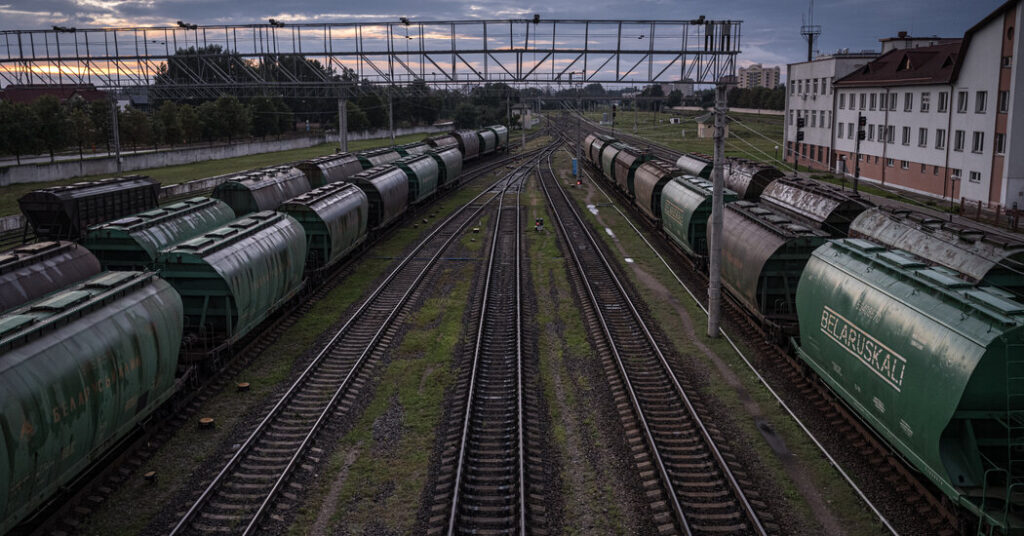
The United States on Thursday lifted sanctions on three Belarusian companies that produce a crucial ingredient in fertilizer, a major concession as the U.S.-Israeli war on Iran causes fertilizer prices to skyrocket and threatens farmers’ bottom lines.
The Trump administration made the move in exchange for Belarus’s freeing of 250 political prisoners, the latest such release amid a continuing thaw in relations between Washington and the authoritarian leadership in Minsk.
The three Belarusian companies sell up to one-fifth of the world’s supply of potash, a fertilizer ingredient crucial to global food security. The United States removed sanctions both on those companies — Belaruskali, Belarusian Potash Company and Agrorozkvit — and on the state investment bank. All are pillars of the Belarusian economy, and the lifting of sanctions hands the country an economic lifeline.
The American action followed a decision last week to suspend U.S. sanctions on some Russian oil, as the Trump administration tries to contain the economic fallout from the war engulfing the Middle East.
The Belarusian leader, Aleksandr G. Lukashenko, granted amnesty to the 250 prisoners as he seeks to normalize ties with the United States while also keeping tight relations with his closest ally, President Vladimir V. Putin of Russia.
President Trump’s envoy for Belarus, John Coale, visited Minsk to speak with Mr. Lukashenko about improving relations with its neighbor Lithuania, where some of the prisoners were resettled on Thursday. Ties between the two countries have reached a low over political and security concerns.
Mr. Coale told journalists that the Belarusian leader may soon visit the United States. Such a trip would be a breakthrough for Mr. Lukashenko, a strongman who has been in power for 32 years and who violently suppressed protests in 2020 after elections widely seen as falsified.
“Today’s release of 250 individuals is a significant humanitarian milestone and a testament to the President’s commitment to direct, hard-nosed diplomacy,” Mr. Coale wrote on social media. A photo with the post showed him with the 15 prisoners who left Belarus for Lithuania.
Mr. Coale said he and Mr. Lukashenko had also discussed the possibility of reopening the U.S. Embassy in Minsk. It was shuttered after Belarus’s decision to allow Russia to use Belarusian territory to invade Ukraine in 2022.
“We are discussing our bilateral relations, from restoring the normal functioning of the embassy to the release of so-called political prisoners,” Mr. Lukashenko told reporters in Minsk, while denying that Belarus has political prisoners.
The human rights group Viasna, whose Nobel Peace Prize-winning leader was freed from prison in December, counts 1,117 people currently imprisoned on political grounds in Belarus. Since 2020, Viasna has recognized 4,457 people in Belarus as political prisoners.
Mr. Lukashenko said that his country and the United States were negotiating over 10 subjects in all: “economic issues, sanctions — all of them together.”
Over the past two years, Washington has slowly but steadily reversed its policy of isolating Belarus diplomatically and economically. Since State Department envoys started re-engaging with Minsk late in the Biden administration, the country has freed more than 600 prisoners, according to the Coalition for the Release of Political Prisoners in Belarus, an advocacy group.
After the most recent meeting between Mr. Coale and Mr. Lukashenko, in mid-December, Minsk freed 123 people. Among them were the Nobel laureate Ales Bialiatski and prominent opposition figures including Maria Kalesnikava and Viktor Babariko.
In exchange, Washington announced a temporary suspension of sanctions on potash. Under the new action on Thursday, all potash sanctions were formally removed, Mr. Coale said.
Among those freed and taken to Lithuania on Thursday was the journalist Katsiaryna Andreyeva, who was arrested in 2020 as she and her colleagues ran a livestream of a protest against Mr. Lukashenko.
While already serving time, she was tried once more, in 2022, on charges of “state treason,” an accusation that Amnesty International called “bogus.” Her secret trial led to the addition of eight years to her sentence. Her husband, Igor Ilyash, who is also a journalist, was arrested in October 2024 and remains in jail.
“Behind every release are fates, families, years of waiting,” Ms. Kalesnikava, the opposition figure who was freed in December after more than five years in prison, said in an interview on Thursday. “Every one of these moments is not just news, it is a return to life, it is the saving of a life.”
Unlike in the previous prisoner releases, most of those freed this time — 235 in all — intend to remain in Belarus. Before now, prisoners have been driven to the border and taken into the custody of foreign countries, including Lithuania and Ukraine.
Many of those freed would prefer to stay in Belarus rather than start a new life abroad, sometimes because of ailing or disabled family members or because they are older themselves, said Evegenia Dolgaya, a Belarusian journalist in exile in Poland.
“Staying is always a risk,” Ms Dolgaya said. “They could face political repression again, but people understand this risk and accept it.”
Valerie Hopkins covers the war in Ukraine and how the conflict is changing Russia, Ukraine, Europe and the United States. She is based in Moscow.
The post U.S. Lifts Fertilizer Sanctions on Belarus as Iran War Causes Price Surge appeared first on New York Times.