I started covering climate change four years ago, after more than a decade reporting on corporate America, technology and media.
Joe Biden was president, and he signed into law the Inflation Reduction Act, the biggest-ever federal effort to promote clean power, just a few months after I joined the beat. The energy transition was underway, the financial sector was marshaling its resources to fund solar and wind projects, and there was a sense that efforts to reduce planet-warming emissions might succeed in slowing global warming.
That’s not the case anymore. An article I just published documents the rapidly intensifying effects of climate change, which have surprised many of the scientists who have spent their lives tracking these issues. They are now raising the alarm with increasingly dire language.
Seas are rising and glaciers are melting — and there’s also now a growing debate about whether the rate of planetary warming is actually speeding up. New research published this month found that even after accounting for other phenomena such as volcanic eruptions, solar radiation and natural variability, the rate of global warming has accelerated since 2015.
“The rate of warming is entirely unprecedented,” Katharine Hayhoe, chief scientist for the Nature Conservancy and a professor at Texas Tech University, told me. “We certainly have never had eight billion people on the planet when it ever happened before.”
Where are we headed?
Only recently, many climate scientists were revising some of their worst-case scenarios downward.
In the years after the 2015 Paris Agreement, nearly every country in the world pledged to reduce its emissions. Even China, still the largest polluter on Earth, embarked on an ambitious effort to replace fossil fuels with renewables.
As a result, a consensus emerged: While it might not be possible to limit global warming to 1.5 degrees Celsius above preindustrial levels, a goal that once served as a rallying cry for climate activists, holding the line at 2 degrees might be within reach. That scenario would mean dodging at least some of the worst effects of climate change.
Then, Donald Trump returned to the Oval Office. At home, the president has rolled back regulations designed to limit planet-warming emissions, stymied the growth of wind and solar power, and used federal resources to bolster the production of coal, oil and gas.
And overseas, the Trump administration has used booming U.S. natural gas exports as a bargaining tool, announced plans to take over Venezuela’s oil industry, and launched a war with Iran that has triggered an energy crisis and driven some countries to return to burning coal in the face of global market disruption.
While other countries, including China, continue to press ahead with efforts to reduce their use of fossil fuels, it is becoming increasingly clear that Trump’s policies will seriously hinder the world’s ability to slow the pace of planetary warming.
The long view
Climate change, it’s often said, is the ultimate long-term problem in a world focused on short-term crises.
For much of the 20th century, scientists warned that burning fossil fuels relentlessly would lead to an intense rise in global heat. But temperatures climbed only gradually at first, even though we use more fossil fuels each year. So many of the worst effects seemed distant and manageable.
Now, global warming is no longer a far-off problem. As I write in today’s article, a number of the planet’s systems are flashing warning signs.
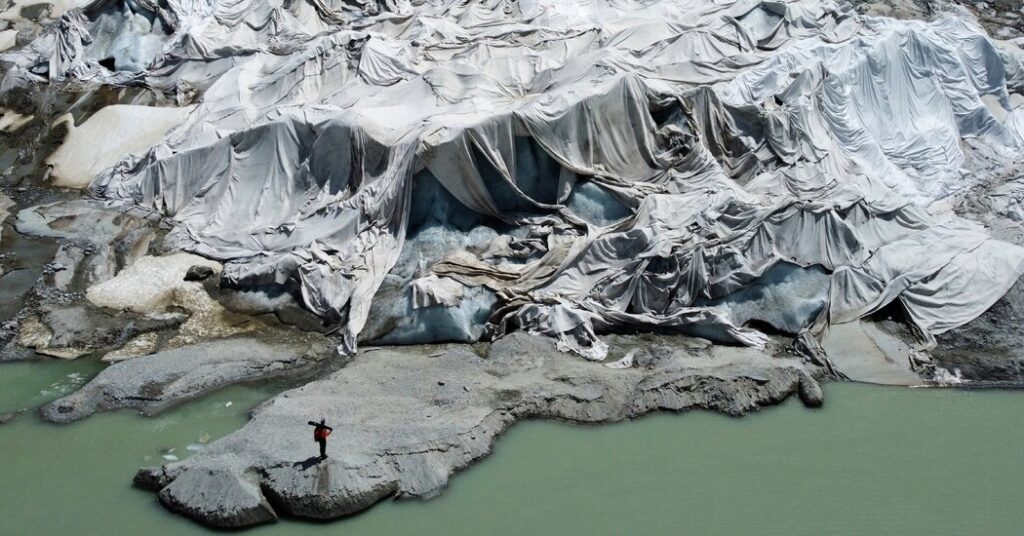
Oceans are warming at an accelerating rate. Glaciers are melting at a quickening pace. Sea levels are rising faster. Droughts, heat waves and storms are all growing more intense. And there are indications that some of the world’s tipping points, including drastic changes to ocean currents, could be breached in the not too distant future.
The world has already warmed nearly 1.5 degrees, and appears on track to blow past 2 degrees by the end of the century, if not sooner. Wall Street analysts are anticipating a world that has warmed at least 3 degrees, a scenario that would render parts of the world uninhabitable and unleash vast economic devastation.
“Our civilization has evolved only over the last 6,000 to 8,000 years, when climate has been stable, so we are profoundly unsuited to the types of shocks that we’re seeing today,” Hayhoe said. “Human systems sort of bend to a certain point. And then, at some point, they break.”
The latest from the war in Iran:
Gas facilities targeted: On Tuesday, Iran attacked Qatar’s Ras Laffan terminal, the world’s largest natural gas facility, which pushed up natural gas prices in Europe as much as 30 percent. Brent crude, the international benchmark for oil, jumped by nearly 10 percent to $118 a barrel on Thursday morning. Follow more Iran coverage.
Iran could plunge into a “severe gas crisis”: Attacks on Iran’s South Pars gas field threaten to worsen the already crippling gas and electricity shortages that have plagued the nation for decades. One analyst said Iran is headed into a “severe gas crisis.” — Sanam Mahoozi and Hiroko Tabuchi
Things could get more expensive: Increasing attacks on energy infrastructure in the Persian Gulf could significantly hurt the already strained global supply of oil and natural gas, pushing fuel prices much higher. The escalating attacks will make it much harder for energy producers in the Gulf to repair and restart their oil and gas operations when the war ultimately ends. — Ivan Penn
Asia turns to coal: Asia is by far the world’s largest consumer of liquefied natural gas and the consumer of more than 80 percent of Qatar’s exports. To ward off potential shortages, utilities across the region have competed to buy up remaining cargoes at record prices on the so-called spot market. Some are taking steps to ration energy and dip into state funds to alleviate price increases. Many facing supply shortages and price increases are turning back to coal-fired power plants. — River Akira Davis
Climate law
24 states sue the E.P.A. for renouncing its power to fight climate change
A coalition of 24 states, along with a dozen cities and counties, sued the Trump administration on Thursday over its decision to relinquish the government’s legal authority to fight climate change.
The lawsuit was filed in the U.S. Court of Appeals for the District of Columbia. It is expected to be consolidated with a case that environmental groups filed in February, making for one of the largest legal challenges to date against the Trump administration’s unraveling of federal climate policy.
The states are arguing that the Environmental Protection Agency acted illegally when it rescinded a 2009 scientific conclusion that carbon dioxide and other greenhouse gases threaten public health and welfare. That determination, known as the endangerment finding, formed the legal basis for the E.P.A. to regulate emissions from automobile tailpipes, power plant smokestacks, oil and gas wells, and other sources. — Lisa Friedman
Quote of the day
“That’s called micromanaging. I’m not a micromanager.”
That’s from Senator Markwayne Mullin, Republican of Oklahoma, President Trump’s nominee to lead the Department of Homeland Security, who testified yesterday in a confirmation hearing on Capitol Hill.
Scott Dance reports that Mullin said he would “absolutely” revoke a policy that has drastically slowed the flow of federal disaster aid under the current secretary, Kristi Noem. Noem has required that her office approve any contracts or grants of $100,000 or more, Dance reports, creating significant delays and uncertainty for disaster-struck states and communities waiting for recovery assistance. An investigation by Senate Democrats this month found that the policy had delayed Federal Emergency Management Agency projects by three weeks, on average.
More climate news from around the web:
-
“Eight years before he got the call telling him he had won the Stockholm water prize,” The Guardian writes, “Prof. Kaveh Madani was being interrogated by Iran’s Revolutionary Guards, accused of being a spy for the C.I.A., MI6 or the Mossad.”
-
For the first time in eight years, the world’s largest oil and gas companies cut back on investments in green technology, Bloomberg reports. Spending on low-carbon technologies by the companies fell by more than a third over the past year, to $25.7 billion.
-
Chinese automakers are preparing to bring their electric vehicles to Canada as soon as this year, Politico reports, a move that could scramble the U.S. market.
Read past editions of the newsletter here.
If you’re enjoying what you’re reading, please consider recommending it to others. They can sign up here.
Follow The New York Times on Instagram, Threads, Facebook and TikTok at @nytimes.
Reach us at [email protected]. We read every message, and reply to many!
David Gelles reports on climate change and leads The Times’s Climate Forward newsletter and events series.
The post The Planet’s Warning Signs Are Flashing Red appeared first on New York Times.