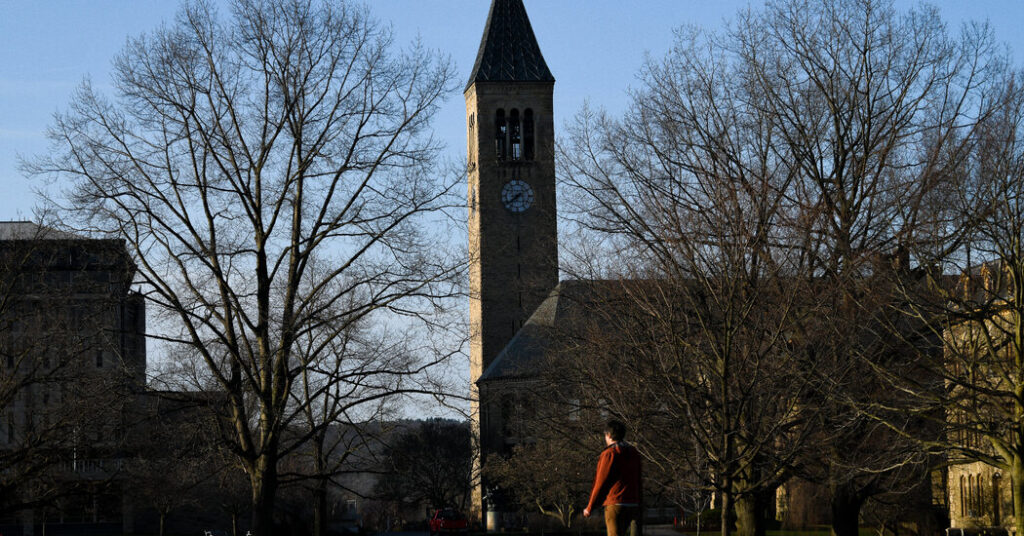
The Trump administration is pursuing a civil rights investigation into antisemitism at Cornell University, months after the Ivy League school signed a settlement intended to end a pressure campaign by the federal government.
The inquiry, which the U.S. Equal Employment Opportunity Commission is leading and that Cornell publicly acknowledged on Thursday, appears focused on whether the university allowed antisemitic discrimination against workers. As a part of the investigation, the federal agency sought this week to survey current and former Cornell employees, according to emails and a copy of the questionnaire reviewed by The New York Times.
One question asked workers whether they had been subjected to a range of behaviors, including “antisemitic or anti-Israeli protests, gatherings or demonstrations” that left them feeling threatened, “because you practice Judaism, have Jewish ancestry, are Israeli” or are associated with an Israeli or Jewish person.
Other questions inquired whether a person had reported potential antisemitism to Cornell; believed that Cornell was using “rubrics or programs” to give preference to people on the basis of religion, national origin or other protected classes; or participated in university training that addressed antisemitism.
The E.E.O.C., which reached many people through personal email addresses, asked Cornell employees to respond by March 31, and it urged recipients not to take the survey during work hours or on university-owned devices.
The E.E.O.C. declined to comment.
In an email on Thursday, three senior Cornell officials told employees that the university had complied with a “lawful and mandatory request” for information that it had in its files last summer.
But the officials, including Cornell’s interim general counsel, appeared surprised by the commission’s move this week.
“The university,” they wrote, “was not consulted on the survey contents nor the government’s plans for dissemination.”
Cornell declined to comment beyond the email.
The university announced a settlement with the Trump administration in November, after the government spent months squeezing the school through cuts to research funding. Cornell, which had been under scrutiny over accusations of antisemitism and admissions discrimination, agreed to pay a $30 million fine. It also agreed to invest $30 million on programs designed to enhance efficiency and lower costs in agriculture and farming.
The Trump administration had been particularly interested in campus protests at Cornell tied to the war in Gaza, including an encampment in 2024 and a campaign among some students for the university to divest from weapons manufacturers tied to Israel’s military.
The principal incentive for Cornell to settle was to restore hundreds of millions of dollars in research money. But the agreement included a provision for the government to “permanently close any and all pending investigations and compliance reviews” by the Justice Department, the Health and Human Services Department and the Education Department, if they were related to the university’s compliance with anti-discrimination laws.
The agreement, though, had a carve out for the E.E.O.C that explicitly preserved the commission’s power to “bring, process, investigate, litigate, or otherwise seek relief in any charge” filed against Cornell after the settlement took effect on Nov. 7, 2025. It also said that the agreement would not affect any pending E.E.O.C. matters involving Cornell, and that the government retained the authority to open new investigations or request information “related to alleged violations of civil rights laws arising after the effective date.”
The E.E.O.C. has emerged as a central part of the Trump administration’s toolbox to pressure elite universities. Last year, Columbia University agreed to a $21 million E.E.O.C. settlement as a part of a larger truce with the federal government. A proposal for the University of California, Los Angeles, to pay $172 million into an E.E.O.C.-related settlement fund was part of a broader demand — spurned by California officials — for more than $1 billion to resolve accusations of antisemitism.
And just last week, the commission was before a federal judge in Philadelphia to defend a subpoena it sent to the University of Pennsylvania for information about Jewish employees. The judge has not yet ruled.
David A. Bateman, the president of Cornell’s chapter of the American Association of University Professors, assailed Cornell’s decision to share employee information, including contact details, with the government.
“It is difficult to see how this does not violate commitments made by university leadership to notify employees or students if the university provided personal information to the federal government,” Dr. Bateman said in an email on Thursday afternoon.
“Apparently, ‘broad data requests’ for names and contact information don’t violate this commitment,” he added. “We’ll be notified if they ask for a little, but kept in the dark if they ask for a lot.”
Michael C. Bender contributed reporting.
Alan Blinder is a national correspondent for The Times, covering education.
The post Trump Administration Surveys Cornell Employees About Antisemitism appeared first on New York Times.