Oil and gas prices have surged as Iran intensified strikes on facilities across the Persian Gulf, prompting the Trump administration to consider lifting sanctions on millions of barrels of Iranian oil as other global leaders call for de-escalation.
The price of Brent crude, the global oil benchmark, briefly climbed past $117 per barrel before settling around $111 Thursday, as Gulf states reported more attacks on critical infrastructure. The price of European natural gas futures also rose.
As the latest attacks rattled markets, U.S. Treasury Secretary Scott Bessent said the administration may lift restrictions on Iranian oil that has already been loaded onto vessels, a move that could help the regime generate funds for its war effort.
“In the coming days, we may unsanction the Iranian oil that’s on the water,” Bessent said on the Fox Business Network. “It’s about 140 million barrels.”
Bessent’s comments come a week after the administration lifted sanctions on Russian oilthat was already in tankers, enabling as much as 130 million barrels of that country’s oil to flow into the marketplace, according to the administration.
That move threatens to generate large amounts of cash for Russia and its war effort in Ukraine, which the United States has condemned and sought to end. If Iranian sanctions were to be eased, it would provide revenue to a regime actively trying to kill Americans on the battlefield.
“Two countries that we’ve spent years sanctioning are now the direct beneficiaries of a conflict the United States chose to start,” said Brett Erickson, managing principal at Obsidian Risk Advisors, a consultancy that specializes in financial crime and regulatory issues. “The United States has spent years building sanctions architecture specifically designed to constrict Russia and Iran. Within three weeks of this conflict starting, we’re tearing it to shreds. That is not a short-term adjustment, it’s a complete strategic collapse.”
The latest attacks on energy infrastructure signal the war has entered a new phase that could exact lasting and extensive economic damage worldwide. The challenge of restoring stability no longer lies solely on reopening the Strait of Hormuz, a choke point for one-fifth of the world’s oil supply that has been mostly closed for weeks because of Iranian attacks on tankers.
Now, the very infrastructure that produces a large share of the world’s oil and natural gas is under threat. More extensive destruction of oil and gas fields, liquefaction facilities and shipping terminals would cause prices to continue their upward spiral. Many analysts are revising their projections, warning that the cost of a barrel of crude could quickly spike to $150 if the attacks continue to escalate.
“I hope everybody returns to reason,” French President Emmanuel Macron told reporters in Brussels, noting the potential long-term impact on global markets and calling for a moratorium on such strikes, as well as those on civilians. “If the production capacities themselves are destroyed, there will be a much more durable impact of this war,” he said.
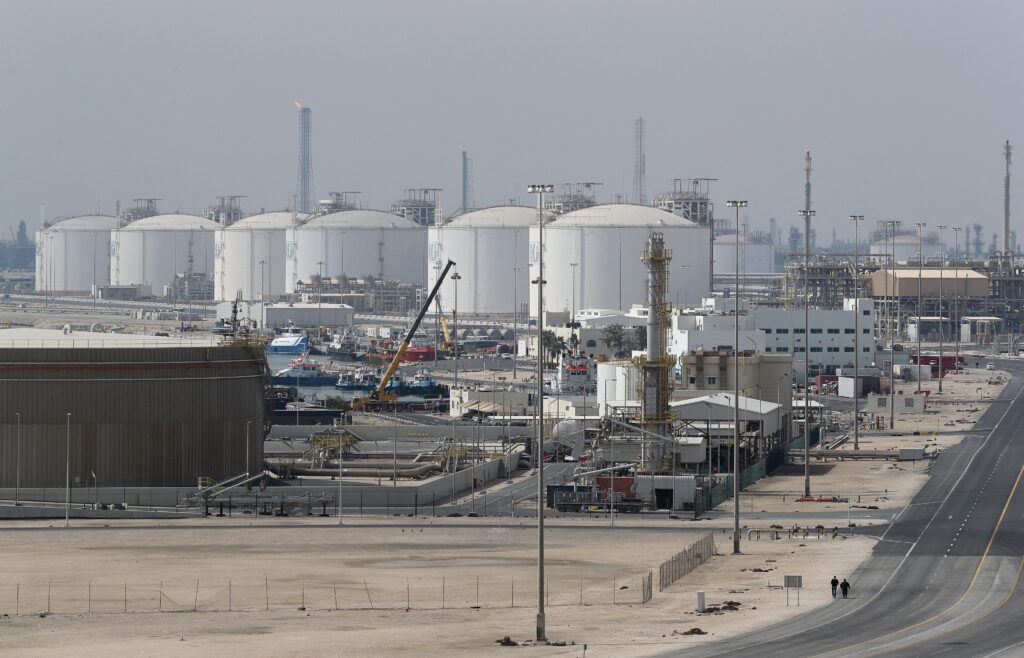
Qatar’s state-owned energy company said Thursday that several liquefied natural gas facilities were hit by missile attacks, causing fires and “extensive further damage,” in addition to the attacks on Ras Laffan Industrial City, a hub for exports of LNG, a day earlier.
Kuwait’s National Petroleum Co. reported that two refineries were targeted by drones, causing fires. Saudi Arabia’s Ministry of Defense said that it was assessing damage after a drone strike at the Samref refinery and that it had intercepted a ballistic missile launched toward the port of Yanbu on the Red Sea.
At the Pentagon on Thursday, the chairman of the Joint Chiefs of Staff, Gen. Dan Caine, acknowledged that Iran could still put regional partners’ oil infrastructure at risk despite weathering more than 15,000 strikes by the U.S. and Israel over the past three weeks. “Clearly, they came into this fight with a lot of weapons,” Caine said, adding that Iran retains “some capability.”
The U.S. still has air defenses in the region, but those systems rely on some of the scarcest munitions in the U.S. stockpile, including Patriot air defense system munitions, THAAD missiles and Navy-launched interceptors. The Pentagon is seeking more than $200 billion in supplemental funding from Congress in part to replenish those stockpiles.
Later in the day, U.S. military officials said in a statement that an advanced F-35 fighter jet had made an emergency landing in the region after a combat mission over Iran. They declined to comment on what prompted the emergency or whether the aircraft was hit with any kind of Iranian gunfire.
Leaders in the Gulf and around the globe called for a swift de-escalation.
Representatives from 12 countries in the region, including Qatar, Turkey, Jordan and Lebanon, denounced what they called Iran’s “deliberate attacks” targeting civilian areas as well as oil facilities, airports, diplomatic buildings and residences in a joint statement Thursday.
In their own joint statement, the leaders of Britain, France, Germany, Italy, the Netherlands and Japan called for an immediate moratorium on attacks on civilian infrastructure including oil and gas facilities and condemned the effective closure of the Strait of Hormuz, expressing their readiness to contribute to “appropriate efforts” to secure the strait. European allies have rebuffed calls to deploy warships to reopen the strait while missiles are flying, but several European nations have expressed openness to helping diplomatically or providing military assistance once the fighting abates.
Defense Secretary Pete Hegseth refused to predict how long the conflict may go on, asserting in Thursday’s briefing that only President Donald Trump will decide when it is finished. However, in recent days Israel has undertaken strikes on Iranian oil facilities that are counter to the administration’s desire to reduce pressure on oil prices, illustrating that Israel’s timeline and objectives for the conflict may not be completely aligned with U.S. objectives. When asked about that Thursday, Hegseth acknowledged that “we have allies pursuing objectives as well,” but he asserted that the war will end when the U.S. decides to end it. “We hold the cards,” Hegseth said. “The United States military controls the fate of that country.”
Hegseth’s comments followed a lengthy post on Truth Social late Wednesday in which Trump appeared to distance the U.S. from an Israeli attack on the South Pars gas field — the world’s largest — earlier in the day, saying Israel carried out the attack “out of anger for what has taken place in the Middle East.”
“The United States knew nothing about this particular attack, and the country of Qatar was in no way, shape, or form, involved with it, nor did it have any idea that it was going to happen,” Trump said, adding that Iran “unfairly” attacked a Qatari gas facility in retaliation.
“NO MORE ATTACKS WILL BE MADE BY ISRAEL” on the South Pars field unless Iran attacked Qatar, Trump said, in which case the U.S. would “massively blow up the entirety” of the gas field with “an amount of strength and power that Iran has never seen or witnessed before.”
“I do not want to authorize this level of violence and destruction because of the long term implications that it will have on the future of Iran, but if Qatar’s LNG is again attacked, I will not hesitate to do so,” he wrote.
The strikes by Israel and Iran on Wednesday jolted energy markets and further embroiled Persian Gulf nations in the conflict. After Israel struck the South Pars field, Iran fired back with missile attacks that caused “extensive damage” at the Qatari gas facility, according to Qatar’s state-owned energy company.
On Thursday, Iran’s Foreign Minister Abbas Araghchi said his country’s response to Israel’s strike on South Pars used only a “fraction” of its power. “The ONLY reason for restraint was respect for requested de-escalation,” he said in a post on X. “ZERO restraint if our infrastructures are struck again.”
In the U.S., prices at the pump are already surging upward and reached an average of $3.88 for a gallon of regular on Thursday, according to AAA. That is nearly a dollar more than it was a month ago, and the full impact of current oil prices hasn’t yet registered at filling stations.
Oil analysts are also raising doubts about recent administration assurances that the war would end imminently and markets would quickly stabilize.
After Iran warned that it would be attacking five specific Gulf state energy facilities early Thursday, Rystad Energy warned prices could quickly hit $120 and rise rapidly from there.
“So far, Iran has largely followed through on its stated actions, which makes this a highly credible threat,” said an email sent to reporters from Aditya Saraswat, a Dubai-based senior vice president at Rystad Energy. “Beyond the immediate risks to civilians and workers at these facilities, any such attacks would likely push oil prices up by at least another $10 and significantly disrupt supply, particularly across key producers in the Middle East.”
Saraswat noted that Iranian strikes have yet to affect port loadings of fuel in Saudi Arabia, but that could change. If the port of Yanbu were substantially damaged, for example, that “could remove 5 to 6 million barrels per day from the market and potentially push oil prices to $150 or higher.
The five facilities Iran is targeting account for roughly 20 percent of the liquefied natural gas in the global market. Further disruption of those supplies could lead to major price shocks for Europe and Asia.
“Spot LNG prices, already elevated, could spike to levels not seen since the 2022 energy crisis,” Saraswat wrote. “The more detrimental difference this time around would be that Europe has far less gas storage headroom to absorb the shock.”
Dan Lamothe and Ellen Francis contributed to this report.
The post U.S. mulls lifting oil sanctions on Iran as it hits key Gulf energy sites appeared first on Washington Post.