“So what do we have to do?” Ezra asked. We had finally arrived at the villa we rented at an oceanfront hotel on Elbow Cay, in the Bahamas. We dropped our bags on the tile floor, and Ezra threw himself down on the floral-print couch in the entryway. A golf cart, the primary means of navigating the island, awaited us outside.
“Well, what do you want to do?” I asked. We could see if the pool at our hotel seemed friendly. We could order a frozen drink at the bar, which had six or seven people crowded around it at this predinner hour, especially because, at 18, he was the drinking age in the Bahamas. Or what if we just went to the dock and watched the sun go down? Or simply watched the ocean, striped in different shades of turquoise owing to the brighter sky and the shallow depths and the white sand beneath it, not to mention the relative absence of the plankton that turns other parts of the ocean darker.
He blinked. He wasn’t sure what I was talking about. “But isn’t there something we have to do?” he asked. There was less dread in his voice than I might be making it out to sound. At 18, Ezra is a creature of acceptance and fortitude.
His confusion was hard-earned. Ezra has been on a lot of what we used to call vacations, but as he got older, he came to realize they were actually my work trips he was tagging along on. My husband and I didn’t have any money when I was starting out as a magazine freelancer, and so paying the relatively more nominal price to bring my children along on far-flung reporting trips seemed like the only way they would ever get to see the world.
Work trips are how Ezra returned to Los Angeles, where he was born, many times, and visited a bunch of other American cities too. He has been to Rome with me, hustling down roads and running through museums in the after-hours margins of whatever story I was there to report. My younger son, Haskel, has been with me to Israel for a food story, traveling alongside me to the Lebanon border to tell the story of a chef in exile. (Haskel napped in a room off the kitchen while I did my interviews.) My children have been dragged around this globe in the name of my work, and therefore the trips sort of looked the same: arrival, me saying something about how lucky we were to be there, a hotel, a hotel restaurant, being propped up with my phone at a neighboring table while I interviewed someone or talked urgently to my editor.
But still, we were traveling. What more could a person want for her family? I wanted time with my children, and I wanted time to work; it didn’t seem to me that I could cobble together anything resembling the life I wanted for us all if I wasn’t constantly doing both at once.
Now it was our last winter together before Ezra left for college, before he became independent and realized that his captivity to me would now be optional. He was now a fully formed person, having been the eager recipient of all I had to teach him in his life.
And I’d done my job; I’d taught him. I taught him how to crawl, how to walk, how to run. I taught him how to talk and the right etiquette for seeing a movie (hat off, phone on do not disturb). I taught him how to fly standby and what the sacrifices of choosing a bulkhead seat were. I taught him that you should never recline your chair unless the person in front of you did (hurt people hurt people) and that the person in the middle seat should get to use both armrests. I taught him that the peanut M&M’s at the minibar are too expensive but that the hotel breakfast is almost always worth it (unless it’s “continental,” which means it’s terrible and you’re better off getting something en route to the airport). I taught him to assess a security line for possible delays (strollers, recalcitrants who are already complaining about taking their iPads out of their cases in Donald Trump’s America or having to take off their shoes in Zohran Mamdani’s New York). I taught him how to fit it all in. I taught him the secrets to an efficient life, to getting things done.
But I hadn’t taught him how to vacation.
“I thought we were here for work,” he said.
“We are,” I said.
He looked at me and nodded, resolute. A story in which the assignment is a vacation. Sure.
So we headed outside and boarded the golf cart, and I finally faced what this trip portended. Ornithologists cataloged birds heading for extinction. Scientists monitored pathogens that could become the next pandemic. Astronomers tracked asteroids that had a nonzero chance of colliding with Earth. And Ezra was leaving for college, and there was nothing I could do to stop any of it.
He suggested that we just drive, so we headed down a road that was varying degrees of paved, passing brightly colored houses that didn’t so much have addresses as names: Yellowtail, High Dunes, Sea Breeze, Tahiti Hai. At nearly every intersection, a pole holding up electrical wires also featured a lineup of directional signs, pointing everywhere from Omaha to Guatemala to Bend, Ore., with mileage markers that accounted for their distance to Elbow Cay. Visitors put those signs up themselves, all of them painted in different colors.
“Why do you think they do that?” I asked Ezra.
“I don’t know,” he said. “Maybe just to say, ‘We were here.’”
Elbow Cay is an island, part of the Abaco Islands archipelago in the Bahamas — itself a group of roughly 700 rock formations, some of which are places you make sure your boat doesn’t graze on your way to some of the other formations, which have homes and hotels and golf courses. Elbow Cay itself is relatively calm, made up of locals and people from usually Florida and the Carolinas who own second homes there. It’s only five miles long, and according to an only somewhat recent census, there are only around 400 people who live there year-round.
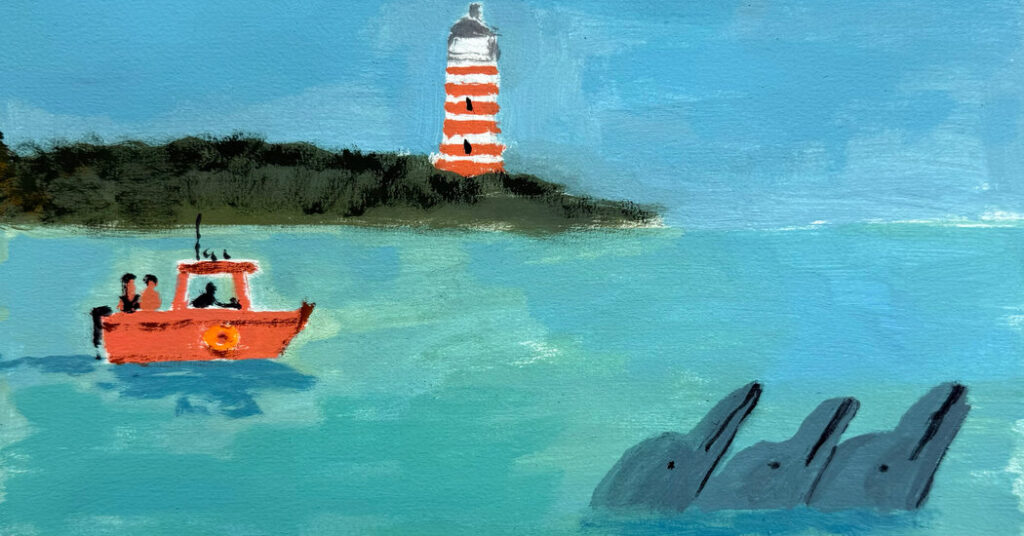
There is more to know about it. Its town, with a tiny museum. Its red-and-white candy-striped lighthouse, with a lamp powered by kerosene instead of electricity and a flashing mechanism that’s still hand-wound by a human being. Its history, as a place where British loyalists who opposed the American Revolution fled. The catastrophic impact of Hurricane Dorian in 2019, which hit Elbow Cay particularly hard and cost the Bahamas an estimated $3.4 billion in all. I can’t tell you more because finding out more would have constituted work, and this was a vacation.
A woman driving an actual car slowed down to say hello to us. (In fact, everyone on the island said hello to us: people in their tennis pastels and swimwear bopping along in their golf carts, people walking along the side of the road. Ezra loved this and considered it the height of welcome and civility.)
“You got a cart!” the woman said. We realized we had met her on the ferry on the way over.
“Yes! Where should we go?”
“Have you been to Tahiti Beach yet?”
A sore point. We had not been to Tahiti Beach yet — forgivable this trip because we just landed, but the entire reason we chose Elbow Cay was because we had been here not two months before, for a friend’s wedding. That trip fell prey to the typical travel shenanigans — shenanigans being the rule and not the exception, lately, and therefore another reason to stay home! — and we were able to stay for only 17 hours, arriving on the island about 40 minutes before the wedding, just enough time to rent our golf cart and change our clothes, smear some makeup onto my face and army-crawl, breathless, over the finish line into the church. “If you see nothing else, you have to at least go to Tahiti Beach,” the groom told us before we left. There are swings there, he said, right in the sea, and sometimes there’s a boat that comes by to sell drinks and food. But there wasn’t time for Tahiti Beach then, and the closest we came was staring at the beach forlornly as our ferry motored us back to the dock in time for our (delayed again!) plane.
We were already pointed in the right direction, the woman said. Just keep going, past what look like gates, and then follow the road to the right.
“And then?”
“And then you’re there.”
There is no formal parking lot at the beach. You simply can’t drive any longer, so you put your cart in park and get out. (Another thing about Elbow Cay is how long it takes to get used to the lack of bureaucracy there.) We got out and started walking along the shore. We looked out onto the ocean, and Ezra said, “We don’t talk enough about the fact that the world is, like, 75 percent water.”
“The ocean is generally a popular place to swim and a sought-after destination,” I said. “But I’m not sure how surmountable the amount of urine in that thing is.”
“And how big and menacing it is,” he said.
“And the dead people. Don’t forget the dead people. How many parts per trillion of Osama bin Laden or Titanic-victim decay should we really feel comfortable swimming in?”
“Exactly,” he said.
“Exactly,” I said.
A real thing is that you raise a child to see the world through your eyes, and then the minute you get all the levels right, he’s out the door. We were only a few hours into this vacation, and I was already mourning its end.
By then, we had seen the swings, hundreds of feet into the ocean, and we were walking into the ocean, out on the endless sandbar. It was so calm; there were no breakers, no waves, and as we walked, for hundreds of feet, it didn’t get deeper, so we walked like Jesus toward the swings. I told Ezra that where his grandfather lives on Long Island, people used to say as a way of disparaging people, “He thinks he walks on water,” but “water” pronounced with a Long Island accent, like waw-duh.
“What do you want to do after this?” I asked.
“Want to go count some chickens before they hatch?” he asked. This is his new thing, to avoid answering a question about what to do with a cliché. It tickles me.
“I can’t,” I answered. “I’m too busy separating the wheat from the chaff.”
So we decided to go to On Da Beach, an open-air bar that is right there on da beach. There had been a sign pointing toward the bar that said “Dis way,” which made us laugh. I ordered da piña colada and Ezra ordered something called Passion On Da Beach, and we made jokes about being a mother and son having dirty drinks together and sending another one over to a guy on the other side of the bar.
“Will you please send over a Passion On Da Beach to the gentleman over there?” I said (to Ezra, not the bartender).
“It’s from me and my mother,” he said (also just to me).
We drove around more and then went to eat lobster tacos and guacamole at a place with an outdoor bar and picnic benches. A rooster walked right by us, making his sound, and Ezra wondered where, speaking of clichés, it happened that we began to associate roosters with morning when actually they crow all day. On vacation, you have conversations that aren’t purposeful, ones you just back into that include observations and other dumb things, for what feels the first time in years.
We paid the bill, and as we waited, all up and down the wooden scaffolding of the bar we noticed groups of people’s names, written in marker, perhaps the same we-were-here instinct that the signposts spoke to.
“Maybe after this we could go keep up with the Joneses,” he said.
And we laughed more loosely than we did before the drink and got back into the golf cart and headed back to the hotel, to our little villa, the day now over, and I wondered if this was what vacation was. Outside my window, the sun had already moved on, swallowed up by the next group of people who needed to wake up, and I felt a profound loss, as if it was another missed opportunity, a thing you can never hold on to. Maybe that’s why people mark their names and hometowns on this place, because once you leave you will need proof that you were actually here in the first place.
What is the goal of vacation? Is it enjoying the place? Is it seeing everything? Is it the breathless running from monument to walking tour to sight in order to take the measure of a place? Is that even how you take the measure of a place?
I’m skeptical of the version of vacation that gets marketed to me, the version I encounter the most when I visit Las Vegas or Miami or Los Angeles on work trips. It goes like this: Beneath my skin is supposedly a version of me that is so tired of civilized living and wants, needs, to break out and dress in nearly nothing and eat nearly everything and watch people be naked and get so drunk that you’d have to replace my plasma with, I don’t know, plasma — a version of me that is a caged animal barely holding it together until a real vacation comes along to let it out. I don’t know if those people really exist, the kind that can only hold it together on a day-to-day basis knowing that a long weekend full of mojitos (?) and strip clubs (??) awaits. Me, I’m a real regular-day kind of gal. I’m most comfortable with the predictability of a workday. I love a Wednesday. I don’t even like the phrase “Thank God it’s Friday.”
And what is a vacation, anyway? Who says I am supposed to prefer these things — lounge chairs, umbrellas in drinks, massages, Muzakicated music rerecorded by laconically uninvested singers that gets piped into a pool area or a hotel, music that reminds me of music I’ve heard but is stripped of its emotion and soul — to my life? Who says that a preferred state of being is one in which all movement stops and I can hear my spiraling thoughts even louder, only now I hate myself because of the bucolic environment I’m in?
If I’m honest, our lack of real vacations wasn’t just about time or money; it was also about me. The few times we did go on trips with no agenda, I would become paralyzed. How exactly is one supposed to be at a place when one is so unaccustomed to just being in the first place? And there was that part of me that worried that on a real vacation — if I did lie on some sunny chaise, if I did just yield to a sparkling body of water, if I finally stopped — I wouldn’t know how to begin again.
Do you see how if you think like this that even the notion of vacation can lead to your collapse?
The next day was Saturday, and the weather wasn’t great; once you’re on vacation, nearly all you can think or talk about is the weather. It was in the 70s but windy, and while I waited for Ezra to wake up, I read a new book on an Adirondack chair overlooking the small beach in front of my hotel. At breakfast we ate fruit as if we’d just discovered fruit for the first time.
We hired a captain to boat us around for half the day, a young man named S.J. whom we were introduced to over breakfast by another fellow who worked at the hotel. S.J. grew up here; he grew up on boats. When he was a child, his parents gave him a little dinghy that he used to hop from island to island. Now, in addition to running his family’s golf cart rental business on the island, he has this boat, a 23-foot Hydra-Sports, which is great, but he believes there’s still work to be done on it. He wants to redo the seats and replace the overhang for a little more coverage.
“You know what boat stands for?” he asks us. We don’t. “‘Break Out Another Thousand.’”
Deeper into the ocean, S.J. gave us snorkeling gear, the flippers barely able to fit over our giant American feet. We were to plunge off the side of the boat. Like I said, we’re a little afraid of things, Ezra and me. Just being on a boat was tripping the wires of my exquisite combination of claustrophobia and agoraphobia. But we were on vacation, and on vacation, you count to three and without any false starts you slip off the boat and into the water, which was cold for the Bahamas but warm for most other places.
In addition to the decomposition taking place in the ocean, Ezra and I were in general agreement that what lay beneath the water was none of our business. Let the ocean be the ocean. Let it be a frightening ecosystem of Darwinism. Let the food chain do what it needs to do. It was none of our business.
I’m struggling to say anything new about what we found at the reef, these tropical fish that just swam around in schools, unafraid of us. On vacation, you succumb to cliché in a way you previously allowed yourself to believe you were better than, and you find that the best descriptions of things are not the poetic but the practical. So I’ll just say: Some of them were translucent, some of them striped. (See?) Ezra saw a barracuda. It’s easier to talk about what it felt like down there, which was quite a revelation: quiet, a synthesis with the world and nature I don’t have, a question about why I make a big deal over everything, then a wordlessness. Yes, perhaps my entire triumph of the whole trip was a 10-minute period of wordlessness as I followed a sea turtle, as if in a trance.
Maybe what I’ll say is this: On vacation, you stop trying so hard to describe things.
“Is this really a vacation if you’re writing about it?” Ezra asked.
Here it was. He was finally asking the question I had avoided, even as the editors who assigned me this story worried that the true answer was something none of us wanted to face, which is that I am either a broken person or a complete grifter.
So I obfuscated. “What should we do now?” I asked him.
It was Sunday, and we had just learned that on Sunday everything’s closed. Not in the way that we say things are closed in America, which means actually just sometimes they close a little early. Nothing was open. The lighthouse, the museum, most of the restaurants, the ice cream shop, the handful of boutiques.
The weather was worse, too. A muscular wind that blew our hair around. We’d woken up to puddles on our little porch, and everyone at breakfast found the conditions foreboding.
“Let’s cry over spilled milk,” I suggested.
“How about we bark up the wrong tree instead?”
So we returned to Tahiti Beach, a middle finger to our last visit to the island, which saw us there not once. Now old hats at this, we settled in.
Here is what it’s like to be on vacation:
On vacation, instead of having directed conversations, you can have ones of happenstance, backing into things instead of being purposeful about your communication. On vacation, you take turns saying a certain phrase in a different accent and try to make the other person guess the accent you were going for, and always be wrong. On vacation, you sit back in the sand, and, for what seems like the first time in forever, you upward-tilt your head that has ossified in its downward position. The convex nature of the sky makes it feel unending. The night before, there was something about the volume of stars, how it went forever, that scared us but also dazzled and comforted us. In the daytime, on vacation, you look up at the clouds. Thunder rumbled in the distance. On vacation, particularly here, there is so little to do on this island that the only available metaphors are from nature.
Nonetheless, the thunder was far away for now, and so we stayed looking at the sky.
“Look at the clouds,” I said. “You forget.” The last time I thought about clouds was in a meditation class I took, where I was asked to picture intrusive thoughts as clouds. But these clouds, they were the real thing. I was closing my eyes to picture clouds when they were always right up there. There has to be a connection there, right? That has to be a breadcrumb as to how my life became so harried. I hadn’t interacted with clouds in so long.
After a moment, I continued. “Do you see the layers? Do you see a full set of clouds that are stationary behind the clouds that are moving by?” The ones in the back are called cirrus, I explained to him, and the ones moving are called altocumulus, I think.
I looked over at Ezra. I hadn’t taught him about clouds. But worse, I hadn’t taught him about looking up. I hadn’t taught him about just sitting there. I had taught him to be so productive, to make every moment count — and besides, how could I teach him something I didn’t understand myself, 50 years old and asking questions about how to be on a vacation?
Here I was, a parent for 18 years, and now I was looking at clouds that I was probably, definitely misnaming, and I didn’t think I’d taught him anything at all. Did I use my time with him well? Did I teach him enough of what I wanted him to know?
Can he empty a vacuum cleaner? Can he figure out how to get home without his phone or a means of paying? Did he see the third “Godfather” movie yet? Did he see the second “Before Sunrise” movie yet? Does he know to take cabs and not Ubers because of the fragile city economy? Does he know not to buy sushi on Sundays? Does he know about the secret parking spot on Houston Street? Does he know to stand up for a pregnant woman on the subway? Does he know to walk toward the edge of the sidewalk when it’s dark and deserted at night in the city?
This was it. Ezra was leaving. Everyone kept saying it went so fast, but I can account for every day, and I have to tell you, it did not go fast. There was always a basketball game to be at and a parent-teacher conference to drive to and a car pool to coordinate and a form to fill out, and my husband and I teamed up and divided and conquered and signed all the permission slips and made the appointments and got it all done, but in the ugliest, messiest way possible. There were 100 decisions to make every day, and there was always a question of priorities and having to name them and choose them, which felt so unfair, like every day you had to issue a referendum against yourself. All of that, and so slow! And in all that slow-going, I realized that it’s not that it goes fast, that’s not what people mean. What they are saying is that they wished it would last forever. And that is something I can endorse, that I wish it all could last forever.
And so you find yourself here, not knowing how to behave because you thought you had more time — time to teach, to talk. I don’t know if I used that time wisely. Does he know how I got this way? Does he know all the stories, our stories, my stories, so that he could make sense of me when I’m gone? Does he know the one about the time my littlest sister pretended to be my daughter to get me out of a traffic ticket? Does he know that my grandfather used to put peanut butter on saltines every single night? Does he know what town in Poland his grandparents are from?
We haven’t watched “Heathers” together yet. I always planned that we would read “American Pastoral” together. I thought maybe we would be people who played tennis together into adulthood, except he turned out to be someone who hated tennis, and I’m bad at it, and I didn’t replace it for us with a sporty hobby or even a card game. Does he know how to do his taxes? Does he know I change the toothbrushes out every three months?
Did I teach him that he was the most important thing to me, he and his brother and their father? I was always running around, but does he know that everything I did I did because I just had to figure out how to get us to a safer perch, to a better day, to an easier time?
“I know what the clouds are called, Mom,” he said.
“But when is the last time you just looked at them?” I asked him.
“I don’t know. Last week?” He and his friends were in Central Park, just lying around on the lawn in the Sheep Meadow. He sat up. “Hey. Do you want to get those fish tacos again?”
And then he stood up and brushed sand off his shorts, and I realized that even if you’ve inherited some or all of your mother’s neuroses, being on vacation isn’t something you learn. It’s something you unlearn. Somewhere along the line, I had become like this, but Ezra still knew how to just be, just exist, just enjoy, just look up at the sky — the sky, which forgives me for my neglect after all these years.
“Quick, let’s look before we leap,” he said.
I laughed. Yes, I said, let’s look before we leap. Let’s go judge a book by its cover. Let’s make lemons into lemonade. Let’s fake it till we make it. Let’s lead a horse to water but know that it won’t necessarily drink. Let’s let sleeping dogs lie. Whatever will keep us here on this vacation; whatever will make this moment last forever.
We walked down the shore back to the cart. We passed a seashell, and he laughed and reminded me of a joke we love about actually the seashore being the worst place to sell seashells.
And we walked away, me a few feet behind Ezra, as he started saying the phrase “Thank ye kindly” and asking me to guess which accent he was doing. I guessed Australian, then Irish, but was wrong both times.
That’s what you do on vacation.
That night, after dinner, we watched the sky as the sun set and the moon revealed itself in all its patience, along with the stars, which had been there the whole time, waiting for me to come around. I did, at least that night I did, and then, in a moment of grace for myself, I wrote this all down, not because vacation was the job this time but just to say we were here.
The post I Taught My Son Everything, Except How to Take a Vacation appeared first on New York Times.