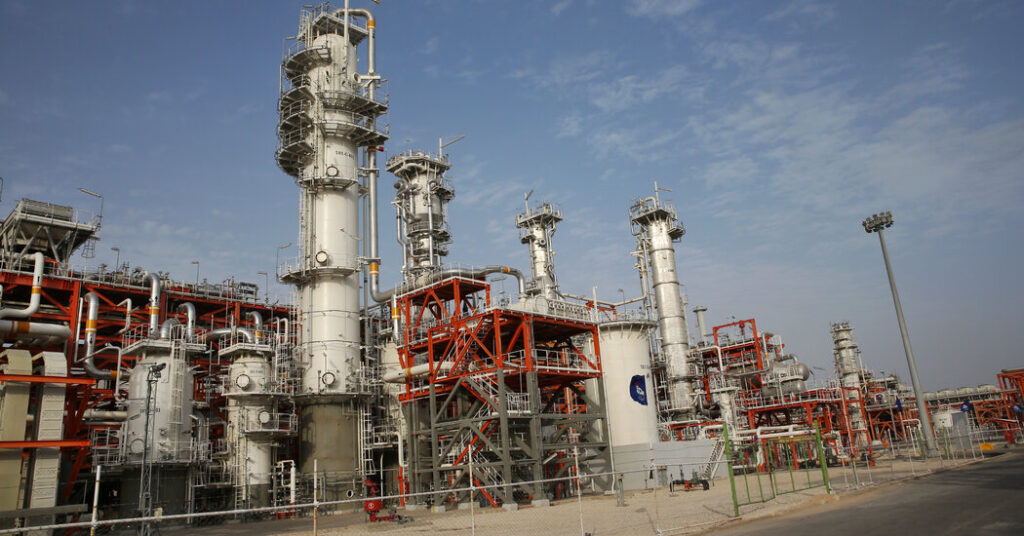
An Israeli strike on Iran’s South Pars gas field was coordinated with the Trump administration in advance, according to three Israeli officials, despite President Trump’s assertion that the United States “knew nothing about” it.
Israel has not commented publicly on the attack, carried out on Wednesday, or on Mr. Trump’s effort to distance the United States from it.
But three Israeli officials briefed on the South Pars strike said that the United States was informed before the attack. They spoke on the condition of anonymity because of the sensitive diplomacy. The White House did not immediately respond to a request for comment.
“The United States knew nothing about this particular attack,” Mr. Trump wrote in a social media post late Wednesday, saying that Israel had “violently lashed out.”
He added that Qatar, a U.S. ally, “was in no way, shape or form, involved with it,” nor “had any idea that it was going to happen.”
The South Pars gas field is shared between Qatar and Iran. Hours after Wednesday’s attack on South Pars, natural gas facilities in Qatar were hit by strikes. Qatar blamed Iran.
The attacks were the latest in a series of escalating strikes on energy infrastructure that have sent global oil and gas prices soaring. South Pars is part of the largest gas field in the world. Qatar is the world’s third-largest exporter of liquefied natural gas.
The war began on Feb. 28 when Israel and the United States jointly attacked Iran.
Israeli analysts said the strike on South Pars may have been intended to warn Iran to stop effectively blocking the Strait of Hormuz, a major transit route for global oil. Since Iran uses most of its natural gas domestically, the strike could have been meant to signal to the regime that Israel could do much more to disable Iran than it has so far.
“The strike attempted to send a broad signal to whoever is in charge in Iran — and that is very unclear — that Israel can paralyze the whole electricity network in the country,” said Ehud Yaari, an Israel-based fellow of the Washington Institute for Near East Policy.
“If you stop the electricity supply,” he said, “in many ways you stop the country.”
Mr. Yaari added that the coordination between the United States and Israel was so close and coordinated over the course of this war that it was implausible Israel would carry out such a strike without Washington being informed beforehand.
Mr. Trump said in his postthat “NO MORE ATTACKS WILL BE MADE BY ISRAEL” on the South Pars field.
But, he added, if Iran was to “unwisely” attack Qatar’s natural gas facilities again, the United States would “massively blow up” the entire South Pars gas field “with or without the help or consent of Israel.” Iran vowed to retaliate for the Israeli strike on South Pars, saying it would attack oil and gas targets throughout the Gulf.
On Thursday, an Iranian military spokesman, Ebrahim Zolfaghari, said Iran had struck energy facilities “considered part of U.S. interests.”
In a statement published by state media, he warned that if Iran’s energy sites were targeted again, retaliatory strikes would continue until the “complete destruction” of the energy infrastructure of the United States and its allies in the region. He did not specifically refer to the South Pars strike.
Israel insists that it is aligned with Washington on all targets in the war that the two countries are jointly waging against Iran.
Isabel Kershner, a senior correspondent for The Times in Jerusalem, has been reporting on Israeli and Palestinian affairs since 1990.
The post Contradicting Trump, Israeli Officials Say U.S. Was Told about South Pars Attack appeared first on New York Times.