Make it new, Ezra Pound ordered; he did not say, make the deadline. New York has been missing one of its most consequential institutions of contemporary art for two years now, ever since the New Museum shut its building in Lower Manhattan to prepare for an $82 million expansion — slicing the sides off its stacked, cantilevered boxes to grow to twice the size.
Creativity doesn’t keep a strict schedule, though, and neither do indiscriminately tariffed supply chains. The New Museum was meant to reopen at the end of 2025. Then it was pushed to the first days of spring. Still, in the hours before its grand reopening, construction workers were racing to install banisters on its showpiece staircase and smoothing the wet cement on the Bowery sidewalk.
When it was founded in 1977, a year of blackout and near-bankruptcy in New York, the New Museum was so scrappy that Marcia Tucker, its founding director, staged its first show in another gallery’s borrowed rooms. If the museum that reopens this week has become a venue of global distinction, it has also retained, under its longtime director Lisa Phillips, much of its original put-on-a-show vigor. The New Museum does not collect art; it works fast, but aims high; it fills an important space between MoMA and the city’s experimental venues.
I’m glad it’s back, especially with a first show of true ambition: “New Humans,” a showcase of more than 150 artists who have defended, abandoned or reimagined humankind as modern technologies rumbled our species’ self-definition. Major new commissions by today’s leading artists, such as Camille Henrot and Wangechi Mutu, share the floor with earlier explorations of humanity under strain, notably from the years after World War I.
The show is wide-ranging, and sometimes helter-skelter. It’s populated — in many galleries overpopulated — by prosthetic metawomen and rattling automatons. It has brilliant new videos and some of the ugliest painting in town. “New Humans” is a big, serious show for adults; it’s meant to fight over, which is just the way I like it.
As museums, universities and Hollywood studios sacrifice themselves on the funeral pyre of A.I., the New Museum is looking in the other direction. “New Humans” is not about technology but about humanity: what makes us distinct from animals or algorithms, and how a century’s innovations and destructions led us to envision fresh beginnings for naked apes.
It’s hard to express just how unfashionable this line would have been in contemporary art just a decade ago, when every other biennial was downgrading the human into just one species (or object) among others, coequal with “vibrant matter” and fungi with feelings. It took just a few years of drowning in ChatGPT slop to restore the nobility of the rational soul. Au revoir, Afropessimism; sayonara, “Cyborg Manifesto”; it’s 2026 and humanism is back!
A Collage of Old and New, No Delirium
Before all that, though, a few notes on the not-quite-finished new building, a squat prism of admirable reserve designed by Rem Koolhaas and Shohei Shigematsu, partners of the firm OMA. Though it may sound like faint praise, this seven-story extension is a problem-solver. The New Museum’s first purpose-built home, inaugurated in 2007, animated the Bowery with its skew-whiff massing and facade of aluminum mesh — but circulation was always a problem, with visitors hiking up service stairwells or waiting for a tardy freight elevator.
The extension, which is OMA’s first public building in New York, makes a virtue of its redressive mission. In both shape and style, it’s less make-it-new than make-it-work.
A chamfered front of laminated glass pulls back from the street, kissing the original building and producing a little piazza. The west of the house accommodates a triangular staircase that alleviates the old circulation struggles. OMA lifers will clock certain quotations from Koolhaas’s and Shigematsu’s previous cultural projects: triangular cutout rooftop windows like those at the Casa da Música in Porto, Portugal, and polycarbonate and aluminum cladding seen at the Fondazione Prada in Milan or the Buffalo AKG Art Museum.
But in the galleries, the architects have been silent. You pass from new wing to old without noticing, as the additional spaces have the same down-to-business concrete floors and steel-beam ceilings. Too soon to say how it’ll all work once the public arrives; already, during a preview, the punched aluminum panels were covered in black scuff marks. But its modesty and functionalism are rare these days in museums; as the kids say, OMA understood the assignment.
You Are Not a Robot, Probably
The New Museum needed the doubled gallery space for “New Humans,” whose inquiry into the state of humanity spans three floors and spills into the stairwell. Its slate of curators, led by Massimiliano Gioni, the New Museum’s artistic director, contend that “the human” is not a perfect synonym for Homo sapiens; the human is a social category, which has expanded and contracted, sometimes with lethal consequences, from the pressure of new technologies and political regimes.
The curators do their best work by juxtaposing contemporary artists, engaged with bio-hacking or machine learning or ecological mutation, with similarly oriented creators from 100 years ago — painters and architects, revolutionaries and eugenicists.
What is a human, who counts as a human? You might say one of woman born, but the modern age was already imagining new kinds of mechanical reproduction. Marcel Duchamp and Francis Picabia both envisioned sex as a matter of gears and pistons, and modern classics from “Ulysses” to “Metropolis” fixated on the erotics of machines. The two Dadaists’ renderings of fleshy gadgets, greased by onanistic desire, find an intriguing update in a recent sculpture by Jenna Sutela: a closed circuit of breast pumps, churning synthetic human milk. Sara Deraedt offers a rather horrific image of a newborn emerging from a computer’s chassis fan.
A related theme (familiar from the 2022 Venice Biennale, curated by Gioni’s wife, Cecilia Alemani) is prosthetics: additions to the human body that merge flesh and object. Delightfully weird photographs of French wartime inventions — a conic wimple to improve hearing, or a pilot’s safety belt equipped with balloons — turn the soldier into a prosthetic demigod, a Surrealist superman. Elsewhere, the New Woman of the 1920s, seen in short-haired self-portraits by the Bauhaus-trained Florence Henri and Marianne Brandt, mingles with Toyin Ojih Odutola’s bald Valkyries, drawn in painstakingly grooved charcoal and pastel, from her imagined Nigerian matriarchy.
The human, usually of the female designation, can also become a fetish object. Perhaps my favorite recent work in “New Humans” is a psychically loaded photographic series, “Mama,” that the Polish photographer Aneta Grzeszykowska made in 2018. She began by casting a silicone bust of her own head and upper torso; she then let her daughter play with the mother-doll, and in Grzeszykowska’s photos the girl seems to be having a ball. She cradles her surrogate mini-mom, bathes with her by the river, buries her in the dirt. She covers her replacement mother’s eyes, or wraps her not-mother in plastic film. Criticism will not be enough; call a Kleinian analyst.
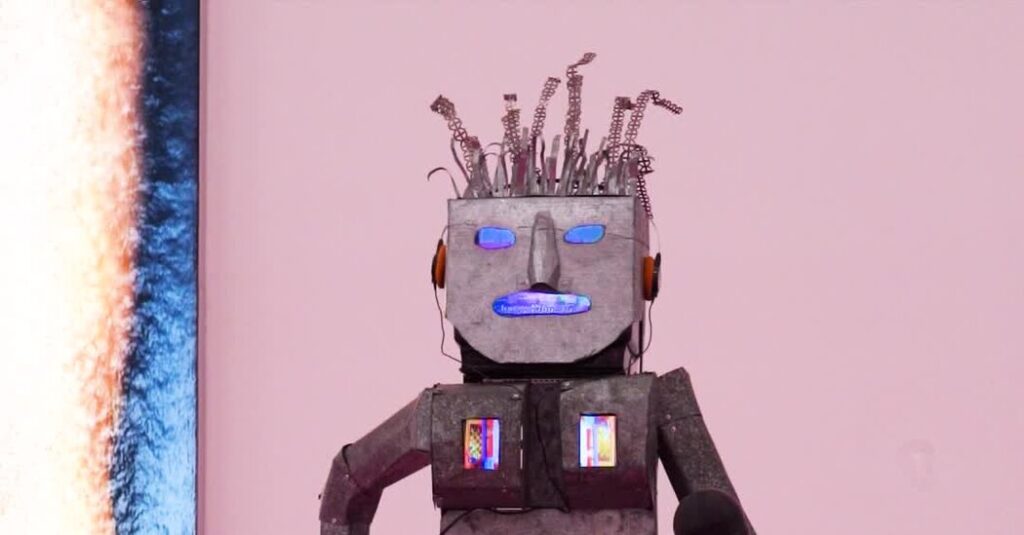
Where’s the border, anyway, between a person and a thing? I’ve already failed dozens of those CAPTCHA tests that purport to tell computers and humans apart (click all the bicycles!), and “New Humans” walks this line in a grand, goofy Hall of Robots, where more than a dozen mannequins, androids and humanoid contraptions congregate on a carpet of Pepto-Bismol pink.
The earliest and most important of these creatures — a literal new “human,” made by human art — is the famous “Glass Man,” a full-scale transparent model of the human body, on loan from the Hygiene Museum in Dresden, Germany. His raised arms reveal his humeri and radii. Wire nerves of red and blue twist around his skull. His skin isn’t glass, actually, but a novel clear plastic. (Franz Tschakert made its first edition in the late 1920s; the specimen here is a later refabrication.) The see-through man is Everyman, but also the model New Man — and, before long, the Nazis’ Pure Man.
Imagining humans as machines goes back to Descartes, and even Kant realized we can’t always treat our fellow humans as ends and never means. (How would you get your matcha otherwise?) Yet Gioni and his team return, throughout “New Humans,” to the danger of reducing humans to data, and what risks come when flesh and blood gets standardized, numericized, optimized. Frank Gilbreth’s time-lapse photographs of efficiency studies in the 1910s, and choreographic notations developed by Rudolf Laban, picture how human movement could be translated — maybe the better word is minimized — into algorithmic steps. A hundred years later, in Hito Steyerl’s new video “Mechanical Kurds,” we are now turning humans into 1s and 0s. The self-driving car that stops when you cross the street, or the all-seeing drone that shoots you in the head, needs the human labor Steyerl films in a refugee camp in Iraqi Kurdistan — where clickworkers earn pennies tagging pictures for A.I military systems.
“New Humans” is not a document-driven historical showcase, but a contemporary art exhibition — and its free mix of old and new implies that the earlier inquiries into human life all apply equally to our screened-out present. To my eye it’s not so simple. The art from the ’20s and ’30s drowns our A.I. arrogance with illuminating precedents of humanity rethought amid accelerating media and unstable work. As the show moves into the postwar era, though, it loses a lot of its comparative punch.
“New Humans” plunges into the years after Auschwitz and Hiroshima in a global gallery of men and women in extremis (by Francis Bacon, Eva Hesse and the Indian painter F.N. Souza), and later through the amoebic monsters of Tatsuo Ikeda, a kamikaze pilot-turned-watercolorist. All very forceful, these paintings and sculptures — but very distant from our times. What you see in Bacon’s gnarled faces or Giacometti’s thin men is an existential humanism, a New Man for Year Zero. But in the 21st century, when the phone and the climate together scream our interdependence, this shattered individualism seems to derive from another species altogether.
These overhung postwar galleries are one of several places where “New Humans” feels like it’s showing too much and thinking too little. It also runs aground when it tries to wrestle with the “human” as a less-than-universal term, with “European” or “white” often implied. Countless postcolonial writers, from Edward Said to Sylvia Wynter, have excavated humanism from a limited, Eurocentric definition of “Man.” But the contemporary art the curators show here — an effigy by Tau Lewis festooned with seashells and pearls, bracingly ugly paintings of the spirit realm by Jaider Esbell — has the opposite effect, plunging us right back into mythology, ritual, magic.
When Sam Altman, the chief executive of OpenAI, drones about children being inefficient gobblers of resources, when right-wing video gamers condemn their political opponents with the dehumanizing term “NPCs” (nonplayer characters), we are fighting again over who counts as human. Your 46 chromosomes alone are not enough to guarantee membership. When prejudices and plutocracies keep trying to reduce some of us to subhuman status, the only way through is to break away from the mirror, or the selfie camera. That’s the core lesson of modern art and philosophy: The self realizes it is a self among others, becoming human when you recognize yourself in a face not your own.
The artists who most inspire in “New Humans” understand that humanity arises out of these encounters — not the divine reflection in Genesis, not the isolated rationality of Descartes, but you and me, together, with our differences, looking at and listening to each other. “Humanity is something we have to achieve,” as the Senegalese philosopher Souleymane Bachir Diagne so beautifully argues. “To be human is to have the responsibility of becoming who we have to be.”
Any old chatbot, in 2026, can say it thinks, therefore it is. We’re going to need a higher bar than that.
New Humans: Memories of the Future The New Museum opens to the public March 21, at 235 Bowery, Manhattan; 212-219-1222, newmuseum.org.
Jason Farago, a critic at large for The Times, writes about art and culture in the U.S. and abroad.
The post The New Museum Reopens, Asking, ‘What Is Human?’ appeared first on New York Times.