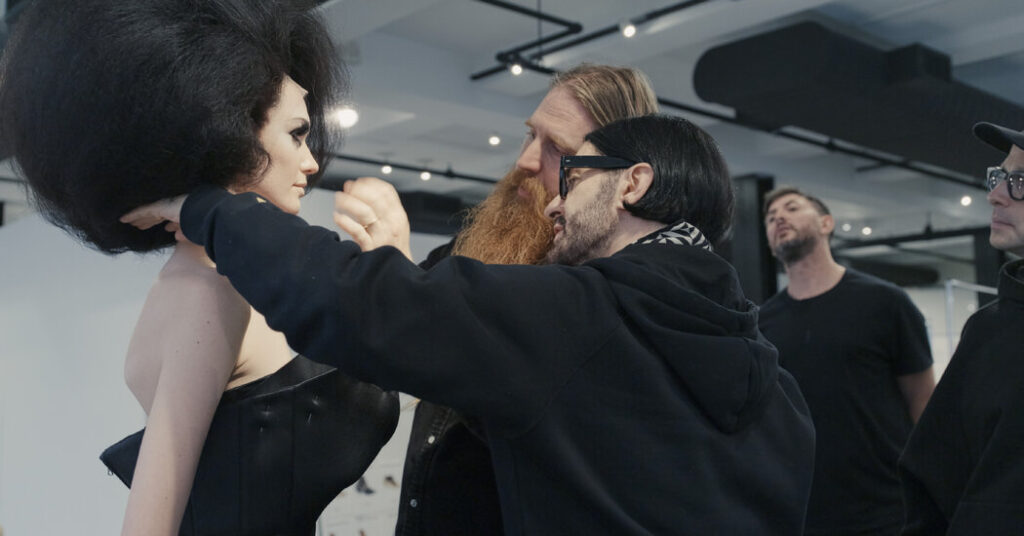
In Sofia Coppola’s new documentary about the designer Marc Jacobs’s fashion career, he is fond of the term “punk.” Bandying it about, he uses it to connote iconoclasm or edge, theatricality or cheek. A person can be punk; so can a handbag. Among others, Jacobs confers punk on the designer Vivienne Westwood, the ballerina Karole Armitage and the artist Marcel Duchamp.
“Marc by Sofia” is, disappointingly, not quite punk, even by the film’s versatile definition. Coppola opens the film — her first nonfiction feature — 12 weeks before the designer’s spring 2024 runway show, as he and his team start with nothing but an array of fabric swatches. From there, the film follows a conventional structure with frequent excursions into past episodes from his career, many of which Coppola, a longtime friend of Jacobs, was around to witness.
One might expect Coppola’s proximity to the material to lend it a measure of intimacy. Here is the woman who attended his earliest shows in the 1990s, appeared as a muse in his 2000s campaigns and orbited his scene throughout. But both subjects — if we can call Coppola a partial subject of her film — mostly come across as guarded. Two creative decision makers more at ease behind the scenes, they are, perhaps, not the most natural chroniclers of their own careers and social lives, and as the film goes on, it strains to arrive at even the most basic personal revelations.
The conversation flows more easily when Coppola and Jacobs gush about other artists, specifically the cinematic influences Jacobs draws from while developing his shows. Pairing the interview with archival montages, Coppola shows how the palette and styling in films like Rainer Werner Fassbinder’s “The Bitter Tears of Petra von Kant,” Gene Kelly’s “Hello, Dolly!” and Bob Fosse’s “Sweet Charity” have woven their way into Jacobs’s work. Classic Hollywood stars like Liza Minnelli and Elizabeth Taylor also loom large. “All roads lead to Liz,” the pair agree as Jacobs shares a brooch design inspired by Taylor’s collection.
These segments are the film’s richest, and not only because they offer a sumptuous trove of fashion-in-film references, but because they build to the documentary’s greatest insight: that fashion shows are pure drama. “In another life I really want to be a theater director,” Jacobs muses at one point. His runway shows, marked by thespian makeup, music cues and elaborate set design, are less about the clothes than the spectacle. Amid an industry so often awash in unchecked wealth and inaccessible luxury, it’s exciting to see couture framed around fantasy, fun and play.
Interestingly, Coppola declines to include journalists or experts, the talking heads documentaries usually call on for context and analysis. They aren’t necessarily missed, although a little more rigor alongside the affectionate reminiscences would have deepened the film’s biographical chapters. When, toward the end, Coppola suggests that Jacobs’s taste for escapism might have roots in his volatile upbringing, he briefly acknowledges the connection and then moves on. The documentary swiftly does too.
Marc by Sofia Rated PG-13 for swearing and ripping cigs. Running time: 1 hour 27 minutes. In theaters.
The post ‘Marc by Sofia’ Review: A Fashion Friendship Across Decades appeared first on New York Times.