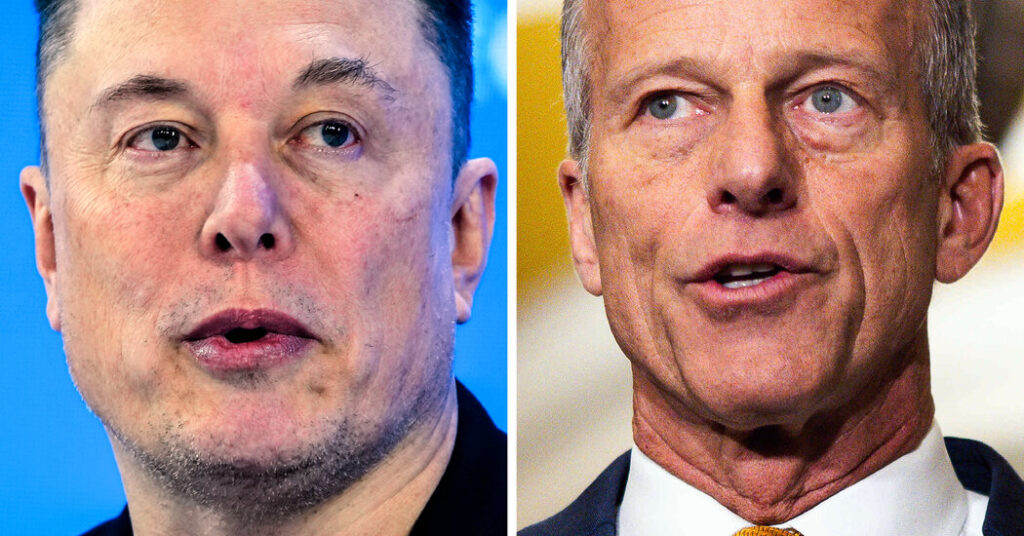
Just a month after Elon Musk donated $5 million to Senator John Thune’s allied super PAC, the billionaire began to unleash a torrent of online attacks and memes about the majority leader.
Mr. Musk’s anger stems from his fixation on passing the SAVE America Act, a strict voter identification bill that President Trump has demanded and the Senate is now debating. In the eyes of Mr. Musk and right-wing Republicans, Mr. Thune is not pushing hard enough to force through the legislation, never mind a lack of votes or the complexities of Senate rules.
“He can’t get it done,” Mr. Musk wrote of Mr. Thune, a South Dakota Republican, last month on his social media site X, responding to a user who had called the Republican leader “SPINELESS.”
Over the next few weeks, Mr. Musk reposted messages suggesting Mr. Thune was “corrupt,” declared that “failing to pass SAVE is an act of high treason against the people of America” and encouraged his nearly 237 million followers to call the senator’s offices in Washington and South Dakota.
Mr. Musk has long been consumed by the notion that many noncitizens vote in the United States, despite a lack of evidence. He wrote last month, with more than a little hyperbole, that if the bill did not pass, “it would be the end of democracy in America.”
In all, Mr. Musk has posted, reposted or replied to posts on X about the SAVE America Act over 100 times this year, according to a New York Times analysis of his feed. (He has also shared dozens of other messages about voting issues more broadly.) The posts and reposts include Thune-themed memes, cartoons with emoji-laden internet-speak and, on a few occasions, apparent suggestions that the majority leader’s inaction is traitorous.
Mr. Musk’s pressure campaign to pass the SAVE America Act represents his most aggressive public engagement in politics since he left Washington last spring in a furious fight with Mr. Trump as his time leading the Department of Government Efficiency came to a close. The tech mogul, the president and other supporters of the legislation say it is needed to prevent noncitizens from voting, even though it is already illegal for them to do so.
Mr. Musk is known for erratic political moves. He was the Republican Party’s biggest disclosed political donor in the 2024 election cycle and parlayed that into a powerful Trump administration job. After he left the government last year, he said he was done with the Republican Party and would start a third party, before abandoning that agenda by the fall and gradually rekindling relations with Mr. Trump in recent months.
So far, Mr. Musk has not evidently backed up his tough talk on the voting bill by using his vast fortune to promote it or by arm-twisting Senate Republicans behind the scenes. A person close to Mr. Musk’s super PAC told The Times last month that the billionaire was likely to make spending decisions in the midterms based in part on how lawmakers voted on the measure.
But his megaphone alone is not to be underestimated, and some allies of Mr. Thune are taking him seriously — and holding him partly responsible for placing the majority leader in such a difficult spot.
Mr. Thune has complained about “paid influencers” who are pushing the Senate to pass the bill. A spokesman for the majority leader declined to comment on Mr. Musk’s pressure. Mr. Musk did not respond to an email requesting comment.
Mr. Trump has said that the SAVE America Act should be Congress’s top priority, but the math makes its passage an uphill battle. Senate Democrats oppose it, leaving Republicans, who control 53 votes, well short of the 60 they would need to overcome a filibuster.
To Mr. Musk’s chagrin, Mr. Thune has resisted the idea of forcing a talkathon on the Senate floor to try to wear down Democrats’ opposition. He has also previously vowed not to undermine Senate filibuster rules to allow Republicans to ram through legislation on party-line votes, and has made it clear in recent days that even if he wanted to, there are not enough G.O.P. senators willing to resort to the tactic.
The legislation includes several new voting restrictions, including requiring people to provide documentary proof of U.S. citizenship when they register to vote and mandating that all voters present a government-issued photo ID at polling places.
Mr. Musk’s desire for the bill to pass is driven by his long-held belief that voter fraud is rampant in the United States. He routinely amplifies posts on X that suggest that the country is at risk of being overtaken by undocumented immigrants who vote in American elections. And he has said repeatedly that the Democratic Party is “importing” such voters as a political strategy, echoing the false, conspiratorial beliefs known as replacement theory.
All of this has led to his face-off with Mr. Thune, who agrees that the bill should become law but who is fundamentally a creature of Washington who talks about Senate procedure and the art of the possible in a way that Mr. Musk struggles to appreciate.
Mr. Musk did not support Mr. Thune when he ran for Senate majority leader in late 2024, calling him the “top choice of Democrats” and preferring a more MAGA-aligned rival. Last summer, the two fought over the Trump administration’s reconciliation bill, which Mr. Thune pushed through despite Mr. Musk’s objections that it did not seriously address the country’s debt.
But they developed a cordial relationship along the way, two people briefed on their interactions said, and last year Mr. Musk gave $10 million in total to Senate Republicans’ main super PAC, the Senate Leadership Fund, which works to achieve Mr. Thune’s aims. In January, Mr. Musk was all smiles with Mr. Thune when they met and toured a Tesla factory outside Austin, Texas.
Over the next few weeks, the tide turned. Mr. Musk did his first re-sharing of criticism of Mr. Thune just five days after the Tesla visit. He has since reposted messages questioning Mr. Thune’s integrity and suggesting that he should be replaced as majority leader. He has also affirmed posts that say Mr. Thune is engaging in “political theater” and “failure theater” and suggested that asking who “owns” the senator was a “good question.” (That one was answered last week, at Mr. Musk’s request, by Grok, the billionaire’s artificial intelligence chatbot.)
“Thune needs to sings a different tune,” Mr. Musk wrote last week on X.
“Pass the SAVE act,” he wrote to Mr. Thune 30 minutes later. “That’s what an overwhelming majority of Americans want.”
Mr. Musk and Mr. Thune have not spoken since the January visit to Tesla, according to a person familiar with the relationship.
The one individual candidate Mr. Musk has financially backed so far in the 2026 midterms — Nate Morris, a Republican candidate for Senate in Kentucky — has frequently attacked Mr. Thune’s predecessor as majority leader, the retiring Senator Mitch McConnell of Kentucky.
Dylan Freedman and Stuart A. Thompson contributed data analysis.
Theodore Schleifer is a Times reporter covering billionaires and their impact on the world.
The post Musk Whips Up Frenzy Against Thune Over Voter ID Bill appeared first on New York Times.