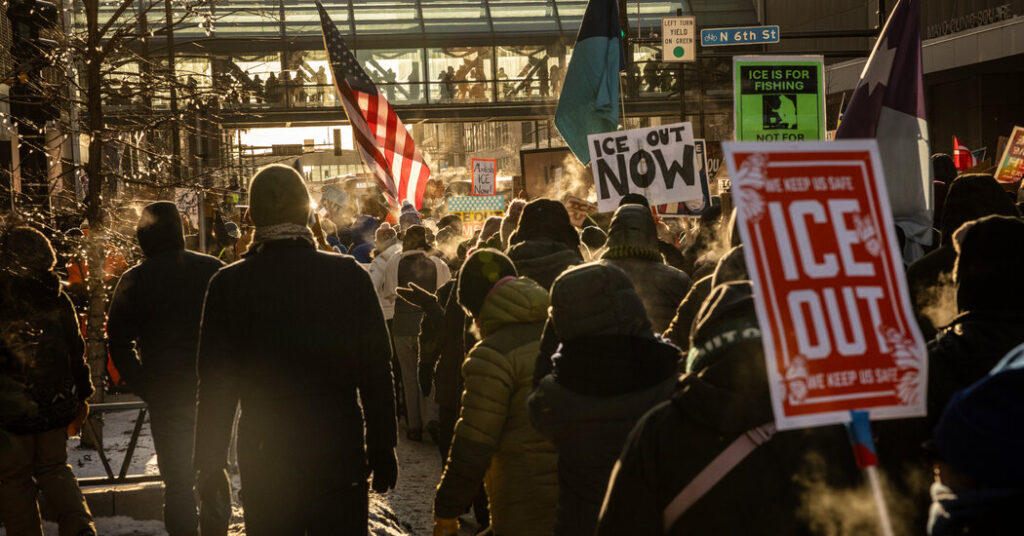
Just days after Minneapolis erupted into protest over the second killing of a resident demonstrating against immigration agents, a top Justice Department official delivered a hardball message to federal prosecutors.
Go after the protesters with everything you have.
In a conference call in late January, the official, Aakash Singh, laid out the department’s basis for prosecuting demonstrators: National Security Presidential Memo 7, a sweeping directive issued by President Trump last September. It expanded the definition of domestic terrorism to include not only violent crimes like assault, but also relatively minor ones, like revealing the personal details of agents or getting in the way of immigration enforcement.
Mr. Singh said that “coordinators” in U.S. attorneys’ offices responsible for charging protesters under NSPM-7 should be “hounding” federal agents to make cases, according to people familiar with his remarks. He also suggested that the department wanted headlines along with indictments, promising that officials in Washington would be “blasting out” prosecutors’ work.
“Go big,” Mr. Singh said, “and go loud.”
Time and again, in cities that have borne the brunt of the administration’s immigration crackdown, agents have gone after demonstrators with an aggressive array of tactics. They have seized cellphones and taken cheek swabs without warrants, court papers say; used license plate readers and facial recognition programs to identify protesters; and subpoenaed tech companies for information about social media accounts that track or criticize immigration agents.
But even though the Trump administration has portrayed protesters as left-wing terrorists and pushed for serious charges to be filed, often over actions that defense lawyers say are protected by the First Amendment, the efforts have failed so far to reveal a pervasive web of leftist groups working together. Indeed, the conspiracy cases the Justice Department has filed against demonstrators it has cast as left-wing activists have had limited success, for now.
Last week, the department secured the convictions on terrorism charges of a group of young people accused of being members of antifa, the radical left-wing movement, after they shot and wounded a police officer during an attack on an Immigration and Customs Enforcement detention center in Alvarado, Texas, last summer. But the victory was undercut by the government’s own cooperating witnesses, five of whom denied under oath that they or the defendants actually belonged to antifa.
Around the same time, prosecutors in Chicago abruptly dropped all charges against two of six protesters accused of obstructing an immigration agent in his vehicle outside an ICE facility in Broadview, Ill., after videos showed the agent himself had turned the vehicle into a crowd of demonstrators.
While the case remains against the other four defendants — all Democrats who have vocally criticized the Trump administration — prosecutors recently admitted there was no “advanced planning” or “preexisting agreement” by the group. Instead, prosecutors say its members entered into a “spontaneous conspiracy” that began the moment their protest did — a theory the defense has derided as “tenuous.”
As Justice Department leaders have pressed top prosecutors to bring cases against protesters, at least one has quit rather than file charges. Last summer, in a little-noticed move, Richard R. Barker, the acting U.S. attorney in the Eastern District of Washington, resigned instead of signing an indictment against nine protesters who were later charged with impeding federal agents driving immigrants to a court hearing in Tacoma.
Mr. Barker’s qualms about the case were validated by his successor, who let most of the defendants plead guilty this winter to a sweetheart deal in which their felony charges would be dropped to misdemeanors if they stayed out of trouble for 18 months.
“I knew there was no place for me in the Justice Department if I was being asked to bring felony charges against these protesters in a way that would compromise my integrity,” Mr. Barker said in a recent interview. “This was not an organized conspiracy. It was a protest where people were exercising their free-speech rights.”
In a statement on Wednesday, Chad Gilmartin, a Justice Department spokesman, defended the cases against protesters, noting they were filed in response to “an unprecedented spike in obstruction of federal law enforcement actions and assaults on federal officers.”
“Antifa is an existential threat to our nation and the rule of law,” Mr. Gilmartin wrote.
Mr. Trump’s desire to crack down on antifa and other left-wing movements has only intensified since he returned to office, accelerated by protests against his immigration policies and by the killing of the right-wing activist Charlie Kirk.
Shortly after Mr. Kirk was fatally shot last September, Stephen Miller, the president’s top domestic policy adviser, blamed leftist groups for the killing and declared that the administration would go after them using “every resource we have at the Department of Justice, Homeland Security and throughout this government.”
Two weeks later, Mr. Trump issued NSPM-7, which cited Mr. Kirk’s murder and the purported threat from antifa as justification for a new strategy to “disband and uproot networks, entities and organizations that promote organized violence.” The memo ordered a whole-of-government approach to investigating not just violent crimes, but also actions based on purely ideological beliefs, including anticapitalism, anti-Christianity and even hostility toward “American views on family, religion and morality.”
After the publication of NSPM-7, the Justice Department began establishing an internal architecture to prosecute protesters with left-leaning views.
Mr. Singh issued a memo instructing some U.S. attorneys’ offices to draft plans to investigate a group funded by George Soros, the billionaire donor who has often supported left-wing causes. He also installed coordinators in many offices to encourage NSPM-7 cases. The F.B.I. set up its own NSPM-7 mission center in Washington to oversee investigations into left-wing movements, according to people familiar with the move.
Under another NSPM-7 initiative, the bureau is close to reaching an agreement with the Internal Revenue Service to investigate nonprofit organizations known as 501(c)(3)s, according to people familiar with the discussions. The term refers to groups that have tax-exempt status because they engage in charitable, educational, religious, or scientific work.
In a second conference call on Wednesday, Mr. Singh highlighted this effort to federal prosecutors across the country, according to people familiar with his remarks. He said that federal law enforcement was not doing enough “to attack the funding of these groups,” the people said.
Some protesters caught up in investigations have described being detained for hours without charges and being asked to relinquish their cellphones — even swabs of DNA — without warrants.
When McKenna Walker, 27, was arrested at an ICE protest on Jan. 17 in Minneapolis, she said she was baffled after immigration agents seized her phone without a court order and tried to take a cheek swab from her. She refused; they backed down.
“What they were trying to do was totally wild,” she recalled.
Agents on a team of Department of Homeland Security investigators, known as Homeland Security Task Force Group 4, have also been assigned to scrutinize “organizations involved in illegal activities during protests,” according to court papers in a recent criminal case in California. It is unusual for agents to investigate particular groups or people rather than specific crimes.
The case centers on VC Defensa, an immigrant advocacy group in Ventura County that is outspoken in its opposition to ICE. It runs a rapid response network of activists who track and follow agents, helps organize protests against ICE and offers assistance to undocumented immigrants.
It helped spread word last year of a large-scale immigration raid at a cannabis farm in Ventura County, which attracted protests that became volatile as federal officers threw crowd control munitions. Federal agents contend that some of the protesters threw rocks and engaged in other forms of violence; protesters and observers have testified that they saw peaceful protests.
Months after the raid, Virginia Reyes, a VC Defensa volunteer who was active in trailing ICE agents, was arrested along with her brother, Isai Carrillo. They were charged with the same crime many ICE protesters have recently faced: a conspiracy to impede federal agents.
Prosecutors say that during the operation, Ms. Reyes used her vehicle to block federal officers from leaving the property while Mr. Carrillo and others threw rocks at them, injuring a federal contractor. Both have contested the charges. In a charging document, a Department of Homeland Security agent noted Ms. Reyes’ ties to VC Defensa and messages on her phone opposing ICE, citing her statements and the group’s desire to stop immigration enforcement as evidence of wrongdoing.
Leo Martinez, one of VC Defensa’s main organizers, said the group is brazen about its opposition to ICE, but acts within the bounds of the law. A lawyer for Mr. Carrillo echoed those remarks last October, acknowledging in court that VC Defensa monitored ICE movements. But, she asserted, “that’s very different than a criminal organization seeking to agitate.”
Some experts have cautioned that when elected officials seek to frame political dissent as a security threat, as Mr. Trump has done in his executive actions, law enforcement agencies can face pressure to bring cases even when the evidence is weak.
“Read narrowly, these directives target genuine criminal conduct — assaults on federal officers, conspiracies to commit violence,” Thomas E. Brzozowski, the former chief legal adviser for domestic terrorism cases at the Justice Department, wrote in a recent analysis of Mr. Trump’s presidential memos. “Read broadly, they invite investigations that begin with ideology and work backward to find crimes.”
In his conference call in January, Mr. Singh referred to another high-profile action by the Justice Department against immigration protesters: a conspiracy case in St. Paul, Minn., in which 39 people — including the former CNN anchor Don Lemon — have been charged in connection with a demonstration at a local church where a pastor also worked as an ICE employee.
Mr. Singh referred to the protest as among the worst attacks on a house of worship in American history, resulting in the defendants being accused of plotting to deprive the congregants of their rights and of interfering with religious freedoms. And yet no career prosecutors at the U.S. attorney’s office in Minnesota are litigating the case, which is unusual. It is being handled instead by lawyers from the Justice Department’s civil rights division in Washington.
Defense lawyers have argued that the protest was a political act and that prosecutors will not be able to prove that the defendants intended to interfere with religious activity. They have also claimed that while the protesters sang, chanted and engaged in “verbal confrontations” with congregants, there is little evidence that they used force.
Lawyers for Mr. Lemon and Georgia Fort, another journalist who was covering the church demonstration, have in particular claimed that their clients were not involved in political activism, yet were prosecuted anyhow.
The lawyers noted that a federal judge in Minneapolis initially declined to issue arrest warrants for either Mr. Lemon or Ms. Fort, finding there was no evidence they had committed crimes. But the Justice Department still sought their indictment after Mr. Trump and top department leaders publicly called for them to be charged.
“In the United States of America, we do not prosecute journalists for doing their job,” the lawyers wrote. “That happens in Russia, China, Iran and other authoritarian regimes. And yet the government sold this unconstitutional mess to the grand jury.”
Hamed Aleaziz, Devlin Barrett and Glenn Thrush contributed reporting, and Sheelagh McNeill contributed research.
Alan Feuer covers extremism and political violence for The Times, focusing on the criminal cases involving the Jan. 6 attack on the Capitol and against former President Donald J. Trump.
The post ‘Go Big and Go Loud’: Inside the Justice Dept.’s Push to Prosecute Protesters appeared first on New York Times.