For governments around the globe, the prospect of a prolonged war in the Middle East is raising the risk of fiscal strain on already stretched public budgets.
Officials from London to Seoul to Bangkok are starting to grapple with a vexing dilemma: Spend more to shield citizens from surging energy costs, risking the ire of global debt investors, or choose fiscal discipline and face the political backlash that is certain to follow.
No country is immune to the problem, but it is especially acute in countries throughout Europe and Asia where dependence on imported oil and gas is great and inflation is an economic and political concern.
Governments with high debt levels are staring down creditors restless about public finances drawn down by military spending, critical public services, aging populations and infrastructure investments.
At the same time, the scars of the last energy crisis, which followed the Russian invasion of Ukraine in 2022, are still visible. Some countries have moved quickly to offer relief to households as the war in the Middle East has escalated. Portugal has cut taxes on diesel. Greece has imposed a cap on corporate profit margins on the sale of fuel and some groceries. In South Korea, the government is considering expanding an energy voucher program for households.
“Fiscal space is important, but the political pressure here is a much more important driver,” said Angel Talavera, the chief European economist at Oxford Economics, a research group. “The threshold for action is much lower because prices have become a hugely contentious issue with voters.”
So far, fiscal interventions have been limited and skewed toward cutting fuel costs for drivers; targeted support is affordable.
But with Iran targeting major energy facilities in Qatar and Saudi Arabia in retaliation for airstrikes on its South Pars offshore gas field, disruptions to global energy flows are showing little sign of subsiding. Officials may soon have to make difficult choices between alleviating economic pain and reducing budgets for popular programs, potentially borrowing more in the process.
In Europe, doable but painful options.
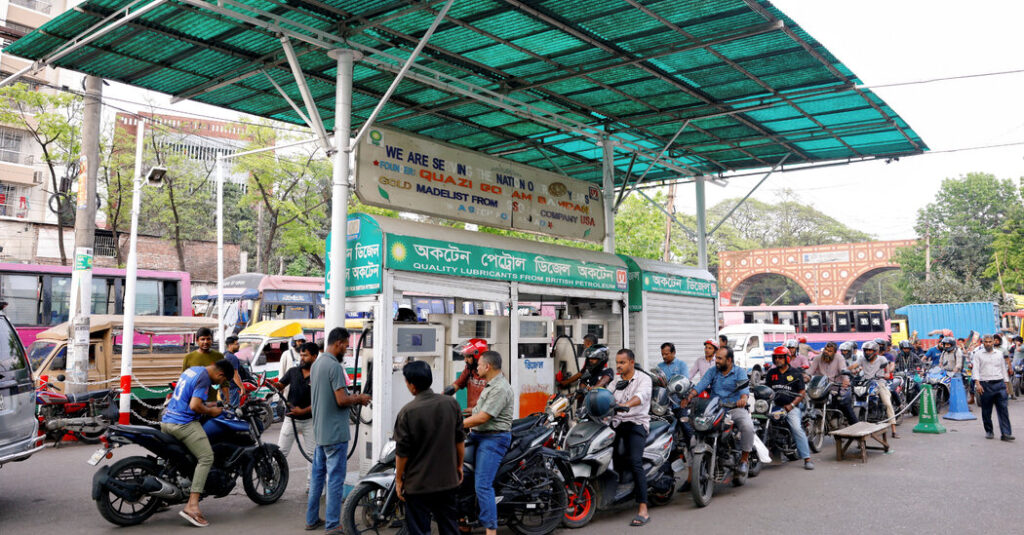
Of the roughly 20 percent of global oil and liquefied natural gas that moves through the strait, about 80 percent is destined for Asian markets. Some Asian airlines are worried about running out of jet fuel; in Bangladesh, the government ordered fuel rationing and closed universities. Several local governments in the Philippines have shifted to four-day workweeks.
While European countries import relatively little oil and gas from the Middle East, energy prices have still surged. Analysts warn that European buyers will face heavy competition from Asian importers for supplies from other parts of the world, further driving up prices.
Sander Tordoir, chief economist at the Center for European Reform, a research institute, said Europe’s overall public finances are in good shape, but that a repeat of the level of relief that governments provided consumers and businesses in 2022 would raise troubling prospects. In the European Union, energy subsidies nearly doubled to 397 billion euros, or $457 billion, in 2022 from a year earlier. Over two years, the British government provided about 75 billion pounds ($100 billion) of support, including subsidizing household energy bills.
“If that’s the kind of order of magnitude that European countries will have to spend on this, it is doable, but painful,” Mr. Tordoir said.
The starkest example may be Britain. This week, its government announced £53 million to help those who depend on heating oil, an acute problem in Northern Ireland. But it has so far stopped short of wider changes, such as postponing an upcoming increase in fuel taxes for drivers.
The British government has bound itself to strict fiscal rules to appease bond investors who are wary of the country’s high debt levels and low growth outlook. Britain’s bond yields tend to rise more sharply than those of its neighbors in a sell-off, driving up borrowing costs. Last year, the government was spending £1 in every £10 on debt interest payments. Now, just as the fiscal picture is starting to improve, the war in Iran risks derailing it.
“The U.K. is especially vulnerable,” Mr. Tordoir said.
Germany, Europe’s largest economy, has very little fiscal leeway, said Marcel Fratzscher, the president of the German Institute for Economic Research. In 2022, Germany slashed taxes on gasoline and diesel for a few months, costing €3 billion, among other measures. If oil and gas prices stay at current levels for the year, Germany’s expected economic growth this year would be halved to 0.5 percent, Mr. Fratzscher’s organization estimates.
“This is nothing that the government can find in the current budget or shift money around,” he said. “And that’s only the beginning.”
Likewise with France. Though it is insulated by having a lot of domestic nuclear energy, the French government has struggled to bring down debt levels. It is a country that “can’t afford to be doing extravagant spending,” Mr. Talavera of Oxford Economics said.
Greece, Spain and Portugal make up one relatively bright spot. Once marked by high debt and loose commitments to fiscal responsibility, the three have improved their fiscal positions, either by bringing down debt or, like Spain, by generating strong economic growth. That has allowed them to act first to try to shield households and businesses from rising costs.
“The classic ‘worry children’ are not really of any concern,” Mr. Tordoir said.
Another oil shock for Asia.
In recent years, Asia had been making progress reining in deficits that spiked during the Covid-19 pandemic, according to Albert Park, the chief economist at the Asian Development Bank. But trade disruptions stemming from the war are “another shock” that could push debt higher again.
“That is a concern especially for those countries that are already walking a fine line on debt sustainability,” he said.
The wealthier economies of Japan, South Korea and Taiwan have measures, such as energy voucher programs, to help shield consumers from surging prices. They also have relatively robust foreign exchange reserves and credit lines.
The impact is expected to be more pronounced in Asia’s emerging markets, said Stefan Angrick, head of Japan and frontier market economics at Moody’s Analytics. In Southeast Asia particularly, governments have historically relied on state funding as a shield against energy price volatility, a strategy used aggressively in 2022.
At that time, Thailand tapped a state-led fuel fund designed to subsidize costs during price spikes. Midway through 2022, the fund started running a multibillion-dollar deficit, forcing the government to secure emergency loan guarantees.
Thailand has resumed its reliance on the fund, spending tens of millions of dollars daily to subsidize diesel. This month, its balance plunged into a deficit again, prompting the government to consider new loan guarantees.
Both Thailand and Indonesia, whose government has signaled plans to increase fuel subsidies, face significant risk of sovereign rating downgrades, the Japanese bank Nomura warned recently. That could raise their borrowing costs.
For now, the two countries’ financial interventions “will limit volatility,” Mr. Angrick of Moody’s said. “But given fiscal limitations, that’s also something that they will not want to keep up for a prolonged period,” he added.
Among Asia’s most vulnerable countries, according to Mr. Angrick, are Bangladesh and Pakistan, which rely on the Mideast for two-thirds or more of their liquefied natural gas and oil supplies and already face financing pressures.
Also at risk are Pacific Island economies including Tonga, Fiji and Samoa, according to Mr. Park of the Asian Development Bank, as well as the Maldives.
While energy costs are still a long way from their 2022 levels, the pressure to spend and the damage to economic growth will compound if the war drags on.
Governments with tight budgets will need to use directed subsidies, not broad spending measures, Mr. Park said. At the same time, higher energy prices and inflation will weigh on companies and consumers.
“There will be bigger and bigger effects on economic output,” he said, “and that is another shock that will undermine debt sustainability.”
Eshe Nelson is a Times reporter based in London, covering economics and business news.
The post The Iran War’s Economic Threat to Europe and Asia appeared first on New York Times.