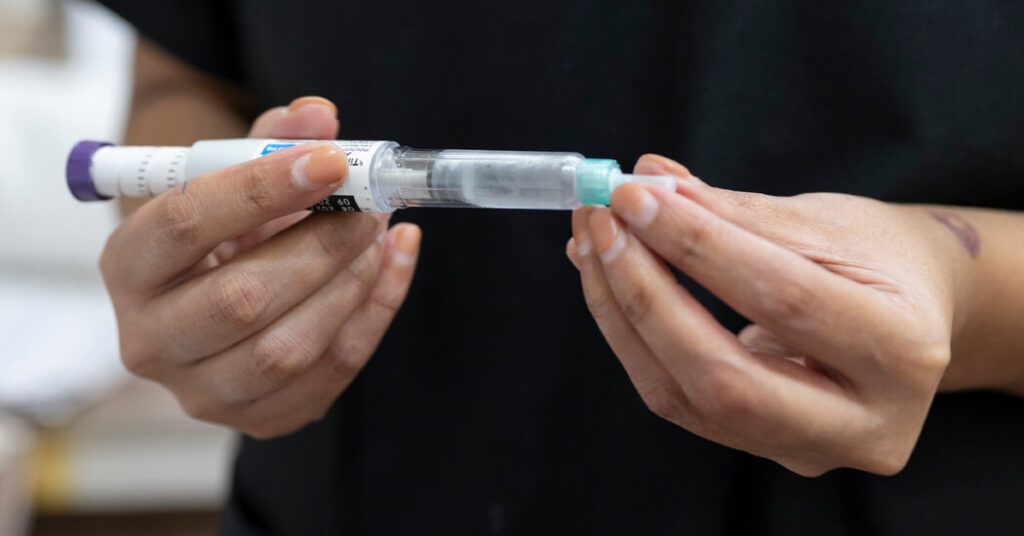
The blockbuster weight loss drug sold as Ozempic and Wegovy will soon go generic in countries that are home to 40 percent of the world’s population, significantly lowering the price of a costly medicine that had been largely unaffordable to nearly all but the wealthiest people.
On Saturday, Novo Nordisk, the company that until now has had a monopoly on selling the drug, will lose patent protection in several of the world’s most populous countries. The first generic versions are expected to arrive in India as soon as this weekend. In the coming months, the generics are also expected to become available in China, Canada, Brazil, Turkey and South Africa.
“The availability of these drugs, which have been restricted to high-income countries to very wealthy people, will now be democratized by the generics,” said Leena Menghaney, an activist in New Delhi focused on treatment access.
The new markets for generics are enormous. Together, India and China are home to more than 800 million adults who are obese or overweight and more than 360 million adults with diabetes.
The generics are poised to shake up a global market for drugs that have transformed the treatment of obesity. Novo Nordisk and its competitor, Eli Lilly, have generated huge sales around the world, but access has been very limited. Generics promise to significantly increase the number of people taking the drugs, which have also been shown to help prevent heart attacks and strokes.
In the United States and Europe, the drug is not expected to go generic until the early 2030s. That delay is due to special regulatory protections that are intended to encourage innovation by extending a brand-name drugmaker’s monopoly.
Dozens of generic manufacturers have been racing to produce supplies and win regulatory approvals in countries where they can soon compete. Huge demand is expected from patients who could not afford Novo Nordisk’s offering but can budget for cheaper generics. Novo Nordisk sells the drug, semaglutide, as Ozempic for diabetes and as Wegovy for obesity.
“I don’t think there has ever been so much excitement for any class of drug going off patent,” said Siddharth Mittal, chief executive of Biocon, a manufacturer in India that hopes to introduce generics next year in Brazil, Canada and Turkey.
Generic makers have not yet disclosed pricing plans. Analysts predicted that as more competitors enter the market, prices for the generics could eventually drop to about $15 a month. By comparison, higher doses of Wegovy can be bought in the United States without insurance for $349 a month.
(The drug is generally available at five dose levels. Higher doses are more expensive. Patients typically start at a low dose and move up to higher doses over a matter of months.)
The drugs are not a cure-all. Some patients stop taking them because of side effects, like nausea, vomiting and constipation, but adverse reactions that have been reported are rarely severe.
Public health advocates hope that if competition from generics drives down prices enough, national health insurance systems might agree to cover the drug for their citizens. Some public health systems, mostly in rich countries, pay for its use to treat diabetes, and all reject coverage for most people taking it to lose weight, because of the cost.
Argent Wang, 31, who lives in the northeastern Chinese city of Dalian, said she spends about $160 a month for the drug. She stopped working to manage complications from diabetes and lives at home with her mother, who also has diabetes. Ms. Wang’s doctor suggested that she switch to a different dose, but at $291 a month, she cannot afford it.
If a Chinese company offered a generic that was just as effective and cost under $75 a month, Ms. Wang might try it. “My expenses are so large, I will consider the path that saves money,” she said.
More competition for Novo Nordisk
The expiration of the patents presents more trouble for Novo Nordisk, whose stock has plummeted as global competition has eroded its market share. At its peak in mid-2024, the Danish drugmaker was the most valuable public company in Europe.
Eli Lilly, an American company that sells its weight loss drug as Mounjaro for diabetes and as Zepbound for obesity, poses the biggest competitive threat. Eli Lilly is expected to retain patent protection for another decade in most major markets.
Last year, the United States accounted for two-thirds of Novo Nordisk’s global sales of Ozempic and Wegovy. But the company has lost U.S. market share to cheap copycat versions of the drug produced through a process known as compounding. These are not generics; they fall into a legal gray area, and U.S. regulators recently vowed to restrict their sales.
Seeking to preserve its monopoly, Novo Nordisk has fought in courts in India, China and Brazil to try to block the generics. The company has also cut prices in China and India in anticipation of competition.
Officials at Novo Nordisk said the company had developed several strategies to keep reaching patients in countries where it will soon face generics. It might sometimes try to position the original version as a premium brand, they said.
Once the generics arrive in Canada, where Novo Nordisk’s patent protection expired in January, some U.S. patients might seek to import the drug from Canadian pharmacies.
Generic makers could also bring semaglutide to poorer countries where Novo Nordisk never sought patent protection and where there has been very little use of the drug so far. Researchers estimated that the generics could be mass-produced for as little as $3 a month per patient.
Anticipating lower prices in India
In India, Novo Nordisk sells higher doses of Wegovy for about $180 a month, a price that is out of reach for most patients.
“Many of my patients would benefit from them, but haven’t been using them because of their cost,” said Dr. Reema Arora, a dermatologist and cosmetologist in New Delhi.
Alkem Laboratories of Mumbai, one of several manufacturers that has won regulatory approval to market a generic in India, has been producing supplies and preparing to distribute them. “We will try and make sure as quickly as possible that we can make our product accessible to doctors and patients,” Vikas Gupta, the company’s chief executive, said.
On Instagram and WhatsApp, Indian patients have been eagerly discussing the arrival of the generics, said Himani Raj, who lives in Ahmedabad, in western India. She takes Eli Lilly’s drug and runs one of the discussions.
In New Delhi, Dr. Nivedita Dadu, a dermatologist, said she expects patient demand for the drugs to grow once cheaper generics become available. Already, she and her sister, an anesthesiologist, have been prescribing the brand-name drugs to hundreds of patients.
One, a 55-year-old man, lost enough weight that he was able to fit back into a beloved pair of jeans from 25 years ago, she said. “When he finally came to the clinic in those jeans, he got so emotional,” she said.
India, like many countries, does not permit the kind of prescription drug ads aimed at consumers that are omnipresent in the United States. But with generics looming, Novo Nordisk this month paid for a front-page ad promoting obesity awareness in The Times of India, a major newspaper. Eli Lilly has been running ads featuring Bollywood actors. Apparently in response, Indian regulators last week warned the makers of weight loss medicines about the rules against drug advertising.
Drug production booms in China
By early March, 10 generic competitors were in the final stage of being evaluated by Chinese regulators to sell their semaglutide products, and at least a dozen more firms had completed clinical trials.
The United Laboratories, which has its headquarters in the southeastern province of Guangdong and in Hong Kong, expects approval to sell its generic for diabetes before July, said Cao Chunlai, an executive at the company’s research and development subsidiary.
China’s national health insurance system covers Novo Nordisk’s drug for diabetes, while people taking it for obesity must pay out of pocket.
Novo Nordisk makes all of its global supply in-house.
But more than a dozen Chinese manufacturers have already been making active ingredients for semaglutide that is sold in markets around the world, including compounded versions for American consumers.
Lei Zhang, 33, a tech worker in the southern Chinese city of Suzhou, used to spend about $200 a month for Eli Lilly’s Mounjaro to manage his diabetes. But in August 2024, he switched to Ozempic, which is cheaper, reducing his out-of-pocket cost to just $16 a month.
Mr. Zhang said he’s optimistic about switching to a Chinese generic. Since so much semaglutide is already made in China, “there shouldn’t be much difference,” he said.
A long wait for Americans
Why are Americans and Europeans getting semaglutide generics so much later? The reason can be boiled down to a critical difference in how friendly countries are to the pharmaceutical industry.
Patents are good for 20 years after an application is filed. But because Novo Nordisk spent years developing its drug and waiting for regulatory review, the company has been selling it for only about eight years.
For situations like this, the United States and Europe grant brand-name drugmakers like Novo Nordisk special protections, called patent term extensions, giving them a monopoly for a few more years.
These protections date back to the 1980s and 1990s, when drugmakers intensely lobbied American and European lawmakers, arguing that a shorter monopoly span would discourage investment in new medicines. Such protections do not exist in India.
“These policies are essentially subsidies for the pharmaceutical industry,” at huge expense for American and European patients and taxpayers, said Tahir Amin, chief executive of the Initiative for Medicines, Access & Knowledge, or I-MAK, a nonprofit that tracks drug patents.
U.S. prices for Wegovy have fallen in recent months, in part because of a deal Novo Nordisk struck with the Trump administration in exchange for relief from the president’s threatened tariffs. But that deal did not cut prices as deeply as generic competition would have.
Because of the delay, millions of Americans who could have benefited most likely won’t have access to the drug. Meanwhile, spending on Novo Nordisk’s version of the drug will be inflated by tens of billions of dollars, I-MAK estimated.
Rebecca Robbins reported from Los Angeles; Meaghan Tobin from Taipei, Taiwan; Eshe Nelson from London; and Alex Travelli and Pragati K.B. from New Delhi.
Xinyun Wu contributed reporting from Taipei, and Murphy Zhao from Hong Kong.
Rebecca Robbins is a Times reporter covering the pharmaceutical industry. She has been reporting on health and medicine since 2015.
The post Ozempic Is About to Go Generic for Billions of People appeared first on New York Times.