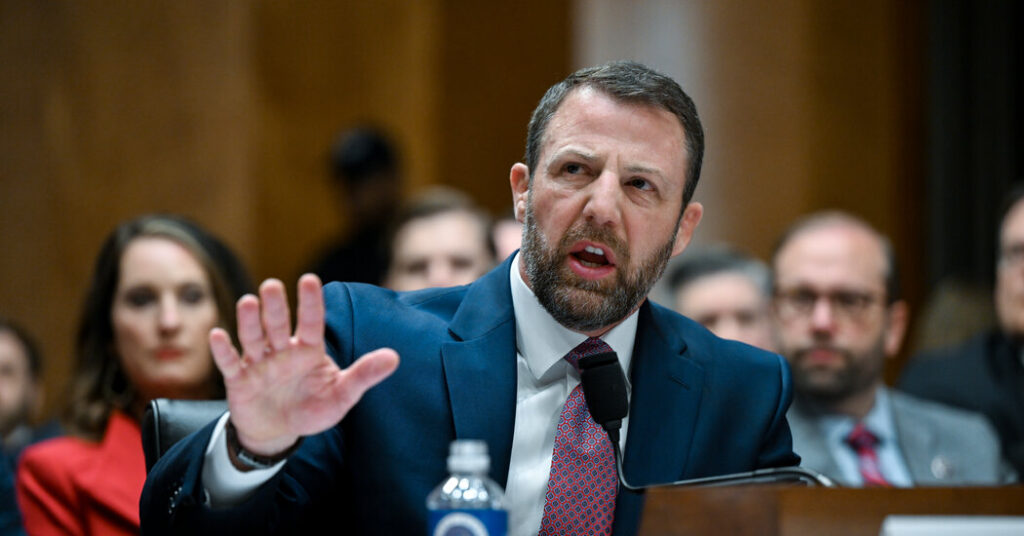
Senator Markwayne Mullin was grilled on Wednesday about comments he had made that suggested he had been in a war zone, even though he has not served in the military and had no record of holding a job that would take him to conflict areas before he was elected to Congress.
Senator Gary Peters of Michigan, the top Democrat on the Homeland Security Committee, pressed Mr. Mullin during his confirmation hearing on his past statements that he had completed “special assignments” overseas and was familiar with the “smell” of war. Mr. Mullin, a Republican of Oklahoma, is President Trump’s nominee to lead the Department of Homeland Security.
“War is ugly. It smells bad,” Mr. Mullin said on Fox News earlier this month. “And if anyone has ever been there and been able to smell the war that’s happening around you and taste it and fill it in your nostrils and hear it, it’s something that you’ll never forget.”
Asked about his international trips, the Oklahoma senator explained to Mr. Peters that he had tried to enter Afghanistan in 2021 to help get Americans out of the country. The attempts were well-documented in media reports at the time and drew objections from some political and congressional leaders. Mr. Mullin told Mr. Peters he had also taken an “official trip” that was classified when he was a member of the House a decade ago.
Mr. Mullin said that in 2015, he “was asked to train with a very small contingency and go to a certain area, which was scheduled for 2016,” he said. “During that time, I was asked to go through — had to meet certain training qualifications, certain qualifications, had to go through SERE training.”
SERE is the Air Force’s Survival, Evasion, Resistance and Escape training program, which is meant to prepare pilots for the possibility that they might be shot down behind enemy lines in wartime. It was created after the Korean War, when airmen who had been captured by Communist forces were tortured and forced to produce propaganda tapes against the United States.
The program includes undergoing various coercive interrogation techniques. After the terrorist attacks of Sept. 11, 2001, when the C.I.A. created its program to torture high-value Al Qaeda suspects, it drew on SERE to craft the techniques it used. Mr. Mullin did not explain why a sitting member of Congress would go through the program, a highly unusual occurrence.
“The training and stuff was kind of fun — the SERE training was absolutely awful,” he said, adding that he had never publicly spoken about the details of the trip, including its mission.
Mr. Peters said an F.B.I. report showed that Mr. Mullin had traveled to places that Mr. Peters thought included Georgia and Azerbaijan. Asked by Mr. Peters where he had “smelled war,” Mr. Mullin responded that he could not discuss classified information.
A House expenditure report from September 2016 states that Mr. Mullin took a trip to Jordan that year, arriving on Aug. 16 and leaving on Aug. 19. Jordan is next to southern Syria, which was then in the midst of a civil war.
Mr. Mullin said he was not yet on the House Intelligence Committee at the time, but was serving on the Energy and Commerce Committee.
Senator Rand Paul, the Kentucky Republican who chairs the Homeland Security Committee, raised the possibility of postponing the committee’s vote on Mr. Mullin’s nomination if he was not willing to discuss the trip. After Mr. Paul and Mr. Peters asked Mr. Mullin if he would provide more detail in a secure room for sharing classified information, the senators relocated there.
After walking out of the secure room, Mr. Mullin declined to answer questions from reporters about what had been discussed.
Senator James Lankford, Republican of Oklahoma, who was also in the meeting, brushed off questions afterward about Mr. Mullin’s travels and declined to share details with reporters.
“When you hear the story, you’re like, why is this a story?” Mr. Lankford said. “This is not a big story.”
Mr. Paul also declined to reveal more details about Mr. Mullin’s secretive trip on Fox News later that day. Mr. Paul, who sparred with Mr. Mullin during the hearing, said that he would not vote to confirm Mr. Mullin, pointing to his refusal to apologize for criticizing Mr. Paul.
Mr. Paul said the vote was still scheduled for Thursday “as of now.”
Mr. Mullin would most likely need the support of one Democrat to advance his nomination out of committee if Mr. Paul maintains his position. That backing may come from Senator John Fetterman, Democrat of Pennsylvania, who said before the hearing that he supported confirming Mr. Mullin.
Michael Gold and Charlie Savage contributed reporting.
Madeleine Ngo covers immigration and economic policy for The Times.
The post Mullin Faces Questions About War Zone Observations appeared first on New York Times.