Latino politicians in California routinely invoke Cesar Chavez as a source of inspiration for their activism. His portrait hangs in their offices. They have passed legislation making his birthday an official state holiday. And they chant “Sí Se Puede” at their own rallies.
In the 1960s, as Mr. Chavez and the United Farm Workers union rose to national prominence, there were a handful of Latino elected officials in the State Legislature. Today, Latinos make up nearly 40 percent of California lawmakers — what many see as a testament to their political power throughout the state.
Mr. Chavez became the first and most recognized Latino leader in American politics, and his union activism helped popularize the Chicano civil rights movement.
Even as some political leaders called the reports of his sexual assaults devastating, they spoke of meeting him for the first time with a kind of awe.
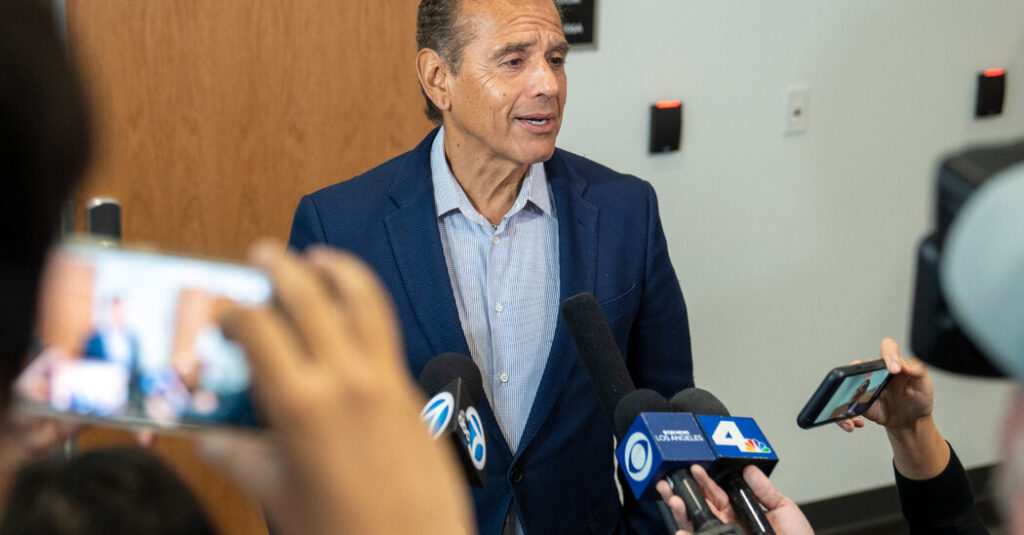
Antonio Villaraigosa, who in 2005 became the first Latino mayor of Los Angeles in modern history, recalled his first impressions when he was a 15-year-old activist in East Los Angeles.
“I remember hearing him speak about the indignities that farm workers endure and the grape boycott movement,” he said in a statement on Wednesday. “I was inspired by his quiet dignity and his seeming selflessness.”
Mr. Villaraigosa, a Democrat now running for governor, called the allegations “shocking, painful, and deeply troubling.” He added: “No individual, no matter how revered, is above accountability.”
Other prominent Latino leaders in the state also had ties to Mr. Chavez or to the farmworker union movement he led.
Art Torres, one of the first Latinos elected to the California Legislature, worked as a lawyer for the union in the 1960s and ’70s. Richard Alatorre, the co-founder of what became the California Latino Legislative Caucus, wrote the 1974 bill that allowed collective bargaining for farmworkers. When Mr. Alatorre died in 2024, a United Farm Workers flag was draped over his coffin.
But even as Mr. Chavez became a national icon, in some sense his political influence was more mythic than pragmatic.
“He was inspirational broadly, but there is a difference between inspirational and consequential,” said John Perez, a former speaker of the State Assembly who met Mr. Chavez as a teenager in East Los Angeles and again as a student at the University of California, Berkeley.
“He adamantly was very singularly focused on the union and not involved with a broader civil rights movement,” Mr. Perez added.
The U.F.W. created a field operation to help some political campaigns. But the union’s importance became more about its imprimatur for Democratic candidates, who continued to seek its endorsement.
Mr. Perez said that Ms. Huerta, who revealed on Wednesday that Mr. Chavez had forced her to have sex with him in the 1960s, deserves far more credit for her decades of work mentoring and helping politicians.
Even as membership in the union declined, U.F.W. held onto important allies in Washington and Sacramento, the state capital. Lorena Gonzalez, a former state lawmaker who is the daughter of a farmworker, helped bring the union into a powerful coalition known as the California Labor Federation.
Ms. Gonzalez, who grew up near San Diego, wrote her college essay about the Delano grape strike and boycott.
“There is nobody who has had a more profound place in my life than the role of Cesar Chavez,” she said in a 2014 speech.
In 2019, she wrote legislation to extend the statute of limitations for lawsuits about childhood sex abuse. On Wednesday, she said she was “just devastated” by the allegations against Mr. Chavez.
Jennifer Medina is a Los Angeles-based political reporter for The Times, focused on political attitudes and demographic change.
The post Chavez Inspired California’s Latino Leaders but Left a Complex Legacy appeared first on New York Times.