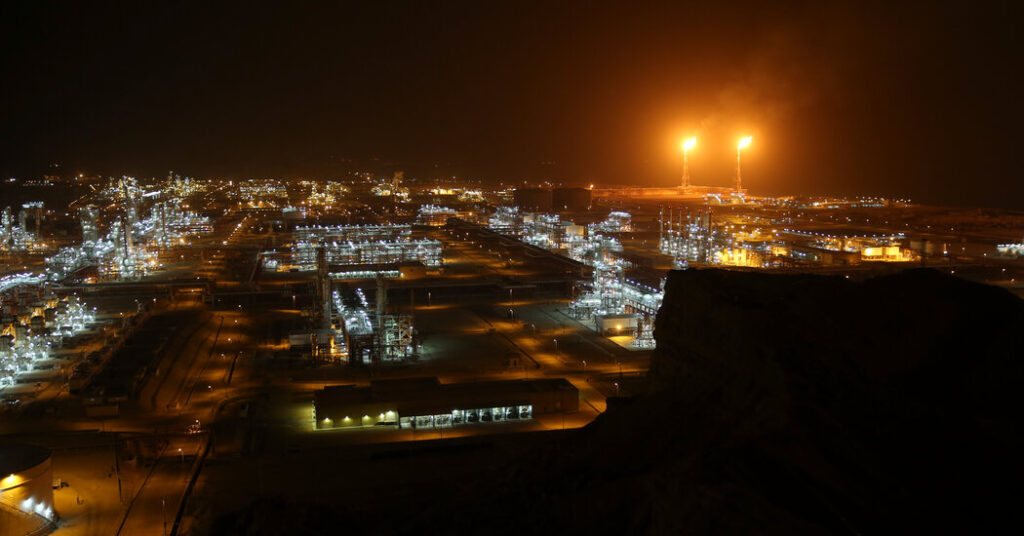
The attacks on the vast South Pars offshore gas field of Iran on Wednesday are sending oil and natural gas prices soaring around the world.
Within Iran, the damage to the gas field threatens to worsen the already crippling gas and electricity shortages that have plagued the nation for decades.
South Pars is a cornerstone of Iran’s energy supply, accounting for as much as 70 percent of the nation’s gas production. Initial reports indicated damage to sections of the gas field that make up nearly 12 percent of Iran’s total gas production, analysts said. Iran shares the gas field with Qatar.
Iran was plunging into “a severe gas shortage crisis,” said Dalga Khatinoglu, an Azerbaijan-based expert on Iran’s energy sector.
Late Wednesday, further attacks on South Pars raised concerns of an escalation of strikes on energy infrastructure across the region as the war waged by United States and Israel on Iran — and Iranian counterattacks — threatened to spiral out of control.
Iran’s heavy reliance on South Pars helps explain its swift talk of fresh retaliation.
Iran and Qatar have accused Israel of the attack. The bombing, and Iran’s response to it, are signaling that the Persian Gulf’s extensive energy facilities may be at growing risk.
The Islamic Revolutionary Guards Corps told people in other Persian Gulf countries including Saudi Arabia, Qatar and the United Arab Emirates to evacuate from around oil and gas facilities there, stating that they would be the target of Iranian attacks in the coming hours in retaliation for the damage to South Pars.
Iranian gas exports to Iraq have been completely cut off amid the attacks on Iran’s oil and gas infrastructure, the Iraqi Ministry of Electricity also said, raising the specter of a widening regional energy crisis.
Iran sits on the world’s second largest natural gas reserves after Russia. Yet even before the attacks on South Pars, provinces across the country had experienced debilitating gas and electricity shortages, particularly in the winter months, when demand for hot water and heating goes up.
To meet that shortfall, power plants across Iran have increasingly turned to burning mazut, a severely polluting “bottom of the barrel” residue of crude oil that is banned in much of the world because of its detrimental effects on human health. The burning of mazut had created an air pollution emergency in the months leading up to the U.S. and Israeli attacks.
A severe drought that has gripped Iran has also worsened air pollution, as wetlands around the country have dried up, making it easier for winds to sweep up dust.
Analysts said that the attacks on the giant South Pars field were likely to hasten a decline in productivity there that had been worsening Iran’s energy predicament. Gas production on the Iranian side of the South Pars field has been falling by about 10 billion cubic meters a year as the field has matured, Mr. Khatinoglu said.
Overall, Iran produces around 260 billion cubic meters of gas per year. Even amid a domestic shortage, it had exported about 18 billion cubic meters annually of that to countries like Turkey and Iraq.
Iran’s crumbling infrastructure has worsened the shortfall. Iran flares, or intentionally burns off, about 23 billion cubic meters of gas per year because of a lack of facilities to capture and sell it or use it as an energy source. Another estimated eight billion cubic meters a year is lost through leaks.
Meanwhile, a lack of access to clean-energy technologies and investment has kept Iran reliant on fossil fuels. Renewables and nuclear together make up less than 2 percent of its energy consumption.
Prof. Nima Shokri, an expert in environmental engineering at the Hamburg University of Technology in Germany, said any sustained disruption risked “cascading effects,” including rationing and increased reliance on mazut. If the damage to oil and gas infrastructure results in prolonged flaring and massive leaks, it would be “ecologically disastrous” to the region, he added.
“The strike on South Pars doesn’t just damage infrastructure,” Professor Shokri said. “It spreads pollutants across borders while crippling Iran’s fragile energy system, highlighting the risks of targeting energy facilities that power an entire region.”
Hiroko Tabuchi covers pollution and the environment for The Times. She has been a journalist for more than 20 years in Tokyo and New York.
The post For Iranians, Bombing of Gas Field Worsens Already Dire Energy Crisis appeared first on New York Times.