Israel has stepped up assassinations of top Iranian officials in recent days, in what the Israel Defense Forces said was a push to undermine command and control in Iran after more than two weeks of devastating airstrikes that have wiped out military infrastructure but not dislodged the regime.
But as Iran continues to escalate retaliatory strikes against its Persian Gulf neighbors, it is unclear what impact the targeting of senior leadership is having on Iran’s war effort. After an Israeli strike on Iran’s South Pars gas field Wednesday, Iran struck back at Persian Gulf energy facilities, roiling global energy markets.
“An eye for an eye equation is in effect, and a new level of confrontation has begun,” said Iranian Parliament Speaker Mohammad Ghalibaf, following the attack on South Pars, one of the world’s largest gas fields. Ghalibaf accused Israel of attacking infrastructure to conceal battlefield defeats in an X post.
The attack on South Pars is “dangerous & irresponsible,” said Qatar’s Foreign Ministry spokesman, Majed al-Ansari, in a post on X. “Targeting energy infrastructure constitutes a threat to global energy security,” he said. The United Arab Emirates said the attack on South Pars “represents a serious escalation.”
Iran fired back with missile attacks that caused “extensive damage” at a major Qatari gas facility Wednesday, according to Qatar’s state-owned energy company. In Riyadh residents reported loud explosions as air defenses intercepted a ballistic missile attack and in eastern Saudi Arabia, a drone attack was reported on gas facilities.
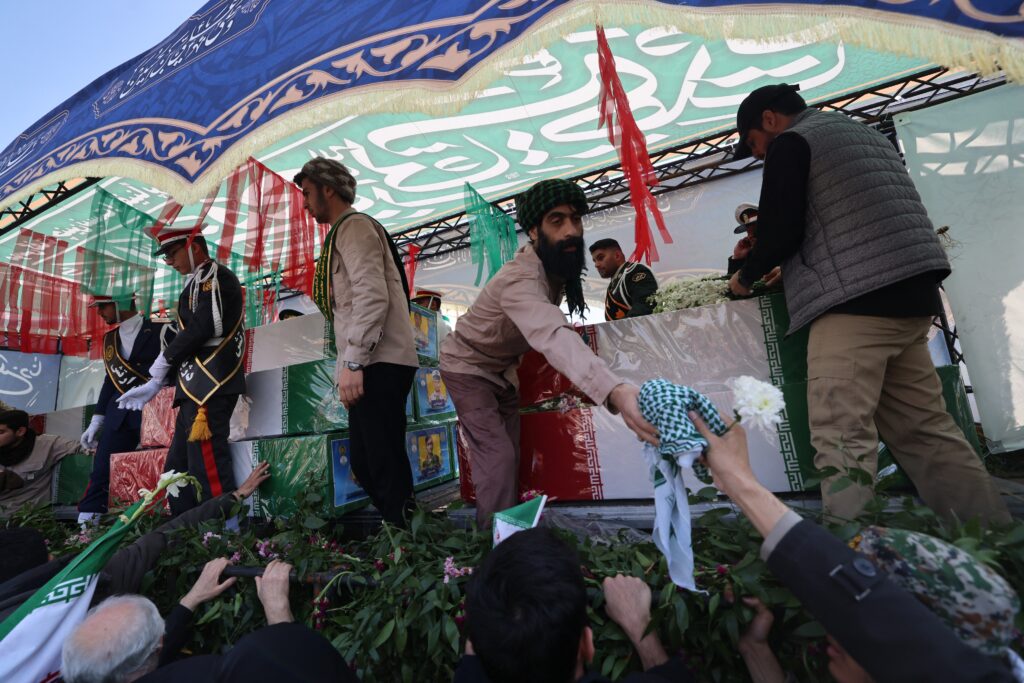
Inside Iran, Israel says its strikes have killed three senior Iranian officials in two days. Ali Larijani, the secretary of the Supreme National Security Council of Iran, was the most senior Iranian official to be killed since the strike that killed the country’s supreme leader at the outset of the war late last month.
Larijani’s death was announced Tuesday along with Gholamreza Soleimani, commander of the Basij paramilitary force. On Wednesday Israel announced the death of Iranian Intelligence Minister Esmail Khatib was killed in an overnight strike.
“The intensity of the strikes in Iran is reaching a new level,” Defense Minister Israel Katz said in a statement about Khatib on Wednesday. “Israel’s policy is clear and unequivocal: no one in Iran has immunity, and everyone is a target.”
U.S. intelligence assessments have found U.S. and Israeli strikes have weakened the regime, but do not appear close to toppling it. Additionally, the loss of key leadership appears to have left the regime more hardline and allowed the powerful Islamic Revolutionary Guard Corps to expand their control. In Senate testimony Wednesday, Director of National Intelligence Tulsi Gabbard told lawmakers the regime in Iran “appears to be intact but largely degraded.”
The strikes in Iran came as Israel also intensified its offensive in Lebanon, striking in the heart of the capital throughout the night before launching a campaign targeting all bridges on the Litani River — a rare assault on Lebanese state infrastructure.
Since the start of the conflict, more than 960 people had been killed in Lebanon and more than 2,432 injured, according to ministry of health figures Wednesday.
The sound of gunfire crackled through the heart of Beirut at 4 a.m., alerting residents in the Bachoura neighborhood that the Israeli military had posted an evacuation warning for a residential building there on social media. About 90 minutes later, an airstrike hit the lower floors of the building and leveled it — the first time in this war that the Israeli military has brought down an entire building in an area that would usually be considered safe.
Israel’s razing of the building in the very center of Beirut appeared to signal a new reality to both the Lebanese government and civilians that nowhere could be considered safe, following threats from Israeli military leaders to turn parts of Lebanon into Gaza-like devastation unless there is immediate action to disarm Hezbollah. The Lebanese government has said it cannot disarm Hezbollah while under attack, and analysts have warned that any attempt to do so could spark civil strife.
Entire building brought down in the middle of Beirut at 05:30 in the morning https://t.co/zOIydh6Brw pic.twitter.com/l5Lafzkn0t
— Abbie Cheeseman (@cheesemanab) March 18, 2026
Israeli leaders have vowed to continue pursuing Iran’s senior officials, with Prime Minister Benjamin Netanyahu saying that “crossing names off the list is good — doing it shoulder to shoulder with our American friends is even better” in a post on X on Tuesday, referencing a meeting with U.S. Ambassador to Israel Mike Huckabee.
Khatib’s death was confirmed by Iranian President Masoud Pezeshkian in an X post in which he also mourned the loss of Larijani and Defense Minister Aziz Nasirzadeh, who was killed on the first day of the U.S.-Israeli war against Iran. “I am certain their path will continue more steadfastly than before,” he said.
Khatib had been subject to U.S. sanctions since September 2022 for his role overseeing the Intelligence Ministry and directing cyberattacks, the U.S. Treasury said in a statement at the time.
Graphic by Júlia Ledur. Heba Farouk Mahfouz contributed to this report.
The post Israel steps up assassinations as Iran war widens to energy facilities appeared first on Washington Post.