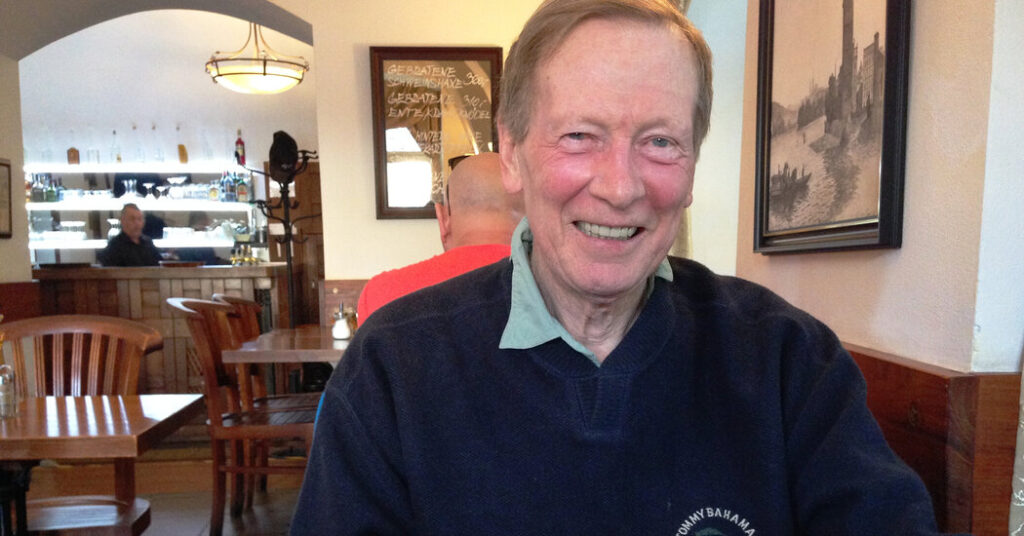
James L. Barnard, a South-African born environmental engineer who invented a biological method that helped transform wastewater treatment around the world, died on Jan. 27 at his home in Leawood, Kan., a suburb of Kansas City, Mo. He was 90.
His death was caused by complications of Parkinson’s disease, his wife Maryna Barnard, said.
It was in the 1970s that Dr. Barnard developed processes of using naturally occurring microorganisms to remove nitrogen and phosphorous from wastewater, so that, after being treated, it can be safely returned to rivers, lakes and oceans.
Nitrogen and phosphorous are essential nutrients, but their presence in excessive concentrations can cause blooms of algae and bacteria that turn water green or red, kill oxygen-starved fish and produce toxins that contaminate drinking water and sicken humans and animals.
For his pioneering work, Dr. Barnard was celebrated as the father of biological nutrient removal, or BNR. At treatment plants, naturally occurring bacteria enter with the wastewater and alternate between oxygen-free and oxygen-rich zones inside of bioreactors. This sequence stimulates the process that converts ammonia, a concentrated source of nitrogen, into harmless nitrogen gas, which is released into the atmosphere.
Phosphorous is consumed and retained in large amounts by another group of bacteria, which become engorged, as if they are the hot-dog-eating-contest winners of the microscopic world. These bacteria are separated from treated wastewater through sedimentation and removed from waste solids, which can then be processed and converted to fertilizer.
Before Dr. Barnard’s discovery, the traditional method of removing nitrogen and phosphorous from wastewater involved the use of chemicals, which were often more expensive, less dependable and less environmentally friendly.
In 2011, Dr. Barnard received the prestigious Lee Kuan Yew Water Prize, named for Singapore’s first prime minister. His citation for the prize said, “All BNR systems used worldwide today were developed from Dr. Barnard’s technology.” That still holds true, experts said.
Dr. Barnard helped design more than 100 nutrient-removal facilities on five continents, including the first one in the United States, in Palmetto, Fla., in the Tampa Bay area, in 1978, according to Black & Veatch, an engineering firm based in suburban Kansas City, where he worked for a quarter-century. His technical insights bolstered some of the world’s largest water-treatment systems, such as those in the New York City region and in Hong Kong.
Jeanette Brown, a research professor of civil and environmental engineering at Manhattan University in the Bronx, who worked with Dr. Barnard in protecting the water quality of Long Island Sound, said in an interview that his efforts helped ensure, locally and globally, that “water bodies will support fish life, will support recreation, swimming, all of the things we want.”
James Laing Barnard was born in South Africa on June 6, 1935, in Bellville, a suburb of Cape Town. He was one of eight children of Jacobus and Dorothea (Everts) Barnard, who were farmers. According to his family, he was a second cousin of Dr. Christiaan Barnard, the cardiac surgeon who in 1967 performed the first human heart transplant.
James Barnard intended to become a preacher, but his mother suggested that he become an engineer because he was always building or fixing things around the family farm and wondering how things worked.
In 1956, he received a bachelor’s degree in civil engineering from Stellenbosch University, east of Cape Town, but grew impatient with the sameness of an early job designing the framework of buildings and bridges. In what would become his life’s work, he then took a job at a wastewater treatment plant. He married Maryna Minnaar in 1963.
Ms. Barnard, his wife, who has a chemistry degree and worked occasionally in water treatment labs with her husband, explained his thoughts on changing his career: “We come from a poor continent; why would you not start with making sure the rivers are not polluted? Making sure the water is clean as possible from parasites and disease. Water is life saving and life threatening at the same time.”
Dr. Barnard continued his education in the United States, receiving a master’s degree in environmental engineering from the University of Texas at Austin in 1969 and a doctorate in water resources and environmental health engineering from Vanderbilt University in Nashville 1971.
He then returned to South Africa, where the population in and around Johannesburg had swelled, resulting in water scarcity along with severe algae growth and oxygen depletion in reservoirs. After viewing one reservoir that he described as resembling “green pea soup,” he decided to pursue biological means of removing nitrogen and phosphorous from the water supply.
His development of a four-stage nitrogen removal process in 1972 and an enhanced phosphorous removal process in 1974 made Johannesburg the site of the world’s first full-scale biological nutrient-removal plant. “What began as a regional breakthrough ultimately reshaped water treatment practices worldwide,” Black & Veatch said in a tribute to Dr. Barnard.
In 1992, Dr. Barnard and his wife left South Africa for Vancouver, British Columbia, where he spent six years working on water treatment projects before joining Black & Veatch in 1998.
In an interview with Black & Veach in 2024, shortly after Dr. Barnard retired, he advised young engineers to “be curious and question everything.” He was known to be collegial and a willing mentor, valuing the opinions of others, especially plant operators who worked on the front line of wastewater treatment.
When traveling internationally, he often sensed where water treatment plants were placed, his wife said, adding, “If we were in a car, we had to take a little detour to check.”
In addition to her, he is survived by a daughter, Yvette Wilsenach; a brother, Sarel; two grandsons; and a great-grandson.
More than a decade ago, Ms. Wilsenach said in an interview, “My father said: ‘Everybody’s fighting about oil. Forget oil, it’s going to be water.’”
Jeré Longman is a Times reporter on the Obituaries desk who writes the occasional sports-related story.
The post James Barnard, a Global Force in Wastewater Treatment, Dies at 90 appeared first on New York Times.