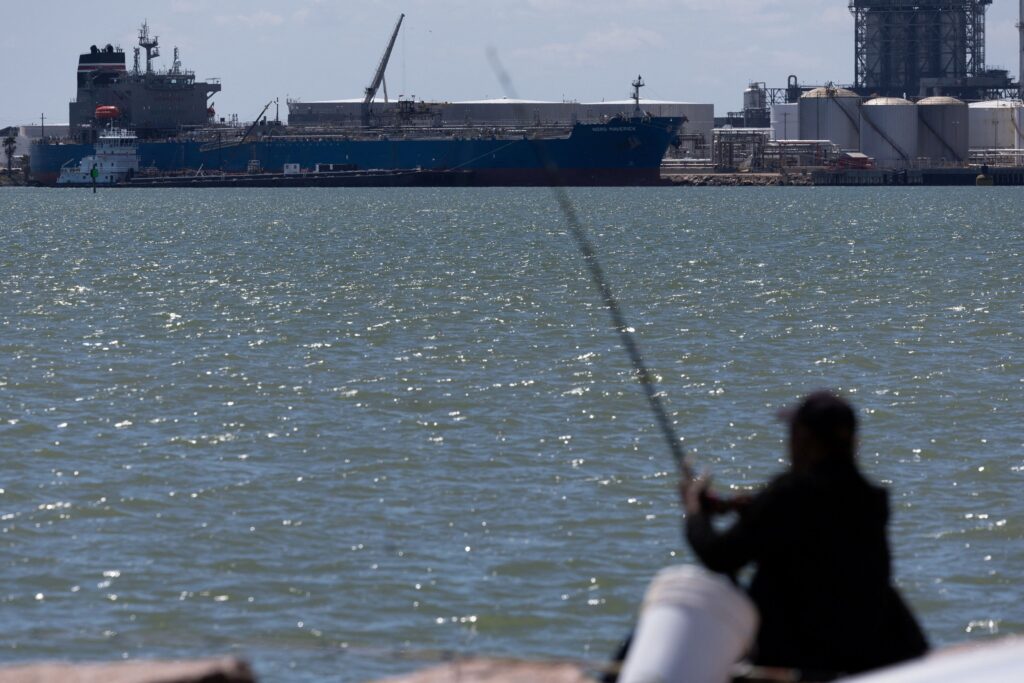
The Trump administration announced on Wednesday that it will suspend the Jones Act for 60 days to reduce fuel prices. It’s a good start.
The Jones Act says that any vessel carrying goods between United States ports must be U.S.-built, U.S.-owned, U.S.-flagged and U.S.-crewed. Given that shipping is one of the most globalized industries, few of the world’s ships meet those requirements.
The law was supposed to encourage more domestic shipbuilding. But outside of mobilization during the world wars, commercial shipbuilding has not been one of America’s strong suits for 150 years, despite — or perhaps because of — near constant protectionism since the founding of the country.
Today, the Jones Act protects industry segments that hardly exist. Only 54 of the world’s roughly 7,500 oil tankers meet the law’s requirements. The sole U.S.-flagged liquefied natural gas tanker has to operate under an exemption because it was foreign-built. Not one of the world’s oceangoing dry bulk carriers — used to transport ore, fertilizer and agricultural products — are Jones Act compliant.
The Jones Act vessels that do exist are primarily engaged in trade between the U.S. mainland and Hawaii, Alaska and Puerto Rico. The Americans who live in those places pay higher transportation costs because they lack the surface transportation options that exist on the mainland or the option of cheaper foreign vessels.
A tanker built in the U.S. costs about $170 million more than a tanker built in South Korea, and it costs millions more to operate every year thereafter. California imports a lot of gasoline from the Bahamas, not because the vacation getaway is an energy powerhouse, but because it’s cheaper to send U.S.-made gasoline there first to get around the Jones Act.
Aside from the economic problems, the law also has a potential legal problem. The Constitution says federal laws are not allowed to prefer one state’s port over another’s. The Jones Act effectively prefers mainland ports over Hawaiian or Alaskan ones, and it puts businesses in those states at a disadvantage compared to the other 48 states.
These are all much longer-running issues than anything having to do with the war in Iran. The law has failed to create a thriving domestic shipping industry — and not for lack of trying: It has been in effect for 106 years.
The costs the Jones Act imposes are significant in the aggregate. Repeal would save U.S. consumers $769 million per year on petroleum alone, according to a 2023 study. But these savings would be barely noticeable at the level of a gallon of gasoline, probably only a few cents in the regions most affected.
Making it easier to transport goods should not be an indulgence the government grants only during an overseas conflict or after a natural disaster, which is the other reason the law is usually suspended.
Legislation already exists to repeal this zombie, thanks to Sen. Mike Lee (R-Utah) and Rep. Tom McClintock (R-California). Repealing the law would render any legal challenges to its suspension moot and prevent the reimposition of its onerous restrictions two months from now.
The U.S. is blessed with an abundance of navigable waterways. The federal government should stop making it harder to use them.
The post The beginning of the end of the Jones Act appeared first on Washington Post.