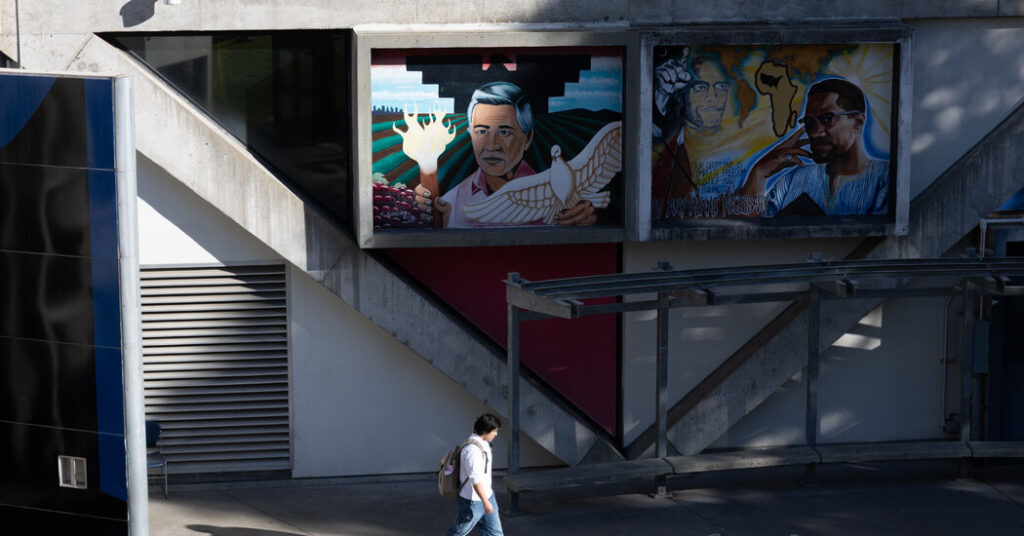
In the Bay Area, at least two universities have student centers named for Cesar Chavez. In the San Diego area, at California State University San Marcos, a plaza and a statue honor Mr. Chavez. And the University of Texas at Austin similarly honors Mr. Chavez in a bronze likeness.
But the outpouring of anguish about sexual misconduct accusations against Mr. Chavez may not lead to his swift erasure from American college campuses.
Although some schools are moving quickly to put distance between themselves and the labor leader — issuing statements of concern, taking the Chavez name off an event and even covering a memorial — many universities rely on careful procedures to decide when and whether to take more significant steps, like altering building names.
At the University of California, Berkeley, where the student center has celebrated Mr. Chavez since 1997, a committee reviews proposals from students, employees and graduates about rechristening buildings. If the panel advances the proposal for wider consideration, a lengthy process of public feedback begins before the committee prepares for a recommendation for the campus’s chancellor. The final decision rests with the president of the University of California system.
A spokeswoman for the university system, Rachel Zaentz, said Wednesday that the 10-campus U.C. system was “deeply concerned about these troubling reports.” She added: “We stand firmly with survivors and are evaluating these findings internally. We will communicate updates when appropriate.”
A spokesman for U.C. Berkeley, Will Kane, said that university leaders were “deeply troubled by these reports” and cited the school’s process for reconsidering building names. When the school first renamed a campus building — removing the name of John Boalt, who had supported Chinese exclusion, from a law school facility — the lead-up took nearly three years.
Building names and statues are notoriously thorny matters for governments and universities alike. The University of California, Davis, was able to act much more quickly this week when it took Mr. Chavez’s name off a youth leadership conference it has long sponsored. A university spokesman said that U.C. Davis had acted late on Tuesday after word of accusations against Mr. Chavez, who died in 1993, began to circulate in California.
And Fresno State’s president, Saúl Jiménez-Sandoval, said Wednesday that the campus would keep a statue of Mr. Chavez covered “while we determine appropriate next steps for its removal.”
“At Fresno State, our values are grounded in dignity, respect and care for one another,” Dr. Jiménez-Sandoval wrote. “When we become aware of reports of such a serious nature, we must acknowledge their weight and hold space for those who have been harmed.”
Cal State San Marcos did not immediately respond to a request for comment on Wednesday. David Knutson, a spokesperson for San Francisco State, where the student center carries the Chavez name, said the university was “committed to thoughtful dialogue around complex historical legacies while continuing to foster an inclusive and supportive campus environment.”
In a separate statement, the Cal State system, which has 23 campuses, said that it was “considering appropriate courses of action” and that it was “firmly committed to fostering university environments centered on respect, integrity and the safety and dignity of all members of our campus communities.”
The University of Texas at Austin declined to comment on Wednesday. The university, though, has previously removed statues with little warning. In 2017, soon after the violent unrest in Charlottesville, Va., campus workers took down several Confederate monuments overnight at the direction of the university’s president at the time.
Lauren McGaughy contributed reporting.
Alan Blinder is a national correspondent for The Times, covering education.
The post For Universities Grappling With Chavez’s Name, Change May Take Time appeared first on New York Times.