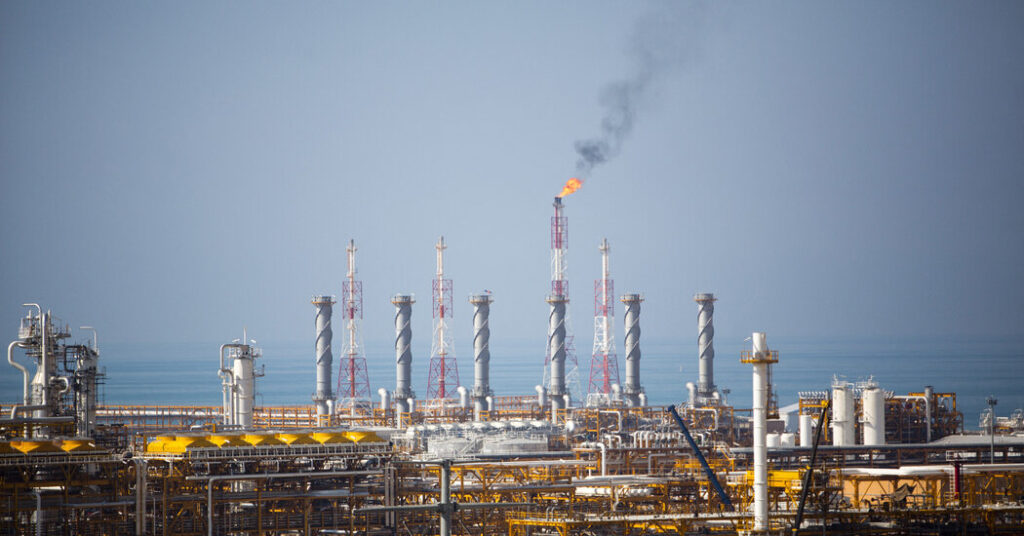
Iran’s domestic energy sector came under heavy attack on Wednesday after airstrikes hit critical infrastructure used to generate electricity for its industries and homes, just hours after Israel killed Iran’s intelligence minister in another blow to the battered regime in Tehran.
Iran said that airstrikes had damaged a number of facilities connected to the South Pars gas field, a vast natural gas reservoir in the Persian Gulf, and had also hit oil and petrochemical facilities in the southern city of Asaluyeh, where gas from the South Pars field is pumped for processing.
Although it was not clear how much damage had been done, the strikes could worsen Iran’s already severe domestic energy shortages. Iran and Qatar, which owns part of the gas field, blamed Israel for the attacks. Israel did not immediately comment.
After the strikes, oil and natural gas prices spiked, with the global benchmark for crude oil soaring to more than $109 a barrel as investors worried that Iran would retaliate by striking oil and gas sites in the region, putting further pressure on crude supplies.
Gasoline prices in the United States have been rising since the start of the war, reaching $3.84 a gallon on Wednesday. The Trump administration, in an effort to lower prices, said on Wednesday that it would temporarily relax a law that restricts the way oil is shipped within the United States.
Relaxing the law, known as the Jones Act, could reduce the cost of transporting fuel and agricultural products by ship between American ports, but analysts and some shipping executives expect the move to have only a marginal impact on gas prices.
Karoline Leavitt, the White House press secretary, said the 60-day waiver would allow “vital resources like oil, natural gas, fertilizer and coal to flow freely to U.S. ports.”
Most of the energy Iran takes from South Pars is used domestically, so any significant disruption would intensify the strain that the U.S. and Israeli bombing campaign is putting on Iran’s economy and daily life in the country. Natural gas is used to generate electricity, and for household heat, hot water and cooking for most Iranians.
Qatar warned that targeting joint energy infrastructure was a “dangerous and irresponsible step” that could put global energy security at risk.
Iran vowed to retaliate for the attack on the South Pars field. The Islamic Revolutionary Guards Corps on Wednesday warned people in Saudi Arabia, the United Arab Emirates and Qatar, which hosts a sprawling U.S. military base, to stay away from major oil and gas facilities.
Not long after, QatarEnergy, a state-owned oil and gas company, said on social media that its Ras Laffan energy hub had sustained “extensive damage” from missile attacks on Wednesday. No one was injured, it said, and crews were working to put out fires.
Saudi Arabia said it had intercepted a drone approaching one of its gas plants, and loud explosions rocked the capital, Riyadh, as its air defenses shot down incoming missiles. It said there were no indications of damage or injuries.
The attacks came as Israel continued to systematically target high-ranking Iranian officials with the killing of Esmaeil Khatib, the intelligence minister.
The Israeli military said in a statement that Mr. Khatib’s ministry had overseen “surveillance, espionage and the execution of covert operations worldwide, particularly against the state of Israel and Iranian citizens.”
His death came a day after Israeli airstrikes killed Ali Larijani, Iran’s top national security official and its de facto political leader, and Brig. Gen. Gholamreza Soleimani, the commander of the Basij, a large Iranian paramilitary force used to enforce security and suppress dissent.
“We will continue chasing all of the regime’s senior officials,” Brig. Gen. Effie Defrin, an Israeli military spokesman, said in a news briefing on Wednesday. “The series of assassinations will not stop.”
Israel has said it hopes that its strikes on Iran’s leaders will encourage Iranians to overthrow the government, a goal President Trump also expressed when he announced the start of the bombing campaign on Feb. 28.
But at a Senate Intelligence Committee hearing in Washington on Wednesday, Tulsi Gabbard, the director of national intelligence, said that although the Iranian leadership had been “largely degraded” by U.S. and Israeli attacks, the government still “appears to be intact.”
In a statement on Wednesday, Iran’s new supreme leader, Mojtaba Khamenei, who succeeded his father Ayatollah Ali Khamenei after his death in an Israeli airstrike, expressed sorrow over the killing of Mr. Larijani. He said that such bloodshed would only strengthen the Islamic republic and promised that those responsible would pay a price.
At Mr. Larijani’s funeral in Tehran on Wednesday, huge crowds of people waved Iranian flags, and the state news media showed Mr. Larijani’s coffin surrounded by mourners who chanted, “Death to America” and “Death to Israel.”
Even as Israel has been pounding targets in Iran, its forces have also been intensifying attacks in Lebanon, raising fears of a full-scale invasion.
On Wednesday, the Israeli military said that it had struck two bridges over the Litani River, a key boundary line in southern Lebanon, in the latest sign that Israel is widening its operations there.
The Israeli military accused Hezbollah, the Iranian-backed militia, of using the bridges to move fighters and weapons into southern Lebanon, where Israeli forces have been expanding a ground invasion and ordering residents to evacuate.
Israel’s defense minister, Israel Katz, said the strikes were aimed not only at disrupting Hezbollah’s movements but also at sending a “clear message to the Lebanese government” that Lebanese infrastructure could not be used by Hezbollah.
Earlier Wednesday, the Israeli military struck Beirut, the Lebanese capital, and other Lebanese cities, towns and villages, after Hezbollah fired a barrage of rockets, drones and artillery shells into Israel overnight. Several Israeli strikes hit central Beirut, away from Hezbollah’s stronghold in the southern outskirts of the city, fueling anxiety that areas of the capital once considered safe are in danger.
Israel’s strikes came at times without warning. An unannounced Israeli attack on the central Zuqaq al-Blat and Basta areas of Beirut early Wednesday killed at least 10 people and wounded 27 others, according to the Lebanese Ministry of Public Health. Another building in Zuqaq al-Blat was struck later without a warning, igniting a fire on its upper floors.
More than 960 people have been killed in Lebanon and more than 2,400 others wounded in the nearly three weeks since fighting erupted between Israel and Hezbollah, according to Lebanon’s health ministry. More than 110 children are among the dead, the ministry said.
The Norwegian Refugee Council, a humanitarian organization, said on Wednesday that one million people had been displaced by the fighting in Lebanon, a sixth of the population.
In Israel, the authorities said that a couple in suburban Tel Aviv was killed by an exploding cluster bomb from the warhead of an Iranian missile. Yaron and Ilana Moshe died in their apartment building in Ramat Gan. A local police chief said it seemed that they had not made it into their apartment’s safe room as sirens, warning of an incoming attack, blared around the city. Iran had said it had launched a ballistic missile assault on Tel Aviv in retaliation for the killing of Mr. Larijani.
Reporting was contributed by Rebecca F. Elliott, Ravi Mattu, Isabel Kershner, Johnatan Reiss, Sanam Mahoozi, Julian E. Barnes, Peter Eavis, Euan Ward, and Rawan Sheikh Ahmad.
Abdi Latif Dahir is a Middle East correspondent for The Times, covering Lebanon and Syria. He is based in Beirut.
The post Strikes Deliver Another Blow to Iran’s Domestic Energy Sites appeared first on New York Times.