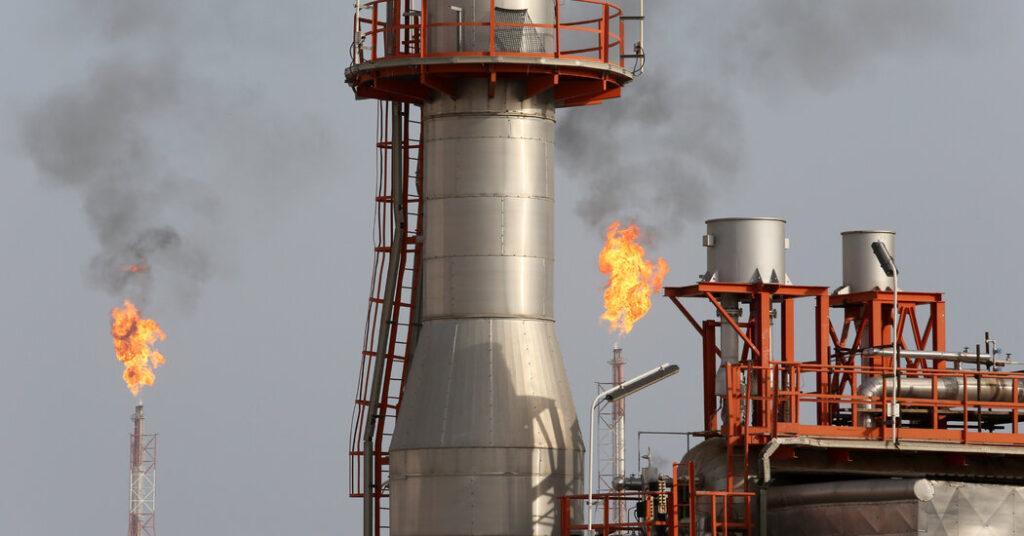
Iran and Qatar on Wednesday accused Israel of attacking a giant offshore natural gas field that the two countries share, sending the prices of oil and natural gas soaring on what would be a sharp escalation of strikes on energy infrastructure in the war against Iran.
Iran uses most of its natural gas domestically, meaning that the strikes will most likely have a limited effect on the global supply of gas, which is used in power plants, home furnaces and heavy industry. But the attacks signal that the Persian Gulf’s extensive energy facilities may be at growing risk.
Hours later, a state-owned Qatari energy company said that a major energy hub in the country, Ras Laffan Industrial City, had sustained “extensive damage” from missile attacks. Qatari officials blamed Iran for the attack.
International oil prices settled above $107 a barrel, their highest settlement level since the war started on Feb. 28. Natural gas prices are more regional, but they climbed in Europe, the United States and Asia.
Iran’s oil ministry said on social media that airstrikes had damaged a number of its facilities connected to the offshore South Pars gas field. It appeared to be one of the most significant energy sites to be hit since the U.S.-Israeli air war against Iran began nearly three weeks ago.
Iranian state media reported that oil and petrochemical facilities in the southern city of Asaluyeh, a key hub for the country’s energy industry, were also hit by an airstrike.
The extent of the damage in Iran and Qatar was not immediately clear. Iranian state media reported that fires at the energy facilities had been brought under control. And QatarEnergy, the state-owned company, said there were no casualties from the strikes at Ras Laffan.
But both attacks illustrated how the war has threatened oil and gas facilities.
The South Pars field accounts for about 70 to 75 percent of Iran’s natural gas production. Most of that fuel is used in the country, partly because Western economic sanctions constrain Iran’s ability to trade internationally.
But reports of the attack caused the price of Brent Crude, the international oil benchmark, to surge more than 6 percent to over $109 a barrel as investors worried that the attack may prompt Iran to strike oil and gas fields and facilities in countries like Saudi Arabia that have close relations with the United States. The price of natural gas also rose by about 6 percent in Europe.
Qatar condemned the attacks on Iran’s gas assets. Majed al-Ansari, a spokesman for Qatar’s foreign ministry, accused Israel of taking a “dangerous and irresponsible step,” and warned that targeting shared energy infrastructure could threaten global energy security.
Israel did not immediately comment on the reports.
Iran’s semiofficial Tasnim news agency quoted the governor of Asaluyeh as saying that attacks on South Pars gas facilities “caused fires” in several structures. He said the fires were contained and “the situation in the area is now fully under control,” Tasnim reported.
South Pars makes up about a third of the world’s largest natural gas reserve, which stretches from Qatar toward Iran and contains enough to supply the world’s needs for about 13 years, according to Reuters.
Qatar, which calls its fields in the reservoir the North Dome, is the world’s third-largest exporter of liquefied natural gas and has made hundreds of billions of dollars from the industry over decades. (To transport natural gas on oceangoing ships, companies must cool it until it turns into liquid.) Many of its installations are joint ventures with Western energy companies, including the U.S. giants ExxonMobil and ConocoPhillips.
Gas exports from Qatar’s export terminals at Ras Laffan stopped in the first days of the war after some facilities there were struck. In addition, Iranian strikes on ships effectively halted most oil and gas shipments through the Strait of Hormuz, a narrow passage on Iran’s southern border.
Iran on Wednesday threatened to retaliate by attacking the energy infrastructure of the U.S. allies in the Persian Gulf, state media reported. The Islamic Revolutionary Guards Corps warned people in Saudi Arabia, the United Arab Emirates and Qatar, which hosts a sprawling U.S. military base, to stay away from major oil and gas facilities.
Israel last attacked parts of the Iranian section of South Pars, about 200 miles from Qatar’s installations, during in its 12-day war with Iran last year.
Parin Behrooz and Joe Rennison contributed reporting.
Ravi Mattu is the managing editor of DealBook, based in London. He joined The New York Times in 2022 from the Financial Times, where he held a number of senior roles in Hong Kong and London.
The post Energy Facilities Attacked in Iran and Qatar, Sending Prices Soaring appeared first on New York Times.