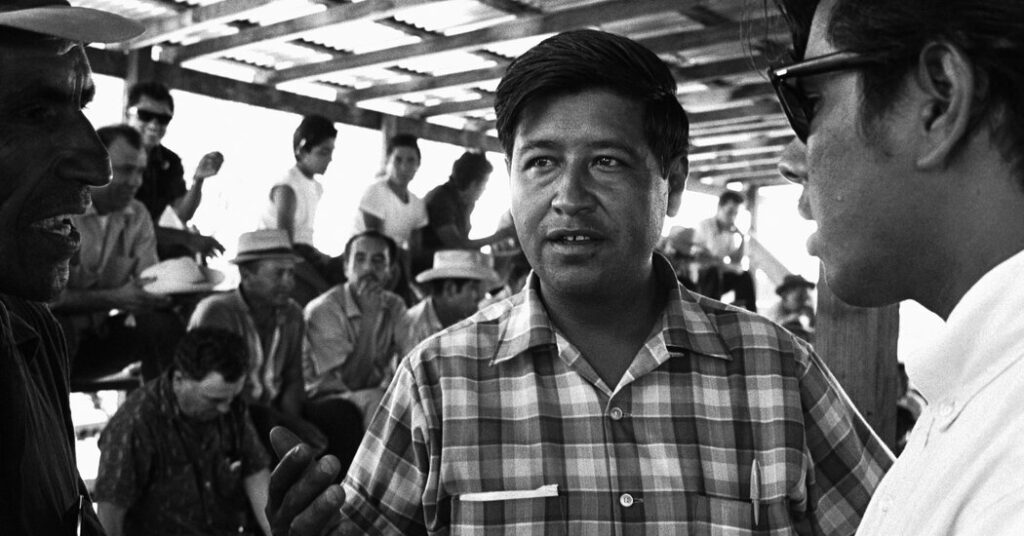
Cesar Chavez, the activist who on Wednesday was accused of decades of sexual abuse, galvanized farmworkers and other laborers far beyond California, helping inspire labor movements in places like Texas.
Emboldened by the attention the farmworkers union was gaining in California’s San Joaquin Valley, laborers in South Texas started their own strike in 1966. On July 4, hundreds of laborers on melon farms in the Rio Grande Valley threw down their sacks and started a nearly 500-mile trek to Austin to demand higher pay and better working conditions.
The demonstrators arrived two months later, on Labor Day, and called on state lawmakers to institute a minimum wage of $1.25 an hour.
Mr. Chavez, who was organizing strikes in California at the time, joined the march. It was led by Eugene Nelson, a labor organizer from California who was affiliated with the National Farm Workers Association, an organization Mr. Chavez helped lead.
The group would become the United Farm Workers of America, one of the most prominent unions representing agricultural workers in the country.
The 1966 strike, known as “La Marcha,” was a crucial moment for the labor movement in Texas and laid the groundwork for the passage of the state’s first minimum wage years later. It also better connected the labor rights movement in Texas to the Chicano Movement, which aimed to ensure the social and political rights of Mexican Americans.
Mr. Chavez, who focused mostly on California, returned to Texas for rallies and demonstrations over the years. In 1977, farmworkers replicated the march in an effort to secure collective bargaining rights for all farmworkers.
In the mid-1970s, Texas laborers under the leadership of organizer Antonio Orendain broke from Mr. Chavez’s organization and formed their own group, the Texas Farm Workers Union. The split was spurred by disagreements over tactics and the desire of Mr. Orendain and other leaders for a Texas-based union that could focus on the needs of local workers full-time.
The Texas Farm Workers Union dissolved in the 1980s without achieving its goal of securing the right to collective bargaining for its members.
The post Cesar Chavez Helped Spark a Texas Farmworker Uprising appeared first on New York Times.