Federal Reserve officials expect the Iran war will worsen inflation this year while having little impact on growth, but they still expect to cut their key rate once in 2026.
For now, Fed policymakers left short-term interest rates unchanged Wednesday for the second straight meeting at about 3.6%. In a statement, the central bank said that the “implications of developments in the Middle East for the U.S. economy are uncertain.”
Still, by keeping their forecast for a rate cut this year and next — the same projections that they made in December — central bank policymakers appear to expect the gas price spike from the Iran war to have a largely temporary effect on inflation and the economy. Policymakers also foresee unemployment remaining unchanged by the end of this year, a more optimistic outlook than most outside economists.
Whether that turns out to be true will largely depend on the length of the conflict. The officials expect inflation to fall back to 2.2% in 2027 and hit the Fed’s 2% target in 2028.
Fed officials now expect that inflation will be 2.7% at the end of this year, up from their December forecast but slightly below the 2.8% it reached in January. They expect core inflation, which excludes the volatile food and energy categories, to also finish the year at 2.7%, up from a previous forecast of 2.5%. The Fed considers core prices a better measure of longer-run inflation. Consumer prices will spike higher in the coming months as gas prices have soared, but those increases could unwind by the end of the year, particularly if the conflict ends soon.
Wherever the Fed comes down, it is a particularly difficult time for policymakers to issue economic projections. The Iran war that the Trump administration launched Feb. 28 has already sent gas prices soaring and will push up inflation for at least the next month or two. The Fed will have to raise the inflation forecast it issues Wednesday from where it stood in December, when Fed officials projected inflation would fall to 2.6% by the end of this year.
The jump in gas prices — if it is high enough and lasts long enough — could slow the economy, as more consumer spending is eaten up at the pump, leaving less money to be spent on other goods and services. As a result, unemployment could move higher later this year.
On Tuesday, gas prices averaged $3.79 a gallon nationwide, according to AAA, up 88 cents from a month ago.
Those two outcomes — higher inflation and higher unemployment — typically lead the Fed in opposite directions. The central bank keeps its key rate unchanged — or even increases it — to fight inflation, while it cuts rates to boost spending and hiring. A combination of rising prices and higher unemployment is generally the worst-case scenario for central bankers.
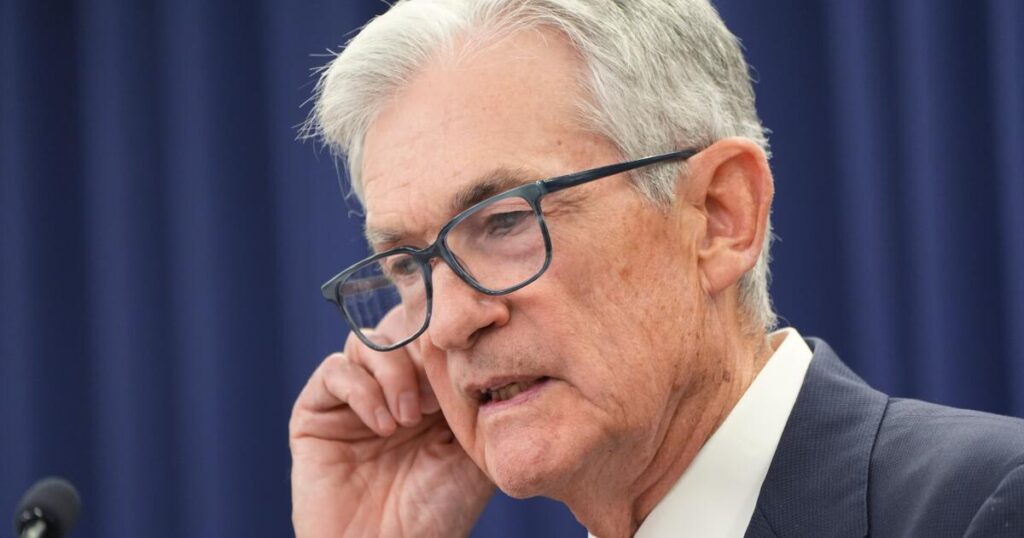
This week’s meeting is among the last with Powell as chair. His term ends May 15 and President Donald Trump has nominated a former top Fed official, Kevin Warsh, to replace him. Yet Warsh’s nomination has been delayed in the Senate because key Republican senators have objected to a Justice Department investigation of Powell over his testimony about a building renovation.
Last Friday, a judge threw out a pair of subpoenas that the Justice Department had issued to the Fed, dealing a blow to the investigation. But U.S. Attorney Jeannine Pirro has said she will appeal the ruling.
This week’s meeting will be Powell’s second-to-last, unless Warsh isn’t confirmed by May 15, at which point Powell could remain chair of the Fed’s rate-setting committee until a replacement is named.
Even before the Iran war, problems had cropped up in both the inflation and jobs data, putting the Fed in a tight spot. Prices rose more quickly in January than in recent months, according to the Fed’s preferred measure, with inflation excluding food and energy reaching 3.1% compared with a year earlier. That is little changed from where it was two years ago, a sign that prices are still rising at a stubbornly elevated pace.
Yet hiring has also stumbled. Businesses and other employers shed 92,000 jobs in February, the government reported earlier this month, an unexpectedly weak showing that followed an encouraging gain of 130,000 in January. The unemployment rate ticked higher to a still-low 4.4% from 4.3%.
Rugaber writes for the Associated Press.
The post Federal Reserve keeps rates unchanged, plans one cut despite Iran war concerns appeared first on Los Angeles Times.