Maddy Butcher produces the radio and podcast program “Awe, Nice!” Daniel M. Shea, a government professor at Colby College, is the co-author, with Nicholas F. Jacobs, of “The Rural Voter: The Politics of Place and the Disuniting of America.”
If you live in the country, you know there are things fundamentally, maddeningly wrong with trucks and tractors these days. On pickup trucks, for instance, the spare tire is cryptically stashed and onerous to extract. When you drive predominantly on gravel roads instead of suburban streets, and always change tires yourself, this becomes a huge hassle.
New pickups have cameras and sensors that fail quickly — again, as if the makers didn’t consider the dust, rocks and harsh weather of rural driving.
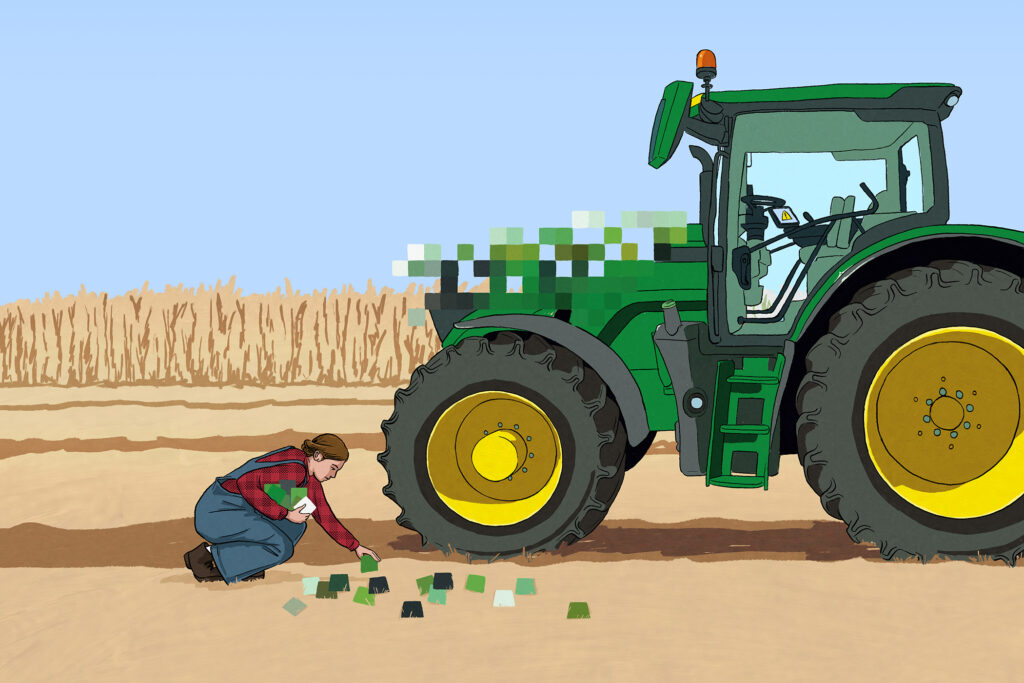
As for tractors, they cost as much as a house, but you don’t really own them and you can’t really repair them yourself. If the software detects an error, the computer will shut down the machine. While your harvest languishes in the field, you will wait for a faraway technician to unfreeze the programming. Good luck baling that hay before the storm moves in.
These problems reflect a bubbling frustration with an economy in which ownership is increasingly symbolic and control resides elsewhere. As physical goods become digitized — embedded with software, sensors and remote locks — manufacturers’ control no longer ends at the point of sale. It extends deep into the life of the product itself.
In rural America, where distance magnifies dependency, that shift feels oppressive. When a silly, redundant sensor costs $200 and can’t be bought locally, when the nearest authorized dealer is 150 miles away and the planting window is a few days, repairs become a form of economic disempowerment.
What’s emerging from this agrarian-rooted angst is an increasingly vocal battle for autonomy — a defense of independence, self-reliance and local capacity. At its core, the idea is simple: If you buy something, you should be able to fix it.
Right-to-repair laws, introduced in all 50 states and enacted in a small but growing number, require manufacturers to provide parts, tools and diagnostic information to consumers and independent shops. Last month, the Environmental Protection Agency clarified its stance as supportive of the right to repair for certain farm equipment. “For far too long,” EPA Administrator Lee Zeldin said, “manufacturers have wrongly used the Clean Air Act to monopolize the repair markets, hurting … farmers.”
In Congress, one of the movement’s leaders is Marie Gluesenkamp Perez (D) of Washington, a former auto-repair-shop owner who has introduced legislation spanning farm equipment, vehicles and consumer electronics. The push is national — but its political energy is especially rural, where a disabled tractor or truck isn’t an inconvenience; it endangers livelihoods.
Right-to-repair policies, though, are best understood as a bellwether — legislation hinting at a discontented herd of issues. They connect to the antiestablishment, no-one-hears-us backlash rural voters expressed a decade ago when many voted for Donald Trump. They echo a broader chorus of technological turnoff, supported by the likes of Neil Postman, Shoshana Zuboff and the BIFL (Buy It For Life) movement. Out here, we distrust the selly-sell of technological progress. It’s often less life-enhancing than life-sapping.
As ownership of machines becomes conditional, ownership of land continues to fray, too. According to the Agriculture Department, the number of U.S. farms fell by more than 140,000 between 2017 and 2022. Yet average farm size grew — a sign that land is concentrating into fewer hands rather than disappearing. Even where land remains locally operated, ownership is eroding. Today, roughly 35 to 40 percent of U.S. farmland is rented rather than owner-operated, a share that has remained relatively stable for decades. Though tenant farming was also common in the early-20th century, the structure of ownership has changed dramatically. Now, most rented farmland is owned by non-owner operator landlords — often retirees, institutional actors, investment funds or pension-backed farmland trusts — rather than by the farmers who work the land. Once regarded as a community anchor, the land is now more abstract as a financial asset.
Seen together, these pressures reshape the backdrop against which right-to-repair fights unfold. Rural voters, even those without dirt under their nails or barbed-wire rips in their jeans, retain a deeply resourceful, neighborly mindset. We like it here. The “progress” rolling into town doesn’t feel like a helping hand. It feels like a shackle, binding farmers to proprietary software and local economies to absentee control.
History suggests that when rural Americans feel materially constrained, the response rarely stays contained to a single policy fight, or a single election cycle. Which party will recognize the stakes and work to solve the problems? Which company, seeing a market opening, will make the buy-it-for-life truck with cup holders but no silly sensors?
We don’t know, but the energy behind right-to-repair suggests something larger is building. Pressures that destabilize a sense of ownership are accumulating — in land, in housing, in tools, in data, in the basic mechanics of daily work. The lid is still on. But the heat is rising.
The post Trucks and tractors reflect a bubbling frustration in rural America appeared first on Washington Post.