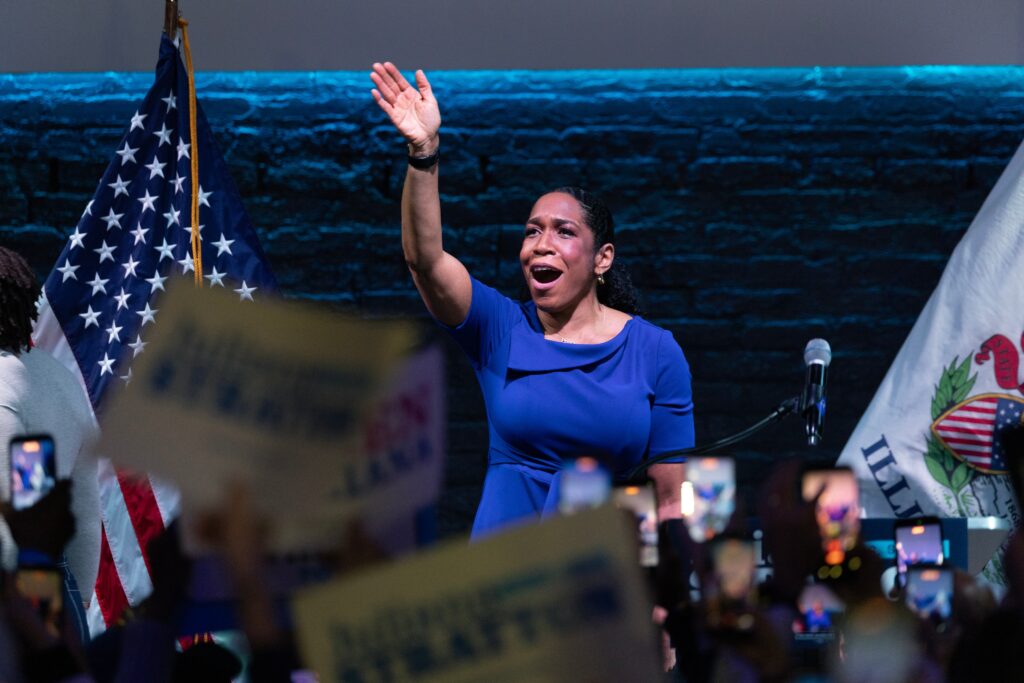
Lt. Gov. Juliana Stratton won the Democratic primary for a rare open Senate seat in Illinois, all but guaranteeing that she will be elected to succeed retiring Sen. Dick Durbin (D-Illinois).
Stratton was leading Rep. Raja Krishnamoorthi by single digits when the Associated Press called the race for Stratton on Tuesday night. A third Democrat, Rep. Robin Kelly, lagged further behind.
Stratton’s win was also a victory for Illinois Gov. JB Pritzker, a billionaire and potential 2028 presidential candidate. Pritzker endorsed Stratton — who has served as his lieutenant governor since he took office in 2019 — and contributed at least $5 million to a super PAC supporting her. The full extent of his support may not become clear until April, when the super PAC files its next disclosure.
Durbin, the No. 2 Democrat in Senate leadership, is retiring after five terms.
Stratton will become the sixth Black woman to serve in the Senate if she wins in November. (The first Black woman to serve in the U.S. Senate, Carol Moseley Braun, was elected from Illinois in 1992.) She will face Don Tracy, the former Illinois Republican Party chairman, who won the Republican primary.
Democrats also fought it out in primaries for four open, safely Democratic House seats in Chicago and its suburbs. The winners are expected to prevail in November.
Here are takeaways from the Illinois primaries:
One former lawmaker is set to return to the House
Dozens of members of Congress are not running for reelection this year, some because they are fed up with Washington. But one former lawmaker is poised to return.
Former congresswoman Melissa Bean, who lost her suburban seat to a Republican in 2010, won the primary to succeed Krishnamoorthi. Bean defeated seven other Democrats, including Junaid Ahmed, who had the support of Sen. Bernie Sanders (I-Vermont) and Rep. Alexandria Ocasio-Cortez (D-New York).
Another former lawmaker seeking to return to Washington was less fortunate.
Donna Miller, a Cook County commissioner, defeated former congressman Jesse L. Jackson Jr. in the Democratic primary for an open seat that stretches deep downstate from Chicago’s South Side. Jackson resigned his House seat in 2012 and later went to prison after pleading guilty to corruption charges. He is the son of Jesse L. Jackson Sr., the civil rights leader and presidential candidate who died last month.
A tough night for AIPAC
Two of the four Democrats backed by super PACs linked to the American Israel Public Affairs Committee won their primaries, raising questions about the group’s influence in Democratic primaries a month after a super PAC funded by AIPAC suffered an embarrassing defeat in the special election primary for a House seat in New Jersey.
A super PAC tied to AIPAC called Elect Chicago Women spent nearly $4 million supporting Bean, according to campaign finance disclosures. Another super PAC with ties to AIPAC, Affordable Chicago Now, spent more than $4 million backing Miller.
But another Democrat whom Elect Chicago Women spent $5.7 million to support, state Sen. Laura Fine, lost the primary to succeed Democratic Rep. Jan Schakowsky. Evanston Mayor Daniel Biss defeated Fine and other Democrats — including the progressive influencer Kat Abughazaleh — in a district that snakes from Chicago’s North Side to its far suburbs.
And state Rep. La Shawn Ford defeated Melissa Conyears-Ervin, the Chicago treasurer, in the primary for another open House seat even though a super PAC funded by AIPAC spent more than $5 million supporting her and opposing Ford. The winner is set to succeed Democratic Rep. Danny K. Davis, whose district includes Chicago’s Loop. Davis is retiring after nearly three decades in Congress.
Crypto’s bet against Stratton doesn’t pay off
Stratton’s victory is a blow to the crypto industry.
A super PAC funded by crypto interests called Fairshake spent nearly $10 million on ads opposing her. The spending helped to offset a blitz of ads attacking Krishnamoorthi run by Illinois Future PAC, the Pritzker-funded super PAC.
Crypto companies and investors have become an increasingly powerful political force as they seek influence over how Washington regulates digital currencies such as bitcoin.
Fairshake’s donors include the crypto companies Coinbase and Ripple Labs, and the venture capital investors Marc Andreessen and Ben Horowitz. The super PAC had more than $191 million in cash on Jan. 31, according to campaign finance disclosures, giving it enormous financial firepower heading into the midterms.
Durbin is a vocal critic of crypto, while Krishnamoorthi was more aligned with the industry. Krishnamoorthi voted for two bills last year supported by the crypto interests, the Genius Act and the Clarity Act.
Sen. Tammy Duckworth (D-Illinois), who endorsed Stratton and appeared in one of her ads, was sharply critical of the industry’s support of Krishnamoorthi.
“I’m deeply concerned that Senator Durbin could be replaced by someone who is deeply compromised,” Duckworth said in a brief interview last week.
Krishnamoorthi rejected the idea that he would be indebted to crypto interests if he won and pointed out that much of Stratton’s support came from a single billionaire patron. He said he favored crypto regulation that prevents fraud but still allows for innovation.
Stratton said in an interview last week that she would prioritize making “sure that there’s equitable access to crypto — that we center equity and do our best to stand up for everyday Americans.”
Fairshake also spent nearly $2.5 million attacking Ford, who defeated Conyears-Ervin. The super PAC fared better in the race Miller won, where it spent more than $800,000 opposing state Sen. Robert Peters. Ford and Peters both voted for the legislation that Pritzker signed last year that the crypto industry opposed.
Pritzker will face Bailey in governor’s race — again
Pritzker, who is seeking a third term, faced no opposition in the primary. He will face Darren Bailey, a former state senator who won the Republican nomination. The race will be a rematch of the 2022 governor’s race, when Pritzker defeated Bailey by nearly 13 points.
Pritzker would be the first Illinois governor to win a third term since Jim Thompson, a Republican who left office in 1991. He is heavily favored in the solidly Democratic state.
Clare Ence Morse contributed to this report.
The post How AIPAC, crypto and a billionaire governor shaped the Illinois primaries appeared first on Washington Post.