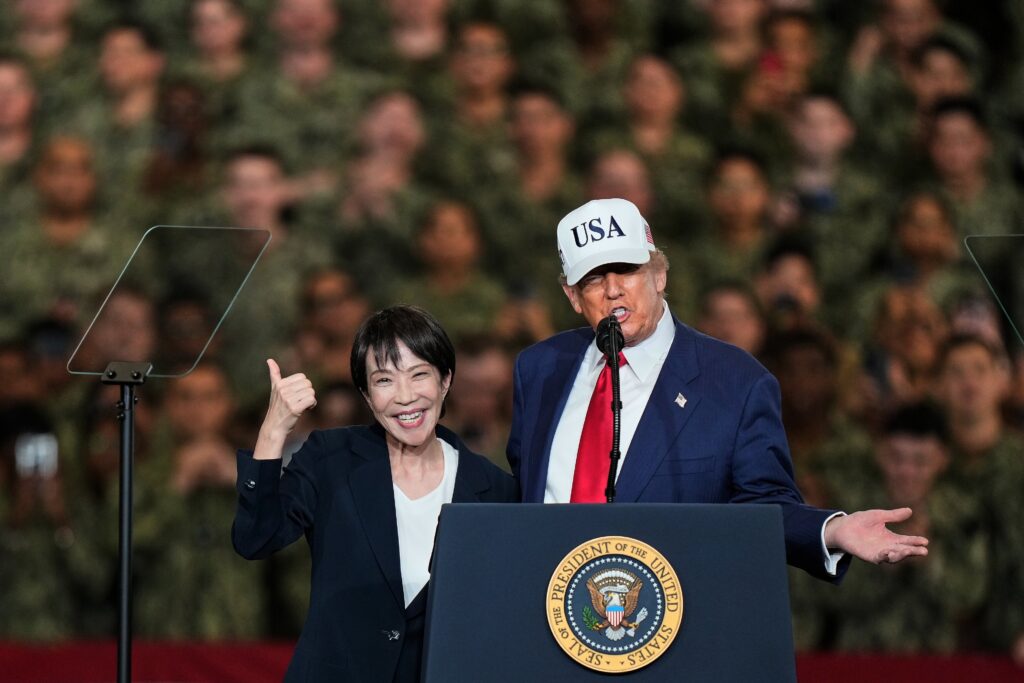
TOKYO — Japanese Prime Minister Sanae Takaichi’s first official visit to Washington this week was supposed to be a triumphant celebration of the friendship, with a gift of 250 Japanese cherry trees to mark America’s big birthday. Instead, she will be greeted by a wartime president who’s looking for a different kind of gift from her country: Military assistance in the Middle East.
Iran is expected to be a dominant topic when the two leaders meet on Thursday, and Takaichi is walking a tightrope. Her pacifist nation wants to avoid taking sides in the war. It also doesn’t want to annoy President Donald Trump, the unpredictable leader of Japan’s only security ally.
Takaichi will be first among leaders of the Group of Seven advanced economies to meet with Trump since the war began and the encounter will pose a major test. The pair, each with a powerful populist streak, got off to a chummy start last fall when Takaichi welcomed Trump to Tokyo with some of his favorite things — golden golf gifts and a massive investment deal.
The mood is much more grim and the stakes even higher as they meet for a second time.
Takaichi took office last October as Japan’s first female prime minister, vowing to restore Japan’s economy and build a strong defense. Dubbed Japan’s “Iron Lady” for her love of Margaret Thatcher and her hawkish views on security, Takaichi has become immensely popular for her reputation as a relatable and decisive leader. An avowed policy wonk, she has been studying briefing materials from her aides and diplomats ahead of her trip, according to Japanese officials.
Tokyo had hoped to use the visit, originally scheduled less than two weeks before Trump’s meeting with China’s Xi Jinping, to remind Washington of its security commitments to Japan in the face of China’s growing military might. But with the Trump-Xi meeting now postponed and with Asia on the front lines of the energy crisis set off by the war in the Middle East, experts say Takaichi’s top goal will be to leave with the U.S.-Japan alliance intact.
“If Trump is not satisfied, it would not be surprising if he makes remarks suggesting some distance from the Japan-U. S. alliance,” said Tetsuo Kotani, a security expert at the Japan Institute of International Affairs. “So the priority now is to avoid that.”
Japan historically has maintained friendly relations with Israel and Arab countries, and has positioned itself as a neutral intermediary in other conflicts in the Middle East. Its constitution, adopted after World War II, restricts military operations overseas, and Japan has previously deployed its Self-Defense Forces in April 1991, following the Gulf War, only after a ceasefire was declared.
A majority of Japan’s population does not support the war, polls show. Japanese policymakers say the United States hasn’t given a clear reason for military action that they can relay to the Japanese public as it weighs Washington’s request for help. Some fear that Japan’s support of the U.S. against Iran could also be seen as tacit approval for China to attack Taiwan, which Japan strongly opposes.
“From Japan’s perspective, the current conflict in the Middle East centered on Iran is, if anything, very perplexing,” said Itsunori Onodera, a lawmaker and former defense minister. “Being asked to cooperate, people will naturally wonder, ‘Why is that?’ So without answers to those questions, it feels like President Trump is making various statements unilaterally. That’s how it’s being received.”
“I think it’s important for the U.S. to clearly explain its reasoning for causing this situation,” Onodera added, “especially since we are allies.”
Takaichi is likely to tell Trump that Japan does not support Iran’s de facto closure of the Strait of Hormuz, a narrow waterway that is vital to global oil shipments, Japanese officials say, and that Japan does support peace in the Middle East and U.S. efforts to de-escalate the situation, without making any judgment on the U.S. and Israeli strikes on Iran.
Takaichi is in a “potentially precarious position,” said Jeffrey Hornung, Japan lead for the national security research division of the Rand Corporation, the U.S.-based think tank.
If Trump on Thursday directly asks Takaichi for Japan to step in militarily, such as by providing minesweepers, destroyers or air defenses, it would test the prime minister’s proactive stance on security and defense, Hornung said. Asking her to involve her country in an active combat zone not only faces potential obstacles in Japanese law but would also put her in a difficult spot with Trump if she doesn’t deliver, he said.
Hornung compared the dilemma to the experience of another popular prime minister, Toshiki Kaifu, who led the government during the 1991 Gulf War and explored the limits of Japan’s defense commitments at the time.
Even as U.S.-led coalition soldiers fought under the mandate of the United Nations in the Kuwaiti desert and pressure grew from the U.S. for Japan to provide some Self-Defense Force support, Japan did not send combat troops and sent minesweepers only after the ceasefire, once Kaifu’s administration determined it would not become directly involved in active combat. Instead, Kaifu donated $13 billion to the U.S.-led effort, which was criticized at the time as “checkbook diplomacy.”
Many Japanese policymakers and diplomats felt humiliated by the country’s lack of response to the Gulf War, Hornung said. The experience prompted a shift toward a more proactive role in international security, which paved the way for Takaichi’s hawkish wing of the Liberal Democratic Party to push the bounds of Japan’s pacifist constraints.
It is unclear what steps Takaichi is prepared to take. She has not committed to sending minesweepers and said her government has not decided on dispatching escort vessels to the strait.
Under a 2015 law, Japan can exercise a limited right of collective self-defense during a “survival-threatening situation,” in which a country with close ties to Japan is under attack and this poses a clear danger to Japan’s survival. The Japanese government’s current stance is that the Iran conflict does not meet this definition.
Takaichi said Japan is exploring other legally permissible options, which could include intelligence-gathering activities. In 2019, Japan declined a U.S. request for escort operations in the Strait of Hormuz, but dispatched a Maritime Self-Defense Force destroyer in 2020 to areas near the strait to monitor vessels that passed through areas close by.
Takaichi is expected to discuss with Trump a U.S. request to join a “maritime task force” endorsing the importance of freedom of navigation in the strait, according to Japanese news reports. Washington made the request this week and said the initiative would be separate from combat operations against Iran and would not require commitments to deploy equipment, Japanese media reported.
The economic stakes are high for Japan, a country heavily dependent on oil imports. Japanese companies already are experiencing price increases of oil products and facing supply restrictions as a result of the blockage in the Strait of Hormuz. The Japanese government has begun releasing oil from its strategic reserves and plans to provide subsidies to help offset the surge in oil prices.
The oil crisis comes just as inflation in Japan was beginning to stabilize, which means the broader economy will suffer due to declining household incomes and weakening consumption, said Takahide Kiuchi, an economist at the Nomura Research Institute.
China will also be on Takaichi’s mind, as the relationship between Tokyo and Beijing sours and as Trump seeks to stabilize U.S. relations with China.
Takaichi is expected to discuss agreements made between the U.S. and Japan to increase cooperation in nuclear energy, liquefied natural gas and critical mineral development, and other efforts aimed at preventing supply disruption caused by resource-rich countries such as China. China has placed restrictions on key exports, including rare earth minerals, as a retaliatory action against Japan in their ongoing diplomatic spat.
The Japanese leader is also expected to present Trump with a new round of investments under a $550 billion trade deal signed last year — a reminder of Japan’s importance as the biggest foreign investor in the United States. Japanese officials hope that Trump doesn’t forget how his dealings with China could affect Japan and the rest of the Asia-Pacific.
“We are allies, and as the U.S. strengthens its stance toward China, it’s also extremely important to consider Japan’s position from a security perspective,” Onodera, the Japanese lawmaker, said. “Reconfirming that between Japan and the U.S. would be meaningful.”
The post Japan’s leader heads to D.C. bearing gifts of peace for a president at war appeared first on Washington Post.