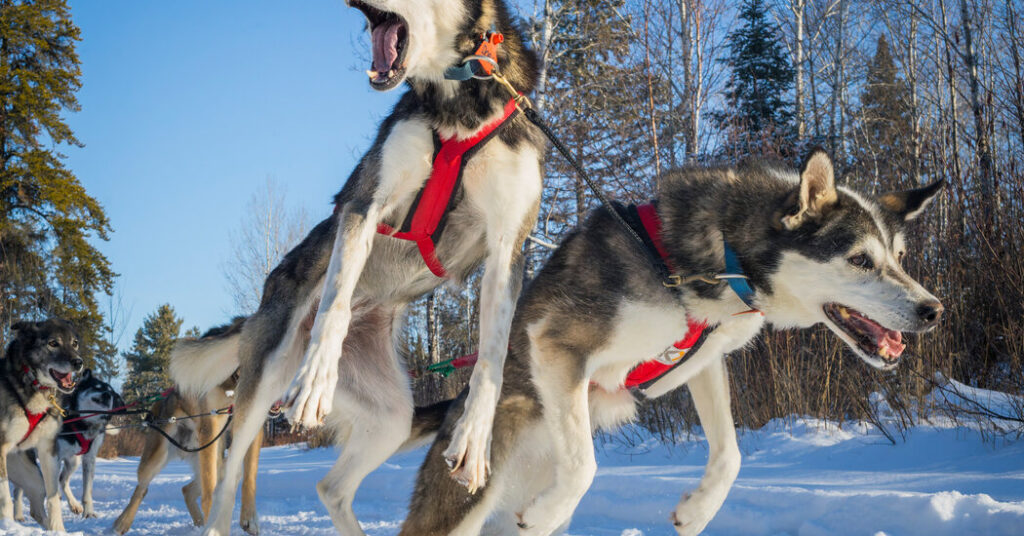
Mushing blurs what it means to be wild. One night, my sled dogs and I were gliding through a birch forest in Wisconsin when a black wolf emerged from the trees and ran beside us. None of the dogs even barked. They treated him as a peer, which unnerved me — the eye contact they made. If my dogs related to the wolf, and I to them, then what did that make me? Another time, in Saskatchewan, a wolf followed us for a hundred miles. I never saw it move, but each time I turned around, it stood in the trail with its chin high.
We were 11 of us then, crossing a chain of frozen lakes, and wind blew hard across the ice. The trail was blown smooth; sometimes the dogs stepped off its edges and stumbled neck-deep in the fluff, or my sled caught the lip and flipped onto its side. It was cold, 30 below zero, and the wind made it colder. My legs grew numb below the knees, and the dogs’ fur lifted in waves. At night, the aurora cast a pearly, shifting glow over the landscape. I’d turn sometimes, look back, and sure enough, there was the wolf: always standing, watching, at the edge of my headlamp’s beam. It was chasing our crumbs, I think. I gave each dog a frozen chicken thigh every hour, and when they chewed, they left chips of meat in the snow.
I fell in love with mushing almost two decades ago, when I was 18. I wanted to run expeditions: mushing long distances on our own, camping out in the snow. It’s an ancient way to cross the north, and it feels ancient, a way of stepping into timelessness for as long as the trip lasts.
Still, the sport has evolved. A hundred years ago, trappers and mail carriers traversed ungroomed routes with well-muscled dogs, and hunters hauled seals and walruses home by sled. It wasn’t until the rise of long-distance racing in the 1970s — an effort to revive sled-dog culture after snowmobiles made subsistence mushing obsolete — that dog teams grew longer, and the dogs lighter and faster. These days, most sled dogs are Alaskan huskies, a fancy name for northern-breed mutts with a yearning to pull and a dash of hound for speed.
I never intended to race. But a musher I worked for was racing anyway, and he lent me his extra team. Later, when my husband learned to mush and we got our own dogs, he liked planning for races, making measurable goals, and he encouraged me to compete. I won a two-day race against 20-odd teams in my second season, and peaked in the top five in two major marathons: the 300-mile Canadian Challenge — that year was a 40-below ordeal that half my competitors didn’t complete — and the infamous Kobuk, which crosses 440 miles of wind-pummeled Arctic terrain.
I wasn’t a natural racer; I sought adventure more than speed. But I had two main strengths. Like the dogs, I didn’t quit. And I was efficient at checkpoints, those camps or villages en route where teams can rest and resupply. I could churn through tasks: making straw beds for the dogs, taking off their booties, lighting the methanol cooker, melting snow, thawing meat, doling out stew, tucking the dogs under blankets, massaging their muscles, then repeating those steps in reverse, with little or no sleep myself, before mushing another 40 miles down the trail and doing it all again and again. Checkpoints are where most mushers lose time, even if their dogs are fast: The sleeping bag’s too enticing, and the booties’ ice-crusted Velcro gets stuck to itself when your hands are fumbling cold.
For a while, my racing career, like a dog sled, went only one direction: I entered longer events each season. Seven years back, I lived in a dry cabin in Alaska, 60 miles from the nearest neighbor or road, and finished the 1,000-mile Iditarod — a colossal journey over the Alaska Range, up the frozen Yukon River and across ice on the Bering Sea — on my first try. When the dogs and I reached trail’s end, in the tiny city of Nome, the bustling world was too much. I wanted to turn around, where they and I could be alone.
Winters passed. My race dogs grew old, as dogs do, as people do, and retired one by one to gentler lifestyles, adventures more their speed. Their pups and grandpups, passionate and green, took their places on the line. And then last spring, at the end of the season, my husband and I separated. We’d been through fire: running successive Iditarods, spending years in a one-room cabin with no plumbing and 30 dogs, training the race team — a herculean task — together. In losing him, losing the witness to my life, I felt our years together becoming less real, flattened into one human memory instead of two. That’s the thing about divorce: You’re losing not just the future you pictured, but also the past as you knew it.
Now he has most of the dogs. After an all-consuming decade, my racing career crashed suddenly to a stop. So I began this past winter with a vision: to gather my still-living retirees and return to the wilderness together. They’re old, so we wouldn’t go far. Just a two-day trip at the top of Minnesota. As I, and they, faced retirement from racing, I hoped they would teach me how to move on. I hoped they knew that we would always be a team.
So many times, in the hardest moments, I’ve wished Pepé could lead my life as she does the team. Pressed my face into her neck, begged, What do I do? She never answers. She just sits straighter and looks away.
As a lead dog, running in front of the others, Pepé’s job is to guide the team. Where she goes, the other dogs follow, and eventually I — swinging behind them on a sled with no steering and only a metal claw that scrapes snow as a suggestion of a brake — follow, too. A musher is like a water-skier behind a boat, making requests he cannot possibly enforce. For this reason, the relationship between musher and lead dog is intimate and intense. Each time I call directions to Pepé — gee and haw for right and left, or on by, or straight ahead, or whoa — it’s with the understanding that she will comply only if she agrees, and she will agree only to the extent that she regards me as competent and useful. I prove my use by learning and anticipating her needs. I lose credibility by doing silly things like crying into the fur of her neck.
Emotion embarrasses Pepé. She is stoic and rarely wags; when she expresses excitement, it’s generally for work alone. I have a recurring insecurity that she doesn’t like me very much. Who could blame her? She’s cooler than I’ll ever be. I can’t count the storms she has led me through, glancing back with a look of simultaneous exasperation and pride before veering hard down some unmarked trail that happens, of course, to be a shortcut home. In the Kobuk, on sea ice, she muscled through a ground blizzard, as the wind whipped fallen snow into a blinding haze. At the finish line, a former Iditarod champion asked to buy her for $5,000 on the spot.
After that race, the other dogs and I rode in a snowmobile trailer around Kotzebue, a village in Alaska. Pepé, who had just run 440 miles in three days, refused to ride with us. Instead, she kept pace, miraculously, with the machine, white paws swinging in an impossibly fast trot, ears flapping and eyes half-closed against the ice wind.
Pepé hasn’t officially retired; at almost 13, her body has slowed, but she still trained with my ex for much of the winter, joining every run she could. But she will, naturally, be leading this trip, along with six of her old peers. Colbert, the eldest, came from champion lines, sold from team to team until a friend offered him to me free — and though I wasn’t looking for a dog, I saw his shaggy face and fell in love. He had a low top speed, falling back when lighter dogs broke into a lope. But he was always first to his feet, barking to run, no matter how short the break. And man, can he eat — an asset for sled dogs, who, despite marathon workouts that burn more than 10,000 calories at a time, don’t always care for food. (Pepé, unnervingly, takes hunger strikes that last for days.) Once, 900 miles into a race, I woke from a nap to find Colbert grinning stupidly and discovered that he’d sneaked into my sled and eaten 10 pounds of frozen chicken skin while I slept. We put him on a bush plane to the finish line because he was too full to run.
Spike and Clem are littermates, brothers, sons of Pepé, both 9. They’re handsome to a fault, square-jawed and robust. Clem tumbled through puppyhood, slow and round, and found his athleticism with age. He has an unshakable good cheer and an obsession with scratches on the rump. Spike was the beast of the litter, a jock from Day 1. He never waited for milk; he simply plowed through his siblings, knocking them aside. Now he lows like a cow at small discomforts, like when I work a burr from his fur. Spike and Clem, though they’ve chilled with age, were cutthroat nemeses for years. I ran their sister Willow between them to keep the peace.
Willow is plain brown, big for a girl, with the kind of wide-eyed innocence that makes you forget how good she is at raiding your pocket for snacks. She loves breaking trail through powder and is, like her brothers, a cuddler; she’ll ram her head right into your chest.
Her daughter Dora is the youngest here, and still races sometimes, but at 7 — middle-aged — she’s lost the freneticism of her youth. She’s brilliant, desperate to please, but used to be too energetic to sit or stay on command; for her first three years, every picture I took of her was blurred. When Dora was spayed and needed rest to heal, I put her in a bunk in the dog truck because she liked it more than a crate. An hour later, she’d gnawed out; her head stuck through the truck’s wall with a maniacal smile. Even being spayed couldn’t stop her: Years later, she gave birth to two puppies anyway, which seemed like a very Dora thing to do.
Boudica, 11, is Pepé’s half sister and a lead dog herself. She gives creepy, endearing kisses; she pushes her snout into your eyeball, then extends the warm tip of her tongue. Years ago, Boudica was attacked by another dog, and when I couldn’t pull them apart, I threw my body over hers to shield her. Felt her trembling beneath me, the other snarling above. This desperate move, plus emergency treatment, helped Boudica pull through. Later that year, a Jack Russell bit me in the face; he had jumped at my dinner plate, and I, accustomed to sled dogs, growled to warn him away. That doesn’t work with terriers. Another musher gave me nine stitches in the mouth by headlamp. Boudica and I recuperated together; we both still have the scars. I’d wake at night to find her forehead pressed on mine.
For this reunion trip, I’m mushing from Chilly Dogs, a retirement kennel for racing sled dogs in Ely, Minn., that is run by my friend Jake Hway, his wife, Jess, and their four ultracompetent kids. It’s where many of my older dogs now live. The kennel’s concept is simple: When sled dogs slow down, at 8 or 9 or 11, they can get discouraged. They feel bad about not keeping up with their friends. Then they come to Chilly Dogs, where they’re the youngest, and get a new lease on life, pulling tourists at their own pace and teaching scouts how to mush in the nearby Boundary Waters Canoe Area Wilderness.
The place is cacophonous, a sea of play-wrestling and wagging tails, but I try to stay focused, packing my sled with gear and straw and meat. It feels good to gather the team. Pepé scouts the trail while I prep Colbert, pulling the harness snug on his thick chest. Clem pushes his head against my cheek. When the dogs are hooked up, they jump and wail, desperate to start the run. I grip the sled hard and untie the rope that holds them back.
Then the dogs surge, and the sled yanks me forward, and we’re flowing down a narrow trail through ice-glazed aspen and black spruce. There’s the sound of breath, the hish of the runners, the sled rattling slightly over bumps. It’s just after noon, but we’re north, so the sun hangs low. The trees cast blue stripes on the golden snow.
I always get a rush of adrenaline at the start of a run. It’s the shift in control from myself to the dogs — the fact that they’re stronger than I am, and we’re entering wilderness, and my influence on the trip’s outcome is largely determined by their grace. But this time, my nerves dissolve fast. I know them so well — Spike’s fur poking up through his harness, Boudica’s bouncing right ear — that being a team, tied together and moving fast, is like returning into my own body. I feel their movements through the sled, passing into my fingers, my feet. New mushers are shocked, always, by a dog team’s power. This power feels like mine.
Colbert is slack, his tug line bouncing behind him, and I ride the sled brake with one heel, slowing the team to his pace. Normally, dogs don’t wag while they run — they’re too focused — but his tail half-lifts, scraggly tip circling anyway. Including him means we can’t run far, maybe five miles instead of 30, which is itself much shorter than the hundred-mile days these dogs ran at their peak. But I can’t leave him, not when he wants to come. How many hours have I watched that shaggy back lope up the trail? How many hours do I have left?
In lead, Pepé and her granddaughter Dora set the pace in unison, a perfect copy-paste. They’re both dark gray, catching the light, and though I know their gaits, their tails, the rhythm of their ears, who slows down to bite snow, who’s prone to looking back, who wants to flirt with passing teams, whose fur gets stickier with frost, I think, watching grandmother and granddaughter together, that if it weren’t for the stripe of white on Pepé’s head, flashing up as she bounds, I wouldn’t be certain who was who.
Now Pepé glances down, to the right, and I see shadows in the snow ahead. Wolf tracks, crossing the trail before forking to the left.
Her gait doesn’t change, but her eyes follow, and she turns her chin to the side. I graze my foot on the brake, sending a minuscule twang through the line. Pepé’s head snaps forward. She thought of chasing the tracks; now she won’t.
The rest of the dogs don’t even know.
But there are more spoor ahead — three, four — and soon the others notice, too. Spike’s gait, normally so smooth, jolts as he sniffs the snow. Clem spurs from a trot to a run. The wolves were just here. Jake snowmobiled the trail this morning; the prints cross over his tracks.
The smell of wolves excites the dogs. They want to run faster. But Colbert is getting tired; he lumbers, even as I ride the brake. And too quickly, the miles pass.
We reach a bog, crusted white, with dry grass and cattails poking through the snow. To the east, a small hill, covered with alder and pine. Sled dogs, even old ones, hate to stop; Colbert patters his feet when I call, Whoa. I tie the sled to a tamarack, so they don’t take off without me, and start to unload.
The rituals of making camp are soothing, especially today. It’s unseasonably warm, 30 degrees. My hands are bare, and my parka’s in the sled, along with mittens I stitched from the fur of two beavers that these dogs once ate. I cut the twine on a straw bale, pulling apart the dusty flakes, and shake them into seven mounds. Six dogs rearrange the beds, nosing and turning until the straw feels right. Pepé ignores her mound and makes for the rest of the bale, which she occupies like a throne.
The cattails are damp, poor tinder, so I shred birch bark into fluff and light it with a match. Willow rests her paw on my thigh as I kneel to feed the flame. Spike licks my chin with his massive tongue. Finally, the fire crackles, and orange feathers wrap the logs. I melt snow in a kettle, propping it on the burning wood, and duck when the smoke spins toward me. Once the water bubbles, I add it to beef and kibble, then dole out dishes to the dogs. Colbert’s done eating before the others even start; he licks his lips and eyes their steaming bowls. Pepé dumps her meat on the snow, uninterested.
For a time, we curl up together, watching the sky turn pink. The fire grows low and the air colder. One by one, the dogs sink into sleep.
Everyone but Pepé.
At first, I think she’s guarding her meat. Standing at the edge of the camp’s packed snow, half-facing the darkness. I call, patting the straw beside me, but she looks away. Why won’t she come near me? And why guard her food when the others are asleep?
I wish she’d come over, let me pet her. She’s just so damn cool.
“Pepé,” I say, but she doesn’t respond.
Her chin sinks, and for a moment she bows and stumbles before shaking her head to wake up. As sleepy as I’ve ever seen her, but she won’t lie down.
Then a twig cracks, and she meets my eyes.
“It’s OK,” I say.
Her ears twitch.
“It was just a bird.”
Pepé licks her nose. She stares at me a moment longer, then turns back to the night. Her head sinks again, lower, and she snaps it back up.
And suddenly I understand. Pepé’s not avoiding me; she’s working with me. I’m sitting up, so she’s sitting up. We’re guarding our team together.
I’ve never been good at letting go. Look at the dogs now: sprawled, content, shrouded in frost and breath, and sorrow is punching me in the ribs. I can’t bear the thought that it won’t last.
Dogs’ lives pass faster than ours. I’ve watched them, loved them, for generations. Willow, Pepé’s daughter, had her own puppies seven years back. When her labor came, I sat nearby, as ripples passed through her fur like waves. Her eyes were closed. Eventually, like a burp, out slid her first.
He was huge. Round-bellied. Brown fur, pebble ears, one dab of a white paw. For a second, I saw him grown — tall and beaver-brown, white paw prancing in the snow. Then Willow licked him and his head fell back. He was steaming warm, and dead.
Willow pressed her tongue to his face, bracing him with her paw, and pushed him to her belly to drink. He flopped over. She licked harder, frantic. Finally, she lifted him with her mouth, arching her neck. In one movement, she opened her throat and swallowed her baby whole.
I could barely breathe. I didn’t know what to do.
Willow sighed and lay back down. New pulses passed through her. She straightened her tail and another puppy slid out, gummy with slime. Small this time. Black and white. This puppy was dead, too.
“No!” I said, though I didn’t mean to speak; the word just appeared in my voice. Not another dead pup. I wouldn’t allow it. I took the puppy from Willow, before she could lick it, and lifted it to my face. A limp girl. Her markings uneven, as if she’d been dipped in paint. No breath. No heartbeat at all.
I didn’t know what I was doing, but I did it anyway. With those tiny ribs in my hands, her skin like membrane, I pumped her chest with the flesh of my palms, squeezing fast and light. I covered her snout with my mouth and blew. Kept squeezing, blowing. Until the puppy coughed. Then I thrust her to Willow’s side, where she nursed as Willow gave birth to eight more pups. Every one of them alive.
The next morning, they were all bigger, except for the black-and-white girl, who had shrunk. I held her to Willow’s nipple, but she wouldn’t drink. I offered formula in a syringe; it dribbled from her mouth. I warmed her under my shirt, but she stayed cool. In three days, she died again, and that time she didn’t come back. I’ve thought of that puppy a lot, wondering if it was right to revive her. If there was cruelty in my refusal to let go. We both had our ways of facing grief, Willow and I, and maybe Willow knew best. Keeping her boy inside her, where he belonged.
We wake up surrounded by wolves.
It’s 2 a.m., I think, although I’m not sure, because I’ve been fast asleep, burrowed deep in my sleeping bag to escape the cold. But suddenly, at once, every dog rises, facing the darkness to the east. And by the time I hear a strange bark, and answering howls, every hair on my body has already prickled up.
The dogs don’t growl, but they’re vigilant. Ears perked. Teeth glinting as the sides of their lips curl. I find my headlamp, cut a beam through the trees. All I see are snow and grass and the steam of our breath swirling white.
The sounds come again. Two barks, two howls. So close that I count the dogs — seven heads — to see if we’ve added more.
Wolves kill and eat dogs, but I’ve never heard of them attacking a sled-dog team. That said, I’ve never encountered a pack this close. I reach for Spike, by my side, and flatten his hackles with my palm. They stay up. His fur is crusted in ice.
Colbert lifts his face to the sky. At first, I think he’s smelling the air. But a coarse howl rises through him. Boudica joins with a wail, and a second later, Dora does, too — wavering cries, short and shrill, her white cheeks rippling in the lamplight. The other dogs’ voices layer on, one by one. Their song is short and stops abruptly. They lift their ears and listen hard.
Silence. Just the crackle of our movements in the cold.
The closest wolf barks back.
This time, though, the mood has changed. Their pack surrounds us; whether they’re drawn to our food or circling the intruders, I can only guess. But our pack has responded, in one voice, answering their questions or their call. With a grunt, Pepé lies on the straw.
If Pepé’s not scared, then the rest of us aren’t, either. Willow’s ears drop. Boudica paws at the snow. Spike snuffles his whiskers on my face, and I rub his cheek with my thumb. Colbert poops.
The wolves, so close, are our acquaintances now. The closest one barks and barks. We sleep to the serenade.
At sunrise, the wolves are gone. The dogs curl in tight balls, asleep in a row, and the frost on their fur glitters when they breathe. Mornings on the trail are always an exercise in will — unzipping the sleeping bag, letting in air, stepping into frozen boots — and this moment is particularly difficult to break. I could lie here happily for a week or more. But after a while, Colbert lifts his head and notices I’m awake. His tail thumps, rousing Willow, and he makes a sound in his throat about wanting breakfast, so high-pitched that it’s hard to hear. He’s not whining. He’s just letting me know.
If we were racing, we’d be 80 miles away. Where are the wolves, the other pack, now? Slipped deeper into the trees, as we’re preparing to emerge?
I start the fire and heat food: beef for the dogs, oatmeal and cocoa for me. Clem backs up for a butt scratch; Spike puts his head on my lap. Dora gnaws my leather knife sheath, and when I take it away, she flops dramatically on the ground. Colbert seems perkier than yesterday; maybe his muscles have loosened, or he’s excited about flirting with Willow, who paws at his back with a spark in her eye. He pees on his bowl and sneezes, making his ears bounce.
When we get back to Jake’s, I’ll refer to these dogs as mine, and then correct myself — “Your dogs, I mean, or both of ours” — and Jake will correct me back. “They’re their own dogs,” he’ll say. “We’re just the people who get to love them.”
Pepé’s restless. She circles the camp, plunging into snowbanks and popping out covered in snow. She keeps looking back at me.
“Pepé,” I say, and the name releases her. She launches down the trail.
She knows what I’m suggesting. She’s been waiting for it, too. She finds the wolf tracks, four or five sets, headed in different directions. One turns right, and she veers, as sharply as if I’d called Gee, and bounds after it into the deep snow.
Off trail, the tracks change; they’re in clumps, five or six feet apart. The wolf was bounding, just like us. We follow it uphill, through clumps of red pine, until the snow thins around rocks. Pepé stops, in packed snow, at the top of a shallow bluff.
She’s found the place where it stood. And right below, through the trees, is our camp.
How long was it here before we realized? An hour? All day? Watching us, reporting on us back to its pack?
I can smell the smoke from the fire. The wolf could smell that, and the rest, too: the straw, ground beef, dregs of cocoa, worn harnesses, beaver-fur mittens, each dog’s particular scent. The trees are thick, but through the branches, I see a flash of yellow. Spike. Colbert wagging. Dora’s white mask when she moves. I want to call their names, so they know I’m here. I want to guard them in secret forever. Pepé steps closer, brushing against my leg, and I rest my hand on her neck. She stares at the others, ears tucked, and the intensity of her gaze tells me that I’m not the only one who doesn’t like to let go.
Blair Braverman is the author of the memoir “Welcome to the Goddamn Ice Cube,” the children’s book “The Day Leap Soared” and the novel “Small Game.” Jasper Doest is a Dutch photographer and a longtime contributor to National Geographic. His work explores the relationship between people and animals and the living world they share.
The post ‘Their Power Feels Like Mine’: A Dog Sled Racer Says Goodbye To Her Pack appeared first on New York Times.