In announcing attacks on Iran on Feb. 28, President Trump declared that Tehran had “rejected every opportunity to renounce their nuclear ambitions, and we can’t take it anymore.” A few days later he said, “If we didn’t hit within two weeks they would’ve had a nuclear weapon.”
Mr. Trump’s timeline is greatly exaggerated, but it’s clear that the nuclear threat looms large in his shifting justifications for the attacks. His statements are also a reminder that he tore up the deal that was designed to prevent a war over Iran’s nuclear program.
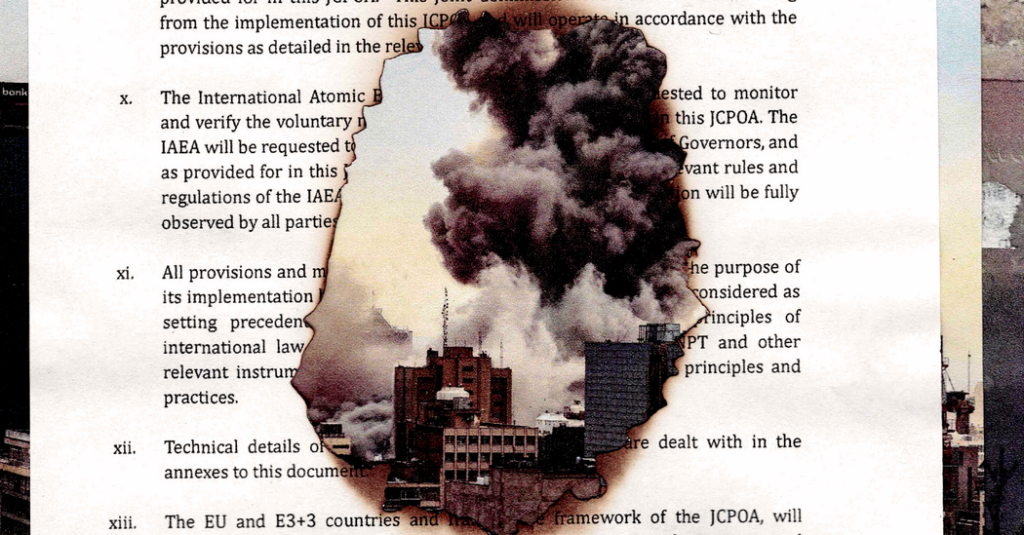
In 2015, President Barack Obama and the leaders of Britain, China, France, Germany, Iran, Russia and the European Union reached an agreement formally known as the Joint Comprehensive Plan of Action that imposed restrictions across the spectrum of Iran’s nuclear activities.
The product of years of diplomacy, the plan elevated a technically complex national security challenge into a fierce political debate split largely along partisan lines. A few months before the deal was signed, Benjamin Netanyahu, Israel’s prime minister, addressed a joint session of Congress — at Republicans’ invitation — to campaign against it.
When Mr. Obama eventually presented the completed deal to Americans, he emphasized the possible over the perfect. He argued that although the agreement didn’t resolve “all our problems with Iran,” it contained “the most comprehensive inspection and verification regime ever negotiated to monitor a nuclear program.”
Critics condemned the agreement as insufficient to rein in a uniquely malevolent regime. They also said Iran was trying to use its industrial-scale enrichment program to maintain pathways to weapons capability in violation of its obligations under the Treaty on the Nonproliferation of Nuclear Weapons. And they denounced the deal’s relaxation of international sanctions that had choked off Iran’s oil revenues, enabling its leadership to gain access to tens of billions dollars of frozen funds.
During the deal’s short life, Tehran lived up to its end of the bargain, undertaking technical steps to cap its uranium enrichment and stockpiles, restricting the use of its nuclear facilities to civilian purposes, and allowing inspections and monitoring by the International Atomic Energy Agency.
More than once during Mr. Trump’s first term, his administration certified that Iran was complying with the agreement. Yet in his 2017 speech to the U.N. General Assembly, he called the deal an “embarrassment.” For a brief period, he sought to renegotiate its terms.
In May 2018, Mr. Trump announced that he was withdrawing the United States from what he called a “horrible, one-sided deal that should have never, ever been made,” adding, “It didn’t bring calm, it didn’t bring peace, and it never will.”
His decision undercut the Iranian moderates who had advanced the deal and wreaked havoc on Iran’s economy. Iran responded by attacking energy production sites in and around the Persian Gulf with help from its proxies — previewing its playbook in the current war. Iran also accelerated its enrichment program: By the time of last year’s U.S. and Israeli airstrikes on its facilities, Iran had around 970 pounds of uranium enriched to 60 percent (to be weapons-grade, that uranium would have to be further enriched to 90 percent). Most of its stockpile is believed to be buried deep underground at its facility in Isfahan.
Ultimately, Mr. Obama’s nuclear deal rested on the theory that diplomacy could, over time, moderate a theocratic regime with enduring antagonism toward the United States and Israel and that regularly engaged in internal repression and external aggression. That bet might have paid off, but it was hardly a guarantee. At least some of the concessions made in the deal by the Western powers would have strengthened Iran’s nonnuclear military capabilities and proxy militias.
There’s little evidence, however, that the better deal that many of the nuclear agreement’s opponents demanded was ever within reach. Neither Mr. Trump nor President Joe Biden — who tried to revive a deal when he took office — ever got close, though Iran appeared ready to offer more concessions in last-ditch talks just before the current war erupted.
Opponents and supporters of the nuclear deal agreed on at least one thing: that the alternative was war. In 2015, Mr. Obama said, “The choice we face is ultimately between diplomacy or some form of war — maybe not tomorrow, maybe not three months from now, but soon.” Some of Mr. Obama’s detractors didn’t trust that he would be willing to use the military if Iran was violating its obligations. But the notion that Mr. Obama — who sent around 70,000 additional troops into Afghanistan — had any hesitation about projecting American force was always dubious.
Last year’s airstrikes by Israel and the United States demonstrated that coercive measures can be used to respond to nuclear expansion. Still, the war in Iran underscores profound risks associated with using the military as an instrument of counterproliferation. The operation against Iran has succeeded in achieving many of its military objectives, but it has come with painful economic and human costs, including the deaths of 13 American service members, more than 1,300 Iranians and at least 12 Israelis; at least 900 people in Lebanon have been killed in fighting between Israel and Hezbollah.
America’s arsenal of missile interceptors is being depleted, the Strait of Hormuz is effectively blockaded and oil and other commodity prices have spiked. Iran’s regime for now remains in place.
In going to war, Mr. Trump undertook a decision of immense strategic consequence without a clear strategy for managing the fallout. Considering that he returned to office promising to avoid wars, he gave up on negotiation prematurely. And he did so without making the case to Americans why this war was necessary.
In 2015, Mr. Obama said that if Congress killed his deal with Iran, America would lose not only constraints on Iran’s nuclear program but also “credibility as the anchor of the international system.” The long road from Mr. Trump’s abandonment of the deal to where we are today may prove that warning prophetic.
Suzanne Maloney was on the policy planning staff of Secretary of State Condoleezza Rice in the George W. Bush administration. She is the editor of “The Iranian Revolution at Forty.”
The Times is committed to publishing a diversity of letters to the editor. We’d like to hear what you think about this or any of our articles. Here are some tips. And here’s our email: [email protected].
Follow the New York Times Opinion section on Facebook, Instagram, TikTok, Bluesky, WhatsApp and Threads.
The post Obama’s Iran Nuclear Deal Was Working. Trump Tore It Up. appeared first on New York Times.