The longer the war in Iran continues, the more European officials worry it will spur a new refugee crisis. That fear is driving anxious scenario-planning and back-channel diplomacy over how to prevent a fresh wave of migration from roiling Europe.
The planning includes consultations between officials from the European Union and Turkey, the geographic buffer between Iran and Europe that was a thoroughfare a decade ago for more than a million migrants who made their way to the continent by sea.
The talks intensified with a phone call two days after the war started.
In the call, Hakan Fidan, the Turkish foreign minister, assured Magnus Brunner, the European Union’s migration commissioner, that Turkey was working to avoid a repeat. Officials had hardened the Turkish border with Iran, Mr. Fidan said, and would work with Europe to block any new wave of refugees, according to Mr. Brunner’s account of the call in a subsequent broadcast interview.
Mr. Brunner and Mr. Fidan then agreed that if the U.S.-Israeli assault maintained a narrow focus, the fallout might be contained, according to European and Turkish officials briefed on the call. If the strikes broadened and Iran became unstable, Mr. Brunner and Mr. Fidan concluded that people could try to flee, according to the people briefed on the discussion, who also confirmed Mr. Brunner’s account. They spoke on the condition of anonymity to discuss sensitive diplomacy.
Anxiety over a possible new migration crisis joins a growing list of global consequences from the war in Iran. Across the world, leaders and citizens alike are dealing with rising fuel costs, warnings of a recession and snarls in trade flows. In Europe, that fallout has been compounded by fears of a renewed populist backlash to a new wave of refugees — the type that has boosted far-right anti-immigrant parties over the last decade.
The conversation between Mr. Brunner and Mr. Fidan on March 2 was a preliminary discussion and did not lead to concrete new steps to prepare for a potential migration surge, European diplomats and Turkish officials said. That is largely because, more than two weeks into the war, there have been no signs of Iranians — or Afghans living in Iran — amassing at the Iran-Turkey border seeking to flee. Mass movements of refugees can take years to peak. After civil war broke out in Syria in 2011, it took nearly four years before Syrian migration to Europe reached crisis levels.
But as the war persists, more European officials have worried about that scenario. The concerns intensified after fighting flared between Israel and Hezbollah, the Iran-backed Lebanese militia, setting off mass displacement from southern Lebanon.
“We do not want to see a scenario like Syria,” Friedrich Merz, the chancellor of Germany, told an audience in Munich, a week after the war began. He added, “We have a strong interest ourselves in avoiding new influxes of refugees from the region.” Mr. Merz raised similar concerns after meeting last week with the prime minister of the Czech Republic.
Ursula von der Leyen, the president of the executive branch of the European Union, on Sunday sent a letter focused on migration to leaders of the bloc’s 27 member states.
The conflict “has already led to the internal displacement” of millions of people, notably in Iran and Lebanon, Ms. von der Leyen wrote, adding that while people were not crossing into the European Union yet, “what the future holds remains unclear.”
She said leaders should use “every migration diplomacy tool we have at our disposal.”
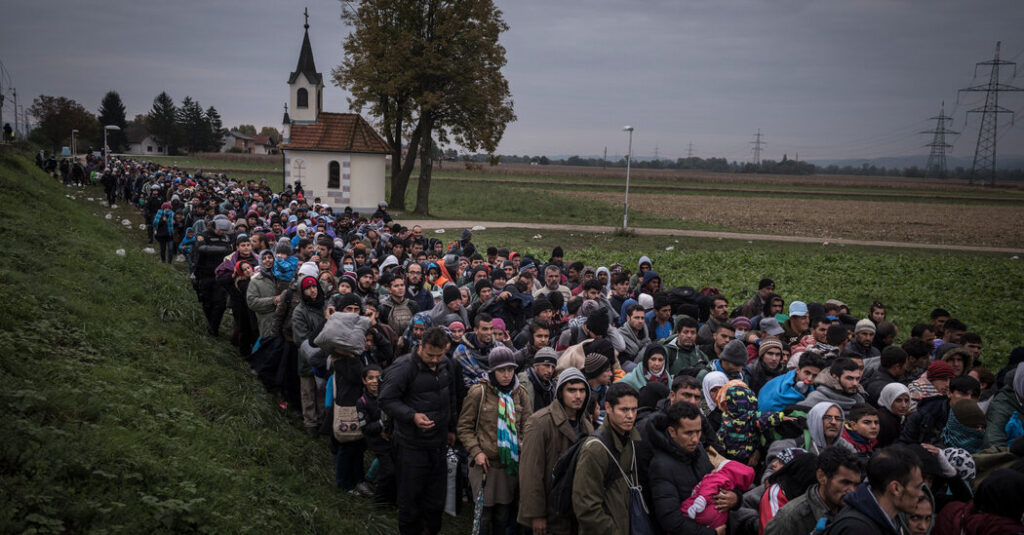
European officials are scarred by the political backlash to the surge of refugees that poured into Europe from countries like Syria and Afghanistan, peaking between 2014 and 2016. Europe has since hardened its borders and persuaded transit countries like Turkey to act as the continent’s border guards — but its actions came too late to prevent the rise of far-right anti-immigration parties in countries like Germany, Austria and France.
The far-right Alternative for Germany, or AfD, is now polling neck and neck with Mr. Merz’s party, despite the introduction of measures like German border checks to stop some migrants before they can enter the country.
The flow of new migrant arrivals to both Germany and Europe sharply fell in 2017 and has ebbed further since. The European Union’s border agency, Frontex, reported that unauthorized border crossings dropped by a quarter in 2025, continuing a yearslong trend.
During the crisis a decade ago, Europeans accused Turkey of turning a blind eye to people smuggling between Turkey and Greece. Smugglers operated with ease along the Turkish coast until European leaders agreed to send billions of dollars in aid to the Turkish government.
Now, European leaders appear keen to forestall that kind of outcome. The call between Mr. Fidan and Mr. Brunner grew out of a weekend of intense coordination between Ms. von der Leyen and Middle Eastern leaders.
Turkish and European officials briefed on the diplomacy said that all sides shared a wariness about a new migration wave, even if there was no significant planning yet for any kind of coordinated response.
Turkey’s interior minister, Mustafa Ciftci, told reporters in early March that his government had prepared three contingency plans to deal with potential migration flows caused by the war.
These included setting up “buffer zones” at the border to house refugees and, in the case of very large numbers, allowing the refugees to cross the border and seek shelter inside Turkey, Mr. Ciftci said.
He called the last option “a last resort,” adding that Turkey could initially host up to 90,000 people in tent camps and other temporary accommodations.
Because of its proximity to long-running conflicts in the Middle East and Asia, Turkey hosts one of the largest refugee populations in the world.
The civil war in Syria that began in 2011 led to large numbers of refugees crossing its long border with Syria, overwhelming host communities. The number of registered Syrian refugees in Turkey has fallen to 2.3 million, from its peak of 3.7 million in 2022, according to the U.N. refugee agency, UNHCR.
The presence of so many refugees is a sensitive political issue for the government, which has stepped up measures along its borders to prevent refugees from entering.
Prolonged war in Iran could unsettle the country’s more than 760,000 refugees, who are mostly from Afghanistan, according to data collected by UNHCR.
Jim Tankersley is the Berlin bureau chief for The Times, leading coverage of Germany, Austria and Switzerland.
The post As Iran War Drags On, Europe Wants to Avoid a New Migration Crisis appeared first on New York Times.