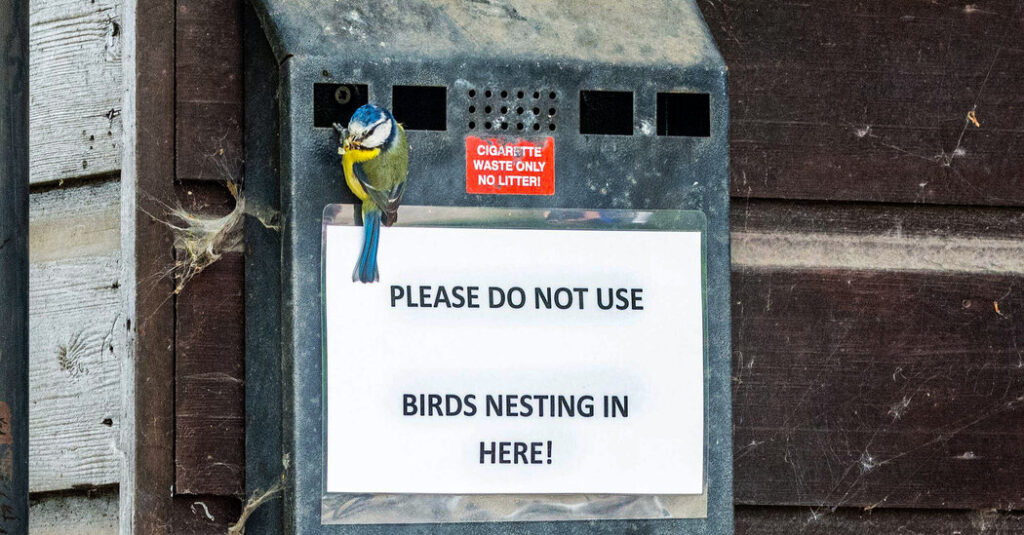
Darwin’s finches in the Galápagos, house finches in Mexico and song thrushes in New Zealand have all developed a curious habit: They put cigarette butts in their nests. Some songbirds in Britain are even nesting in outdoor ashtrays.
A new study adds evidence for why urban birds have picked up this preference, at least in one species: The toxins in tobacco may keep parasites at bay in the nests of blue tits, colorful birds that are found across Europe.
Cigarette butts contain about 4,000 chemical compounds, including nicotine, arsenic, polycyclic aromatic hydrocarbons and heavy metals. These compounds could ward off pests that harm birds and their offspring. The study was published this year in the journal Animal Behaviour.
Blue tits are cavity nesters, building nests in natural hollows or human-built boxes. Their nests are also prime habitat for bloodsucking parasites like ticks, fleas and blowflies that can exploit their captive targets — adults brooding eggs, and helpless nestlings.
So, when it came to cigarette butts and nesting in outdoor ashtrays, the researchers wanted to know whether blue tits could benefit from the pesticidal impacts of tobacco.
A team of researchers at the University of Lodz in Poland studied blue tits in urban parkland and forest near the university. They monitored the health of 99 birds hatched in three different types of nest boxes. Some standard nest boxes acted as a control. A second group received a nest with an interior of sterilized artificial moss and cotton wool.
Placed into the third group of nests were two used cigarette butts.
Using bellows to smoke the cigarettes mechanically “was the most challenging part of the experiment,” said Michal Gladalski, an evolutionary ecologist who led the study. He is not a smoker and wanted to avoid hurting his lungs or anyone else’s.
Thirteen days after hatching, three babies per brood were measured and had blood drawn. Bloodwork indicated that nestlings in both the sterile nests and those with the cigarette butts were healthier than those in the untreated nests.
After the nestlings fledged, the researchers analyzed the parasite populations of all the nest material. The invaders were most numerous in natural nests and nearly absent from nests with the sterilized materials. In the butt nests, the parasites were slightly fewer than in the natural nests, particularly blowflies and fleas.
Constantino Macías García is an ecologist at the Autonomous National University of Mexico and part of a team that has studied bird cigarette use for over a decade. That the team in Poland found any effect was remarkable, he said.
That’s because while the Polish experiment placed intact cigarette butts into nests, finches and sparrows in Mexico City “dismember the cigarette,” he said. When birds spread fibers from cigarette filters, the repellents have more contact with chicks. The modest effect found in the new study, he also suggested, might be a result of using only two butts.
Lorraine Pérez-Beauchamp, a master’s student at the University of Connecticut studying cigarette use in the nests of Darwin’s finches in Galápagos, agreed. There, nests are plagued by an invasive, bloodsucking vampire fly. Her research offered evidence that flies exposed to cigarette tobacco in a lab had reduced survival. But in studying Darwin finch nests, she found the birds hadn’t learned to add enough butts to ward off the pests.
In contrast, in Mexico City, a team led by Monserrat Suárez-Rodriguez, a colleague of Dr. Macías García, found that house sparrows and house finches incorporated an average of eight to 10 cigarette butts into their nests. A follow-up experiment demonstrated that when researchers added more live ticks to nests, house finch females responded by adding more cigarette butts.
The researchers in Mexico City have also shown that the impact of tobacco on nests isn’t limited to parasites. Dr. Suárez-Rodriguez showed that hatching, fledging and immune response in finch chicks improved alongside an increase in butts. But blood cells from nestlings showed evidence of genetic damage from cigarette butt exposure, with the long-term impacts unknown.
Sarah Bush, an ecologist at the University of Utah studying the coevolution of hosts and parasites, called the new study’s effort “monumental “ despite its small sample. “It’s very hard to get large sample sizes with birds in the field,” she said.
Dr. Gladalski hopes there is one clear takeaway from his team’s study.
“Birds are smart,” he said.
The post Why Some Birds Seem to Be Developing a Cigarette Habit appeared first on New York Times.